


Transfer learning improves pMHC kinetic stability and immunogenicity predictions
- PMID: 38577265
- PMCID: PMC10994007
- DOI: 10.1016/j.immuno.2023.100030
Transfer learning improves pMHC kinetic stability and immunogenicity predictions
Abstract
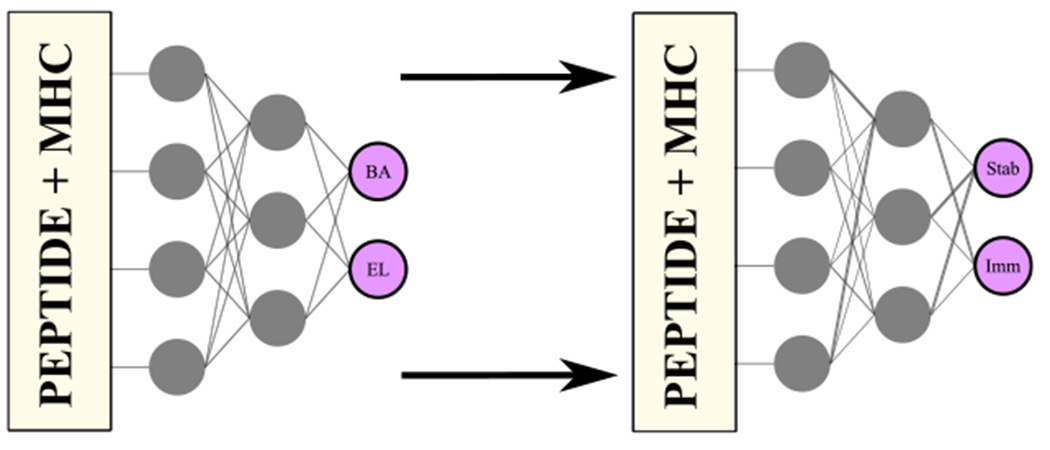
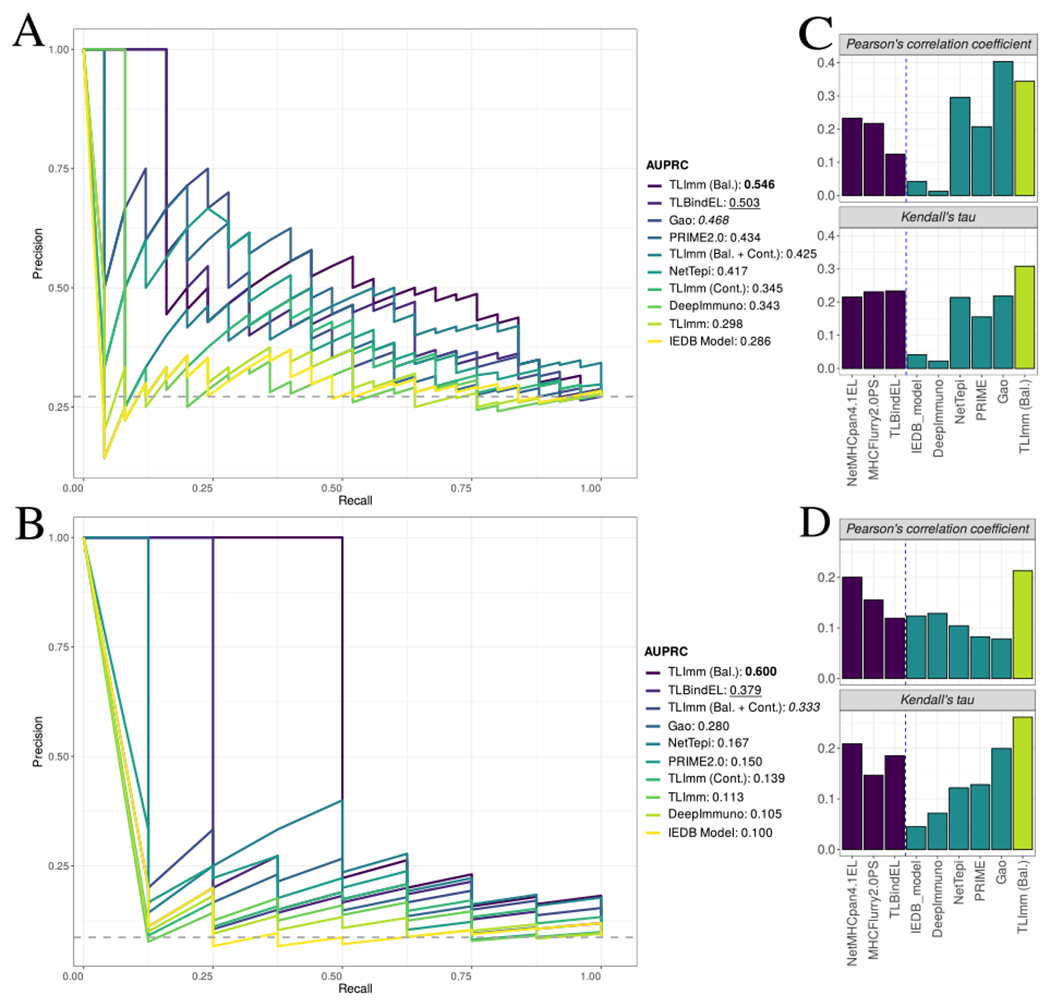
The cellular immune response comprises several processes, with the most notable ones being the binding of the peptide to the Major Histocompability Complex (MHC), the peptide-MHC (pMHC) presentation to the surface of the cell, and the recognition of the pMHC by the T-Cell Receptor. Identifying the most potent peptide targets for MHC binding, presentation and T-cell recognition is vital for developing peptide-based vaccines and T-cell-based immunotherapies. Data-driven tools that predict each of these steps have been developed, and the availability of mass spectrometry (MS) datasets has facilitated the development of accurate Machine Learning (ML) methods for class-I pMHC binding prediction. However, the accuracy of ML-based tools for pMHC kinetic stability prediction and peptide immunogenicity prediction is uncertain, as stability and immunogenicity datasets are not abundant. Here, we use transfer learning techniques to improve stability and immunogenicity predictions, by taking advantage of a large number of binding affinity and MS datasets. The resulting models, TLStab and TLImm, exhibit comparable or better performance than state-of-the-art approaches on different stability and immunogenicity test sets respectively. Our approach demonstrates the promise of learning from the task of peptide binding to improve predictions on downstream tasks. The source code of TLStab and TLImm is publicly available at https://github.com/KavrakiLab/TL-MHC.
Keywords: Machine learning; Peptide immunogenicity; Peptide kinetic stability; Peptide-MHC; Transfer learning.
Conflict of interest statement
Declaration of competing interest The authors declare that they have no known competing financial interests or personal relationships that could have appeared to influence the work reported in this paper.
Figures
References
-
- Alberts B, Bray D, Lewis J, Raff M, Roberts K, Watson J. Molecular biology of the cell. 4th ed.. New York: Garland: 2002.
-
- Rammensee H-G, Bachmann J, Emmerich NPN, Bachor OA, Stevanović S. SYFPEITHI: database for MHC ligands and peptide motifs. Immunogenetics 1999:50:213–9. - PubMed
Grants and funding
LinkOut - more resources
Full Text Sources
Research Materials