


The increase in core body temperature in response to exertional-heat stress can predict exercise-induced gastrointestinal syndrome
- PMID: 38577295
- PMCID: PMC10989703
- DOI: 10.1080/23328940.2023.2213625
The increase in core body temperature in response to exertional-heat stress can predict exercise-induced gastrointestinal syndrome
Abstract
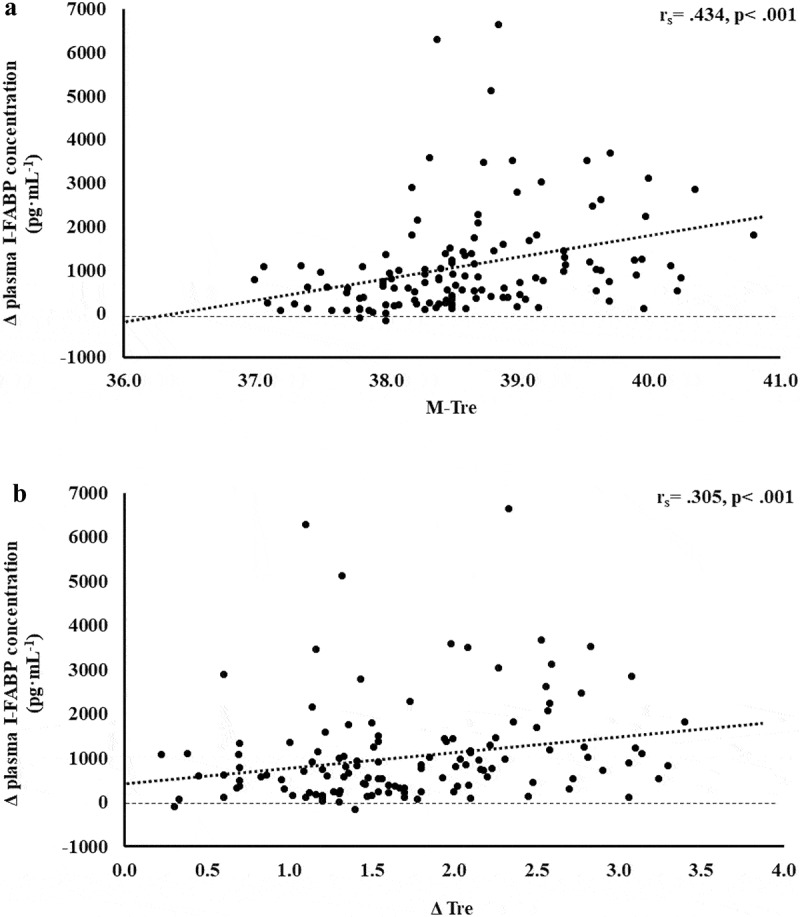
Utilizing metadata from existing exertional and exertional-heat stress studies, the study aimed to determine if the exercise-associated increase in core body temperature can predict the change in exercise-induced gastrointestinal syndrome (EIGS) biomarkers and exercise-associated gastrointestinal symptoms (Ex-GIS). Endurance-trained individuals completed 2 h of running exercise in temperate (21.2-30.0°C) to hot (35.0-37.2°C) ambient conditions (n = 132 trials). Blood samples were collected pre- and post-exercise to determine the change in gastrointestinal integrity biomarkers and systemic inflammatory cytokines. Physiological and thermoregulatory strain variables were assessed every 10-15 min during exercise. The strength of the linear relationship between maximal (M-Tre) and change (Δ Tre) in rectal temperature and EIGS variables was determined via Spearman's rank correlation coefficients. While the strength of prediction was determined via simple and multiple linear regression analyses dependent on screened EIGS and Ex-GIS confounding factors. Significant positive correlations between Tre maximum (M-Tre) and change (Δ Tre) with I-FABP (rs = 0.434, p < 0.001; and rs = 0.305, p < 0.001; respectively), sCD14 (rs = 0.358, p < 0.001; and rs = 0.362, p < 0.001), systemic inflammatory response profile (SIR-Profile) (p < 0.001), and total Ex-GIS (p < 0.05) were observed. M-Tre and Δ Tre significantly predicted (adjusted R2) magnitude of change in I-FABP (R2(2,123)=0.164, p < 0.001; and R2(2,119)=0.058, p = 0.011; respectively), sCD14 (R2(2,81)=0.249, p < 0.001; and R2(2,77)=0.214, p < 0.001), SIR-Profile (p < 0.001), and total Ex-GIS (p < 0.05). Strong to weak correlations were observed between M-Tre and Δ Tre with plasma concentrations of I-FABP, sCD14, SIR-Profile, and Ex-GIS in response to exercise. M-Tre and Δ Tre can predict the magnitude of these EIGS variables and Ex-GIS in response to exercise.
Keywords: Exertional; I-FABP; endotoxin; endurance; gastrointestinal symptoms; heat; inflammatory cytokines; thermoregulation.
© 2023 The Author(s). Published by Informa UK Limited, trading as Taylor & Francis Group.
Conflict of interest statement
No potential conflict of interest was reported by the authors.
Figures





References
-
- Gaskell SK, Lis DM, Costa RJS.. Exercise-Induced Gastrointestinal Syndrome. (Chapter 21. 6th. L Burke, Deakin V, Minehan M., Ed. In: Sydney, NSW, Australia: Clinical Sports Nutrition; McGraw-Hill Education; 2021. pp. 551–575
-
- Gill SK, Teixeira A, Rama L, et al. Circulatory endotoxin concentration and cytokine profile in response to exertional-heat stress during a multi-stage ultra-marathon competition. Exerc Immunol Rev. 2015;21:114–128. - PubMed
-
- Young P, Russo I, Gill P, et al. Reliability of pathophysiological markers reflective of exercise-induced gastrointestinal syndrome (EIGS) in response to prolonged strenuous exercise: a comprehensive methodological efficacy exploration. Frontiers Physiol. 2023;14. In press, DOI: 10.3389/fphys.2023.1063335 - DOI - PMC - PubMed
LinkOut - more resources
Full Text Sources
Research Materials
