BRAND: a platform for closed-loop experiments with deep network models
- PMID: 38579696
- PMCID: PMC11021878
- DOI: 10.1088/1741-2552/ad3b3a
BRAND: a platform for closed-loop experiments with deep network models
Abstract
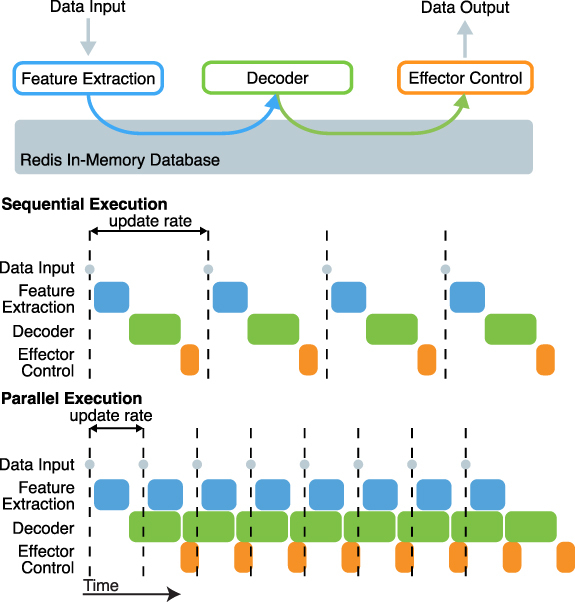
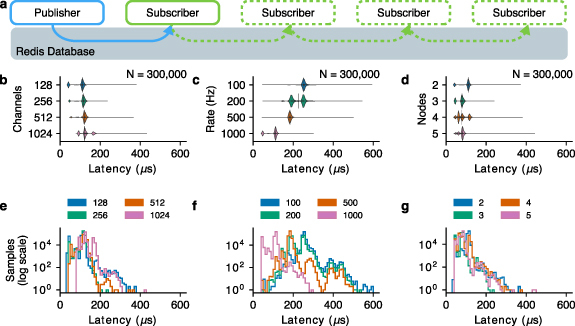
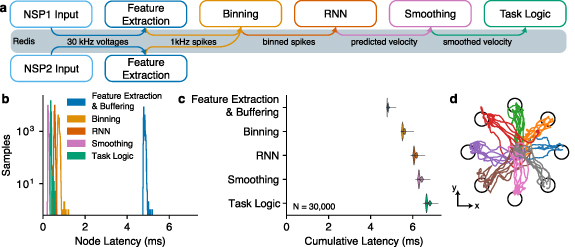
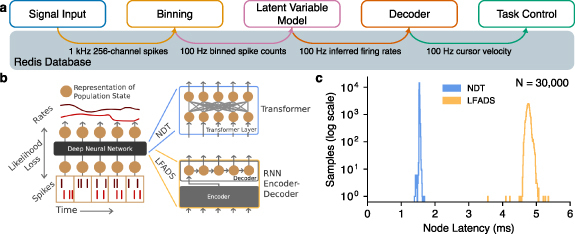
Objective.Artificial neural networks (ANNs) are state-of-the-art tools for modeling and decoding neural activity, but deploying them in closed-loop experiments with tight timing constraints is challenging due to their limited support in existing real-time frameworks. Researchers need a platform that fully supports high-level languages for running ANNs (e.g. Python and Julia) while maintaining support for languages that are critical for low-latency data acquisition and processing (e.g. C and C++).Approach.To address these needs, we introduce the Backend for Realtime Asynchronous Neural Decoding (BRAND). BRAND comprises Linux processes, termednodes, which communicate with each other in agraphvia streams of data. Its asynchronous design allows for acquisition, control, and analysis to be executed in parallel on streams of data that may operate at different timescales. BRAND uses Redis, an in-memory database, to send data between nodes, which enables fast inter-process communication and supports 54 different programming languages. Thus, developers can easily deploy existing ANN models in BRAND with minimal implementation changes.Main results.In our tests, BRAND achieved <600 microsecond latency between processes when sending large quantities of data (1024 channels of 30 kHz neural data in 1 ms chunks). BRAND runs a brain-computer interface with a recurrent neural network (RNN) decoder with less than 8 ms of latency from neural data input to decoder prediction. In a real-world demonstration of the system, participant T11 in the BrainGate2 clinical trial (ClinicalTrials.gov Identifier: NCT00912041) performed a standard cursor control task, in which 30 kHz signal processing, RNN decoding, task control, and graphics were all executed in BRAND. This system also supports real-time inference with complex latent variable models like Latent Factor Analysis via Dynamical Systems.Significance.By providing a framework that is fast, modular, and language-agnostic, BRAND lowers the barriers to integrating the latest tools in neuroscience and machine learning into closed-loop experiments.
Keywords: artificial neural network; brain–computer interface; closed-loop; real-time.
Creative Commons Attribution license.
Conflict of interest statement
The M G H Translational Research Center has clinical research support agreements with Neuralink, Synchron, Reach Neuro, Axoft, and Precision Neuro, for which L R H provides consultative input. M G H is a subcontractor on an NIH SBIR with Paradromics. C P is a consultant for Synchron and Meta (Reality Labs). D M B is a consultant for Paradromics. S D S is an inventor on intellectual property licensed by Stanford University to Blackrock Neurotech and Neuralink Corp. These entities did not support this work, have a role in the study or have any competing interests related to this work. The remaining authors declare no competing interests.
Figures
Update of
-
BRAND: A platform for closed-loop experiments with deep network models.bioRxiv [Preprint]. 2023 Aug 12:2023.08.08.552473. doi: 10.1101/2023.08.08.552473. bioRxiv. 2023. Update in: J Neural Eng. 2024 Apr 17;21(2). doi: 10.1088/1741-2552/ad3b3a. PMID: 37609167 Free PMC article. Updated. Preprint.