Review
. 2024 Apr 29;261(3):e230398.
doi: 10.1530/JOE-23-0398. Print 2024 Jun 1.

RISING STARS: Androgens and immune cell function

Affiliations
Review

RISING STARS: Androgens and immune cell function

Rebecca J Ainslie et al. J Endocrinol. .

Abstract

Androgens can modulate immune cell function and may contribute to differences in the prevalence and severity of common inflammatory conditions. Although most immune cells are androgen targets, our understanding of how changes in androgen bioavailability can affect immune responses is incomplete. Androgens alter immune cell composition, phenotype, and activation by modulating the expression and secretion of inflammatory mediators or by altering the development and maturation of immune cell precursors. Androgens are generally associated with having suppressive effects on the immune system, but their impacts are cell and tissue context-dependent and can be highly nuanced even within immune cell subsets. In response to androgens, innate immune cells such as neutrophils, monocytes, and macrophages increase the production of the anti-inflammatory cytokine IL-10 and decrease nitric oxide production. Androgens promote the differentiation of T cell subsets and reduce the production of inflammatory mediators, such as IFNG, IL-4 and IL-5. Additionally, androgens/androgen receptor can promote the maturation of B cells. Thus, androgens can be considered as immunomodulatory agents, but further work is required to understand the precise molecular pathways that are regulated at the intersection between endocrine and inflammatory signals. This narrative review focusses on summarising our current understanding of how androgens can alter immune cell function and how this might affect inflammatory responses in health and disease.

Keywords: androgen; androgen receptor; immune system; inflammatory diseases; testosterone.


Conflict of interest statement

The authors declare that there is no conflict of interest that could be perceived as prejudicing the impartiality of this review.

Figures

Figure 1
Figure 1
Direct and indirect mechanisms of androgen signalling. (i) Ligand-dependent direct androgen receptor signalling: Upon androgen binding to the cytoplasmic androgen receptor (AR), AR begins to dissociate from the chaperone proteins and translocates to the nucleus. Once inside the nucleus AR binds to androgen target genes through androgen response elements to alter the transcription of target genes (Davey & Grossmann 2016). (ii) Ligand-independent androgen receptor signalling: Cytoplasmic AR can be activated through phosphorylation due to activation of growth factor receptor mediated signalling pathways. The phosphorylated AR is then able to translocate to the nucleus and induce the expression of androgen target genes (Bennett et al. 2010, Davey & Grossmann 2016, Kadel & Kovats 2018). (iii) Indirect membrane-bound androgen receptor signalling: Androgens can bind to a membrane bound form of the AR and induce signalling transduction which results in the binding of transcription factors to target genes altering gene expression. This induction of intracellular signalling pathways can also result in the phosphorylation of the cytoplasmic form of the AR which can then translocate to the nucleus and induce AR-dependent direct signalling pathway (Kousteni et al. 2001, Estrada et al. 2003, Kang et al. 2004, Davey & Grossmann 2016, Thomas 2019). (iv) Indirect membrane associated androgen receptor signalling: Androgens can also exert their effects via the cytoplasmic AR that is localised at the cell membrane. Binding of androgens to this receptor leads to activation of intracellular signalling pathways that result in the transcription of target genes (Kousteni et al. 2001, Estrada et al. 2003, Kang et al. 2004, Davey & Grossmann 2016, Thomas 2019). AKT, protein kinase B; AR, androgen receptor; DHT, dihydrotestosterone; ERK1/2, extracellular signal-regulated kinase 1/2; MAPK, mitogen-activated protein kinases; PI3K, phosphoinositide 3-kinases; Ras, rat sarcoma; Src, proto-oncogene tyrosine-protein kinase; TF, transcription factor. Created with BioRender.com.
Figure 2
Figure 2
Androgen receptor expression in immune cells. Innate immune cells such as neutrophils, monocytes and macrophages express AR. AR is predominantly expressed in the cytoplasm with some evidence for membrane expression in macrophage subsets. T and B lymphocytes of the adaptive immune system are also AR positive with AR detected in the cytoplasm and membrane of T cells and cytoplasm of B cell progenitors (Milewich et al. 1983, Kovacs & Olsen 1987, Viselli et al. 1997, Benten et al. 1999a, Mantalaris et al. 2001, Wunderlich et al. 2002, Liu et al. 2004, Sinha-Hikim et al. 2004, Liu et al. 2005, Ahmadi & McCruden 2006, Bolego et al. 2013, Bizzaro et al. 2018, Rubinow et al. 2018, Lee et al. 2019, Markman et al. 2020, McCrohon et al. 2000, Campesi et al. 2012). •, mouse; °, human; +, mouse and human. Created with BioRender.com.
Figure 3
Figure 3
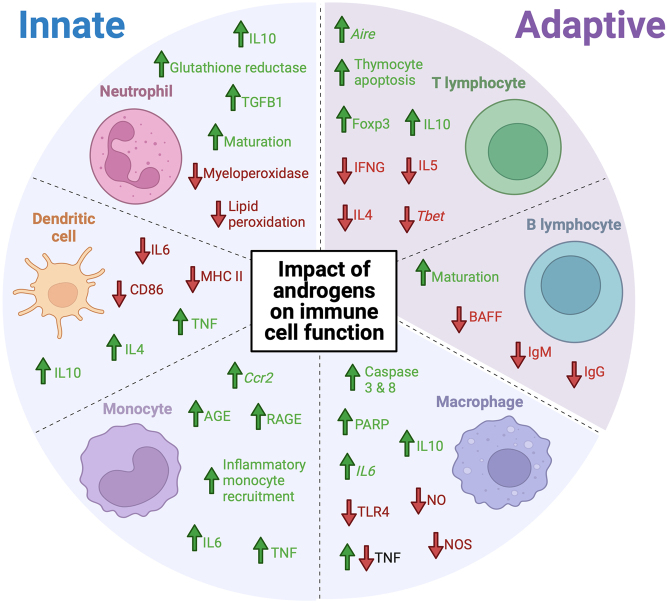
The impact of androgens on immune cell function in health and disease. In general, androgens tend to exhibit an anti-inflammatory effect on immune cells. This is demonstrated by the upregulation of inflammatory mediators, such as IL-10, in various immune cell types including T lymphocytes (Fijak et al. 2015), macrophages (D’Agostino et al. 1999), dendritic cells (Thompson et al. 2017) and neutrophils (Scalerandi et al. 2018) in the presence of androgens. It has also been demonstrated that androgens can reduce production of several inflammatory mediators, such as IFNG, IL-4 and IL-5 in T lymphocytes (Araneo et al. 1991) and NO in macrophages (D’Agostino et al. 1999, Friedl et al. 2000). Androgen have also been found to promote immune cell maturation and differentiation in cells such as T lymphocytes (Olsen et al. 1991), B lymphocytes (Altuwaijri et al. 2009) and neutrophils (Chuang et al. 2009, Inamdar & Jayamma 2012). Green arrows represent upregulation or increase. Red arrows represent downregulation or decrease. For abbreviations see text. Created with BioRender.com.

References

    1. Ahmadi K & McCruden AB. 2006Macrophage may responses to androgen via its receptor. Medical Science Monitor 12BR15–BR20. - PubMed
    1. Alberts B Johnson A Lewis J Raff M Roberts K & Walter P. 2002B cells and antibodies. In Molecular Biology of the Cell, 4th ed.New York, NY, USA: G; ar; land Science.
    1. Alemany M.2022The roles of androgens in humans: biology, metabolic regulation and health. International Journal of Molecular Sciences 2311952. ( 10.3390/ijms231911952) - DOI - PMC - PubMed
    1. Altuwaijri S, Chuang KH, Lai KP, Lai JJ, Lin HY, Young FM, Bottaro A, Tsai MY, Zeng WP, Chang HC, et al.2009Susceptibility to autoimmunity and B cell resistance to apoptosis in mice lacking androgen receptor in B cells. Molecular Endocrinology 23444–453. ( 10.1210/me.2008-0106) - DOI - PMC - PubMed
    1. Angum F Khan T Kaler J Siddiqui L & Hussain A. 2020The prevalence of autoimmune disorders in women: a narrative review. Cureus 12e8094. ( 10.7759/cureus.8094) - DOI - PMC - PubMed

Publication types

LinkOut - more resources