


Effects of Food Insecurity on Hepatic Steatosis and Fibrosis in People With HIV
- PMID: 38582290
- PMCID: PMC11193609
- DOI: 10.1016/j.cgh.2024.03.017
Effects of Food Insecurity on Hepatic Steatosis and Fibrosis in People With HIV
Abstract
Background & aims: Food insecurity (FI) is a risk factor for nonalcoholic fatty liver disease (NAFLD) and advanced fibrosis in the general population, but its impact on liver disease in people with HIV (PWH) is unknown.
Methods: We examined the association of FI with prevalence of NAFLD and fibrosis in a diverse cohort of PWH. PWH aged ≥ 18 years on antiretroviral therapy, HIV RNA <200 copies/mL, and without other known liver diseases were screened for NAFLD (controlled attenuated parameter ≥263 decibels/meter) and advanced fibrosis (liver stiffness measurement ≥11 kilopascals) by vibration controlled transient elastography at 8 U.S.
Centers: Participants were categorized as food insecure using the Six-Item Short Form Household Food Security Survey. We used multivariable logistic regression to estimate odds ratios (ORs) and 95% confidence intervals (CIs) of NAFLD and advanced fibrosis by FI status.
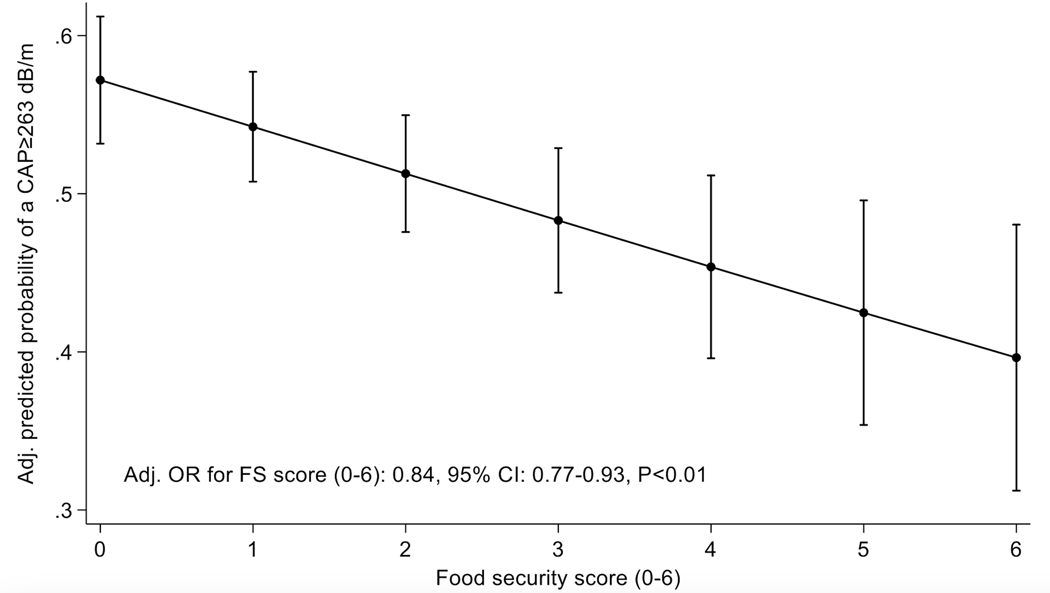
Results: Among 654 PWH, NAFLD was present in 348 (53%) and advanced fibrosis in 41 (6%). FI was present in 203 of participants (31%), including 97/348 with NAFLD (28%) and 18/41 with advanced fibrosis (44%). In multivariable analysis, FI was associated with lower odds of NAFLD (OR, 0.57; 95% CI, 0.37-0.88) and a greater, but nonsignificant, odds of advanced fibrosis (OR, 1.38; 95% CI, 0.65-2.90). We identified a significant interaction between FI and diabetes (P = .02) on fibrosis risk, with greater odds of fibrosis among food insecure PWH and diabetes (OR, 3.83; 95% CI, 1.15-12.73) but not among food insecure nondiabetics (OR, 1.12; 95% CI, 0.47-2.98).
Conclusions: FI is highly prevalent among PWH and associated with lower odds of NAFLD, and among PWH with diabetes, there is greater odds of advanced fibrosis. FI may contribute to hepatic fibrosis through mechanisms other than steatosis in PWH.
Keywords: AIDS; Fatty Liver; Food Security; HIV; Liver Disease; Liver Health Outcomes; MASLD; Social Determinants of Health.
Copyright © 2024 AGA Institute. Published by Elsevier Inc. All rights reserved.
Conflict of interest statement
Conflicts of Interest:
Figures
References
-
- Michelotti GA, Machado MV, & Diehl AM. NAFLD, NASH and liver cancer. Nat Rev Gastroenterol Hepatol 2013;10:656–665. - PubMed
-
- Rinella ME, Lazarus JV, Ratziu V, et al. A multisociety Delphi consensus statement on new fatty liver disease nomenclature. J Hepatol 2023;79:1542–1556. - PubMed
-
- Kalligeros M, Vassilopoulos A, Shehadeh F, et al. Prevalence and Characteristics of Nonalcoholic Fatty Liver Disease and Fibrosis in People Living With HIV Monoinfection: A Systematic Review and Meta-analysis. Clin Gastroenterol Hepatol 2023;21:1708–1722. - PubMed
MeSH terms
Grants and funding
LinkOut - more resources
Full Text Sources
Medical
