


Estimating averted illnesses from influenza vaccination for children and pregnant women - El Salvador, Panama, and Peru, 2011-2018
- PMID: 38584055
- PMCID: PMC11455982
- DOI: 10.1016/j.vaccine.2024.04.007
Estimating averted illnesses from influenza vaccination for children and pregnant women - El Salvador, Panama, and Peru, 2011-2018
Abstract
Background: Estimating the burden of disease averted by vaccination can assist policymakers to implement, adjust, and communicate the value of vaccination programs. Demonstrating the use of a newly available modeling tool, we estimated the burden of influenza illnesses averted by seasonal influenza vaccination in El Salvador, Panama, and Peru during 2011-2018 among two influenza vaccine target populations: children aged 6-23 months and pregnant women.
Methods: We derived model inputs, including incidence, vaccine coverage, vaccine effectiveness, and multipliers from publicly available country-level influenza surveillance data and cohort studies. We also estimated changes in illnesses averted when countries' vaccine coverage was achieved using four different vaccine deployment strategies.
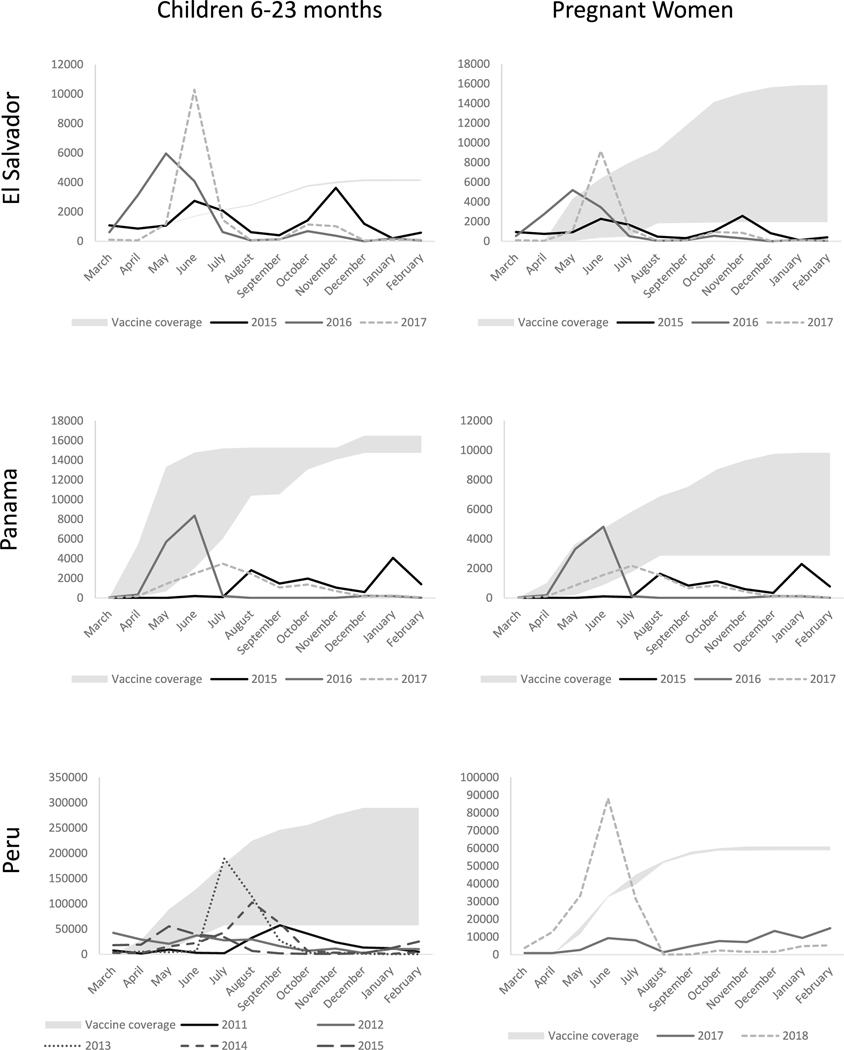
Results: Among children aged 6-23 months, influenza vaccination averted an estimated cumulative 2,161 hospitalizations, 81,907 medically-attended illnesses, and 126,987 overall illnesses during the study period, with a prevented fraction ranging from 0.3 % to 12.5 %. Among pregnant women, influenza vaccination averted an estimated cumulative 173 hospitalizations, 6,122 medically attended illnesses, and 16,412 overall illnesses, with a prevented fraction ranging from 0.2 % to 10.9 %. Compared to an influenza vaccine campaign with equal vaccine distribution during March-June, scenarios in which total cumulative coverage was achieved in March and April consistently resulted in the greatest increase in averted illness (23 %-3,129 % increase among young children and 22 %-3,260 % increase among pregnant women).
Discussion: Influenza vaccination campaigns in El Salvador, Panama, and Peru conducted between 2011 and 2018 prevented hundreds to thousands of influenza-associated hospitalizations and illnesses in young children and pregnant women. Existing vaccination programs could prevent additional illnesses, using the same number of vaccines, by achieving the highest possible coverage within the first two months of an influenza vaccine campaign.
Keywords: Averted illness; Compartment model; Influenza epidemiology; Influenza vaccine; Vaccine effectiveness.
Published by Elsevier Ltd.
Conflict of interest statement
Declaration of competing interest The authors declare that they have no known competing financial interests or personal relationships that could have appeared to influence the work reported in this paper.
Figures
References
-
- World Health Organization, Pandemic Influenza Preparedness Framework: Partnership contribution preparedness high-level implementation plan II 2018–2023. 2021: Geneva.
-
- World Health Organization, Pandemic Influenza Preparedness Framework Partnership Contribution Implementation Plan 2013 – 2016. 2014.
-
- World Health Organization, Pandemic Influenza Preparedness Framework: Partnership Contribution High-Level Implementation Plan III 2024–2030. 2023: Geneva.
-
- World Health Organization, A manual for estimating disease burden associated with seasonal influenza. 2015.
MeSH terms
Substances
Grants and funding
LinkOut - more resources
Full Text Sources
Medical
Miscellaneous
