. 2024 Mar 19;9(13):14805-14817.
doi: 10.1021/acsomega.3c07098. eCollection 2024 Apr 2.

Proteome of Personalized Tissue-Engineered Veins

Affiliations

Proteome of Personalized Tissue-Engineered Veins

Susanna Larsson et al. ACS Omega. .

Abstract

Vascular diseases are the largest cause of death globally and impose a major global burden on healthcare. The gold standard for treating vascular diseases is the transplantation of autologous veins, if applicable. Alternative treatments still suffer from shortcomings, including low patency, lack of growth potential, the need for repeated intervention, and a substantial risk of developing infections. The use of a vascular ECM scaffold reconditioned with the patient's own cells has shown successful results in preclinical and clinical studies. In this study, we have compared the proteomes of personalized tissue-engineered veins of humans and pigs. By applying tandem mass tag (TMT) labeling LC/MS-MS, we have investigated the proteome of decellularized (DC) veins from humans and pigs and reconditioned (RC) DC veins produced through perfusion with the patient's whole blood in STEEN solution, applying the same technology as used in the preclinical studies. The results revealed high similarity between the proteomes of human and pig DC and RC veins, including the ECM texture after decellularization and reconditioning. In addition, functional enrichment analysis showed similarities in signaling pathways and biological processes involved in the immune system response. Furthermore, the classification of proteins involved in immune response activity that were detected in human and pig RC veins revealed proteins that evoke immunogenic responses, which may lead to graft rejection, thrombosis, and inflammation. However, the results from this study imply the initiation of wound healing rather than an immunogenic response, as both systems share the same processes, and no immunogenic response was reported in the preclinical and clinical studies. Finally, our study assessed the application of STEEN solution in tissue engineering and identified proteins that may be useful for the prediction of successful transplantations.


Conflict of interest statement

The authors declare the following competing financial interest(s): The authors SL, BU, JS, and NG declare that they have no known competing financial interests or personal relationships that could have appeared to influence the work reported in this paper. The authors SH, and LJ, declare the following financial interests/personal relationships with VERIGRAFT which may be considered as potential competing interests: employment. The author RS reports a relationship with VERIGRAFT that includes employment and equity or stocks.

Figures

Figure 1
Figure 1
Representative micrographs of hematoxylin and eosin staining of (A) native material of human vena femoralis, (B) DC of human vena femoralis, (C) RC of human vena femoralis, (D) native material of pig vena cava, (E) DC of pig vena cava, and (F) RC of pig vena cava. Scale bar 100 μm.
Figure 2
Figure 2
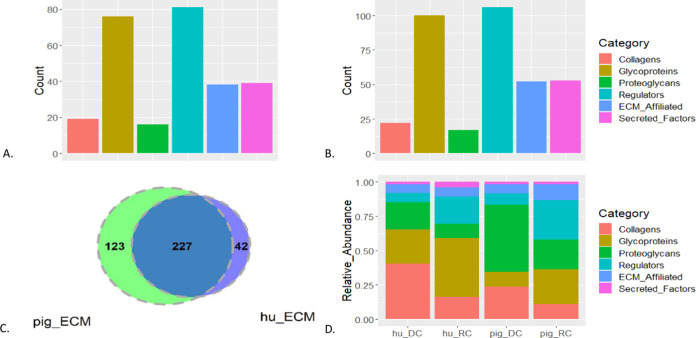
ECM texture of human RC, human DC, pig RC, and pig DC. (A) Counts of matrisome proteins detected in humans. (B) Counts of matrisome proteins detected in pigs. (C) Overlap between the matrisome proteins detected in pig RC and DC (pig_ECM) and human RC and DC (hu_ECM). (D) Relative abundance of proteins composing the ECM and ECM-associated proteins in human DC (hu_DC), human RC (hu_RC), pig DC, and pig RC.
Figure 3
Figure 3
Revigo illustration of enriched GO biological processes for the top 50 significant terms for (A) highly abundant proteins in pigs and (B) highly abundant proteins in humans.
Figure 4
Figure 4
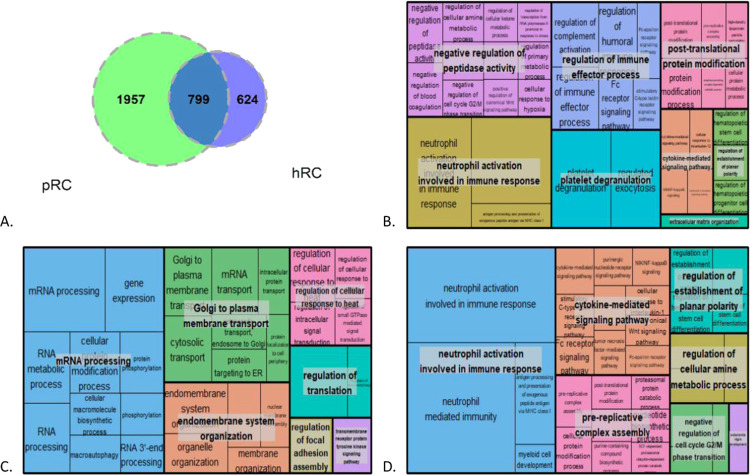
(A) Venn diagram for highly abundant proteins in hRC and highly abundant proteins in pRC, (B) GO enrichment analysis for the intersection of the Venn diagram, (C) GO enrichment analysis for highly abundant proteins detected only in pRC, and (D) GO enrichment analysis for highly abundant proteins detected in hRC only.
Figure 5
Figure 5
Circos plot of 34 proteins involved in immune response activities detected in both hRC and pRC. The legend lists 10 immune response activities that were included in this analysis. These activities are identified by the corresponding colors on the circos plot.
Figure 6
Figure 6
(A) Word cloud graphs showing keywords of high frequency detected in the functional description text of overlapping proteins between hRC and pRC. The bigger the font size, the higher the frequency of the keyword in the text. (B) Circos plot of 43 proteins involved in wound healing activities detected in hRC and pRC. The legend lists 11 wound healing activities. These activities are identified by the corresponding colors on the circos plot. Proteins that were detected in hRC only or pRC only have prefixes h_ and p_, respectively.
Figure 7
Figure 7
Overview of the decellularization and reconditioning procedures of the donated human and pig veins. (a) Veins donated from human and pig donors. (b) The veins were decellularized to obtain ECM. (c) Whole blood was collected from blood donors. (d) Decellularized veins were reconditioned with whole blood mixed with STEEN and growth factors. (e) Reconditioned vein. Created with BioRender.com.
Figure 8
Figure 8
Schematic overview of the data analysis workflow performed in this study. Data sets (green), preprocessing step (violet), analyses (blue), and overlapping results of the analyses (Venn diagram icon).

References

    1. W.H.O. . Cardiovascular Diseases 2021https://www.who.int/health-topics/cardiovascular-diseases#tab=tab_1 [cited 10–10–2021].
    1. Nicolaides A. N.; Labropoulos N. Burden and Suffering in Chronic Venous Disease. Adv. Ther. 2019, 36 (Suppl 1), 1–4. 10.1007/s12325-019-0882-6. - DOI - PMC - PubMed
    1. Klinkert P.; Post P. N.; Breslau P. J.; van Bockel J. H. Saphenous vein versus PTFE for above-knee femoropopliteal bypass. A review of the literature. Eur. J. Vasc. Endovasc. Surg. 2004, 27 (4), 357–362. 10.1016/j.ejvs.2003.12.027. - DOI - PubMed
    1. Klinkert P.; Schepers A.; Burger D. H.; van Bockel J. H.; Breslau P. J. Vein versus polytetrafluoroethylene in above-knee femoropopliteal bypass grafting: five-year results of a randomized controlled trial. J. Vasc. Surg. 2003, 37 (1), 149–155. 10.1067/mva.2002.86. - DOI - PubMed
    1. Betz T.; Neuwerth D.; Steinbauer M.; Uhl C.; Pfister K.; Töpel I. Biosynthetic vascular graft: a valuable alternative to traditional replacement materials for treatment of prosthetic aortic graft infection?. Scand. J. Surg. 2019, 108 (4), 291–296. 10.1177/1457496918816908. - DOI - PubMed