


Post-activation potentiation after isometric contractions is strongly related to contraction intensity despite the similar torque-time integral
- PMID: 38595307
- PMCID: PMC11140177
- DOI: 10.1113/EP091700
Post-activation potentiation after isometric contractions is strongly related to contraction intensity despite the similar torque-time integral
Abstract
Post-activation potentiation (PAP) is defined as an enhanced contractile response of a muscle following its own contractile activity and is influenced by the intensity and duration of the conditioning contraction. The aim of this study was to determine if the combination of intensity and duration, that is, torque-time integral (TTI) is a determinant of PAP amplitude. We compared PAP amplitude following low-to-maximal voluntary conditioning contraction intensities with and without similar TTI in the knee extensors. Twelve healthy males completed two experimental sessions. Femoral nerve stimulation was applied to evoke single twitches on the relaxed quadriceps before and after isometric conditioning contractions of knee extensors. In one session, participants performed conditioning contractions without similar TTI (6 s at 100, 80, 60, 40 and 20% maximal voluntary contraction (MVC)), while they performed conditioning contractions with similar TTI in the other session (6 s at 100%, 7.5 s at 80%, 10 s at 60%, 15 s at 40%, and 30 s at 20% MVC). In both sessions, PAP amplitude was related to conditioning contraction intensity. The higher the conditioning contraction intensity with or without similar TTI, the higher PAP. Significant correlations were found (i) between PAP and conditioning contraction intensity with (r2 = 0.70; P < 0.001) or without similar TTI (r2 = 0.64; P < 0.001), and (ii) between PAP with and without similar TTI (r2 = 0.82; P < 0.001). The results provide evidence that TTI has a minor influence on PAP in the knee extensors. This suggests that to optimize the effect of PAP, it is more relevant to control the intensity of the contraction rather than the TTI.
Keywords: electrical stimulation; knee extensors; muscle strength; neuromuscular performance; quadriceps; twitch.
© 2024 The Authors. Experimental Physiology published by John Wiley & Sons Ltd on behalf of The Physiological Society.
Conflict of interest statement
The authors declare no conflicts of interest.
Figures


 ), session with similar TTI (
 ). Mean values ± SD. *Significantly different from PRE (P < 0.05). †Significantly different between sessions with and without similar TTI (P < 0.05).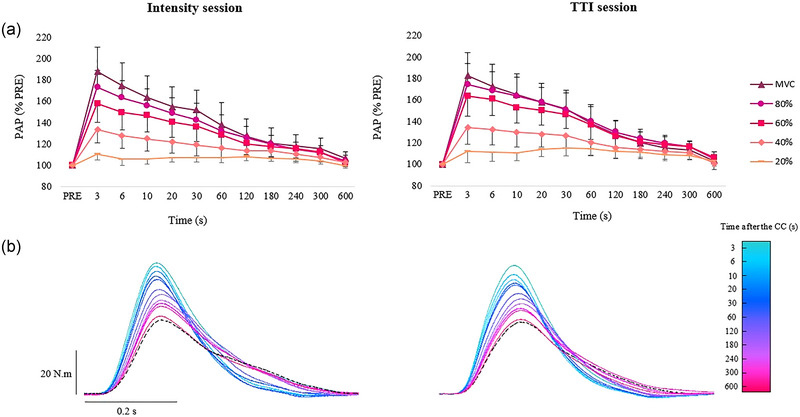
 ), 80% (
 ), 60% (
 ), 40% (
 ), and 20% (
 ) MVC. Mean values ± SD. A significant interaction session × intensity × time was found for PAP (P = 0.035; F = 1.45; DF = 44). For the sake of clarity, symbols for statistics significance are not presented on the figure. (b) Typical recordings of twitch torque from one subject before and after the conditioning 6‐s maximal voluntary contraction (MVC) at each time points in the session with similar and different TTI. The black dashed line represents the twitch torque recorded before the conditioning contraction. CC, conditioning contraction.
 ), 80% MVC (), 60% MVC (), 40% MVC (), 20% MVC (
 ). Each symbol (mean) represents one subject. CC, conditioning contraction.
 ), 80% MVC (), 60% MVC (), 40% MVC (), 20% MVC (). Each symbol (mean) represents one subject.
References
-
- Baudry, S. , & Duchateau, J. (2007). Postactivation potentiation in a human muscle: Effect on the rate of torque development of tetanic and voluntary isometric contractions. Journal of Applied Physiology, 102(4), 1394–1401. - PubMed
-
- Behm, D. G. , Button, D. C. , Barbour, G. , Butt, J. C. , & Young, W. B. (2004). Conflicting effects of fatigue and potentiation on voluntary force. Journal of Strength and Conditioning Research, 18(2), 365–372. - PubMed
-
- Boullosa, D. , Del Rosso, S. , Behm, D. G. , & Foster, C. (2018). Post‐activation potentiation (PAP) in endurance sports: A review. European Journal of Sport Science, 18(5), 595–610. - PubMed
-
- Brown, I. E. , & Loeb, G. E. (1998). Post‐activation potentiation––a clue for simplifying models of muscle dynamics1. American Zoologist, 38(4), 743–754.
MeSH terms
LinkOut - more resources
Full Text Sources
Research Materials
