


Insights into the key odorants in fresh and dried Amomum tsaoko using the sensomics approach
- PMID: 38595757
- PMCID: PMC11002797
- DOI: 10.1016/j.fochx.2024.101344
Insights into the key odorants in fresh and dried Amomum tsaoko using the sensomics approach
Abstract
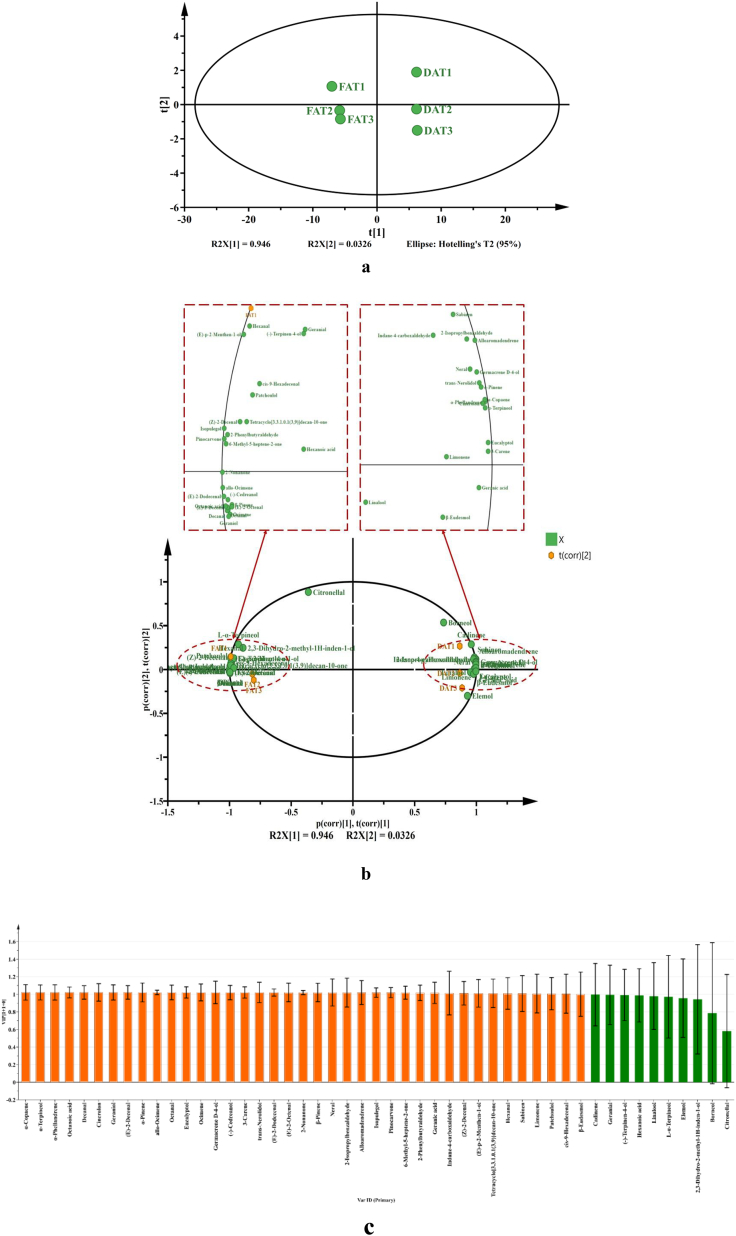
To identify the key odorants in Amomum tsaoko (AT), volatiles in fresh AT (FAT) and dried AT (DAT) were investigated using molecular sensory science. In addition to this, the sensomics approach was used to confirm the presence of the compound in FAT that contributed the most to its aroma profile. A total of 49 odor-active compounds (43 in FAT and 42 in DAT) with flavor dilution (FD) factors ranging from 1 to 6561 were identified, with eucalyptol exhibiting the highest FD factor of 6561. Odorants with FD factors ≥ 27 were quantitated, and 23 and 20 compounds in FAT and DAT, respectively, with odor activity value ≥ 1 were determined as key odorants. Recombination and omission experiment further indicated that (E)-2-dodecenal, geranial, octanal, (E)-2-octenal, (E)-2-decenal, and eucalyptol contributed significantly to the overall aroma profile of FAT. After drying of FAT, the concentrations of aldehydes decreased significantly, whereas those of terpene hydrocarbons increased. Multivariate statistical analysis revealed that 26 FAT and 23 DAT odorants were biomarker compounds.
Keywords: Amomum tsaoko; GC–MS–O; Key odorants; Multivariate statistical analysis; Sensomics.
© 2024 The Authors. Published by Elsevier Ltd.
Conflict of interest statement
The authors declare that they have no known competing financial interests or personal relationships that could have appeared to influence the work reported in this paper.
Figures



References
-
- Chen C., You F., Wu F.H., Luo Y.S., Liu Y. Antiangiogenesis efficacy of ethanol extract from Amomum tsaoko in ovarian cancer through inducing ER stress to suppress p-STAT3/NF-kB/IL-6 and VEGF loop. Evidence-based Complementary and Alternative Medicine. 2020;1-11 doi: 10.1155/2020/2390125. - DOI - PMC - PubMed
-
- Cui Q., Wang L.T., Liu J.Z., Wang H.M., Guo N., Gu C.B., Fu Y.J. Rapid extraction of Amomum tsao-ko essential oil and determination of its chemical composition, antioxidant and antimicrobial activities. Journal of Chromatography B. 2017;1061-1062:364–371. doi: 10.1016/j.jchromb.2017.08.001. - DOI - PubMed
-
- Czerny M., Christlbauer M., Christlbauer M., Fischer A., Granvogl M., Hammer M.…Schieberle P. Re-investigation on odour thresholds of key food aroma compounds and development of an aroma language based on odour qualities of defined aqueous odorant solutions. European Food Research and Technology. 2008;228(2):265–273. doi: 10.1007/s00217-008-0931-x. - DOI
-
- Dang N.H., Aah L.T.V., Dat N.T. Anti-inflammatory effects of essential oils of Amomum aromaticum fruits in lipopolysaccharide-stimulated RAW264.7 cells. Journal of Food Quality. 2020;2020(6):1–5. doi: 10.1155/2020/8831187. - DOI
LinkOut - more resources
Full Text Sources
Miscellaneous
