


Single-center experience with Knee+™ augmented reality navigation system in primary total knee arthroplasty
- PMID: 38596188
- PMCID: PMC10999969
- DOI: 10.5312/wjo.v15.i3.247
Single-center experience with Knee+™ augmented reality navigation system in primary total knee arthroplasty
Abstract
Background: Computer-assisted systems obtained an increased interest in orthopaedic surgery over the last years, as they enhance precision compared to conventional hardware. The expansion of computer assistance is evolving with the employment of augmented reality. Yet, the accuracy of augmented reality navigation systems has not been determined.
Aim: To examine the accuracy of component alignment and restoration of the affected limb's mechanical axis in primary total knee arthroplasty (TKA), utilizing an augmented reality navigation system and to assess whether such systems are conspicuously fruitful for an accomplished knee surgeon.
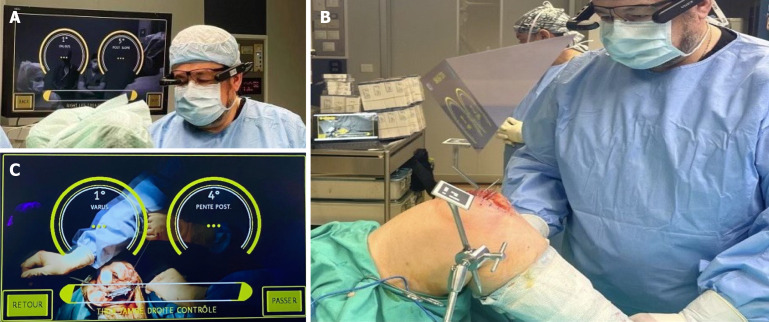
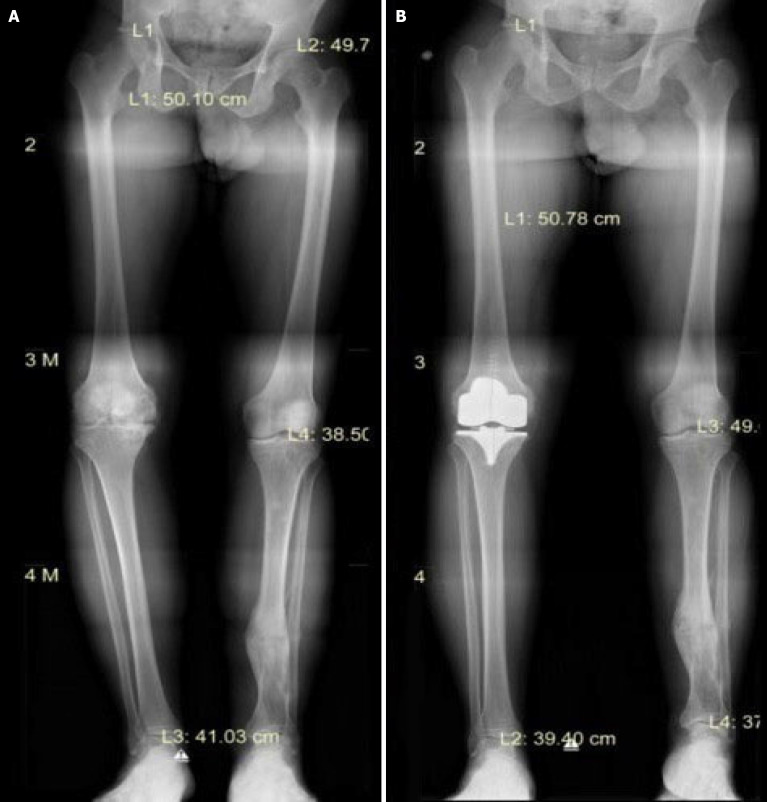
Methods: From May 2021 to December 2021, 30 patients, 25 women and five men, underwent a primary unilateral TKA. Revision cases were excluded. A preoperative radiographic procedure was performed to evaluate the limb's axial alignment. All patients were operated on by the same team, without a tourniquet, utilizing three distinct prostheses with the assistance of the Knee+™ augmented reality navigation system in every operation. Postoperatively, the same radiographic exam protocol was executed to evaluate the implants' position, orientation and coronal plane alignment. We recorded measurements in 3 stages regarding femoral varus and flexion, tibial varus and posterior slope. Firstly, the expected values from the Augmented Reality system were documented. Then we calculated the same values after each cut and finally, the same measurements were recorded radiologically after the operations. Concerning statistical analysis, Lin's concordance correlation coefficient was estimated, while Wilcoxon Signed Rank Test was performed when needed.
Results: A statistically significant difference was observed regarding mean expected values and radiographic measurements for femoral flexion measurements only (Z score = 2.67, P value = 0.01). Nonetheless, this difference was statistically significantly lower than 1 degree (Z score = -4.21, P value < 0.01). In terms of discrepancies in the calculations of expected values and controlled measurements, a statistically significant difference between tibial varus values was detected (Z score = -2.33, P value = 0.02), which was also statistically significantly lower than 1 degree (Z score = -4.99, P value < 0.01).
Conclusion: The results indicate satisfactory postoperative coronal alignment without outliers across all three different implants utilized. Augmented reality navigation systems can bolster orthopaedic surgeons' accuracy in achieving precise axial alignment. However, further research is required to further evaluate their efficacy and potential.
Keywords: Augmented reality; Knee; Navigation; Orthopedics; Robotics; Total knee arthroplasty.
©The Author(s) 2022. Published by Baishideng Publishing Group Inc. All rights reserved.
Conflict of interest statement
Conflict-of-interest statement: All the authors report no relevant conflicts of interest for this article.
Figures
References
-
- HCPUnet, Healthcare Cost and Utilization Project. Agency for Healthcare Research and Quality. Dec 20, 2012. [cited 23 February 2024]. Available from: http://hcupnet.ahrq.gov .
-
- Lavernia CJ, Guzman JF, Gachupin-Garcia A. Cost effectiveness and quality of life in knee arthroplasty. Clin Orthop Relat Res. 1997:134–139. - PubMed
-
- Ewurum CH, Guo Y, Pagnha S, Feng Z, Luo X. Surgical Navigation in Orthopedics: Workflow and System Review. Adv Exp Med Biol. 2018;1093:47–63. - PubMed
LinkOut - more resources
Full Text Sources
