


Prevalence of vitamin D deficiency in exclusively breastfed infants at Charoenkrung Pracharak Hospital
- PMID: 38596439
- PMCID: PMC11000061
- DOI: 10.5409/wjcp.v13.i1.86693
Prevalence of vitamin D deficiency in exclusively breastfed infants at Charoenkrung Pracharak Hospital
Abstract
Background: Vitamin D deficiency is a common problem in exclusively breastfed infants, with supplementation recommended by various international medical organizations. However, in Thailand, no advice for routine vitamin D supplementation is available. Thus, this study investigated the prevalence of vitamin D deficiency and its associated factors in exclusively breastfed infants in Bangkok, Thailand.
Aim: To investigated the prevalence of vitamin D deficiency and its associated factors in exclusively breastfed infants in Bangkok, Thailand.
Methods: This descriptive observational cross-sectional study assessed 109 4-month-old infants at Charoenkrung Pracharak Hospital from May 2020 to April 2021. The 25-OH vitamin D level of the infants was measured using an electrochemiluminescence binding assay. Vitamin D deficiency was defined as 25-OH level < 20 ng/mL, with vitamin D insufficiency 20-30 ng/mL. The sun index and maternal vitamin D supplementation data were collected and analyzed using the independent t-test, univariate logistic regression, and multivariate logistic regression to identify the associated factors.
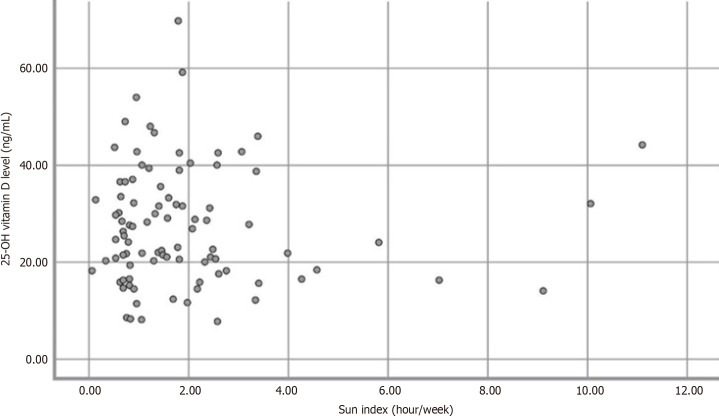
Results: The prevalences of vitamin D deficiency and vitamin D insufficiency were 35.78% and 33.03%, respectively with mean serum 25-OH vitamin D levels in these two groups 14.37 ± 3.36 and 24.44 ± 3.29 ng/mL. Multivariate logistic regression showed that the main factors associated with vitamin D status were maternal vitamin D supplementation and birth weight, with crude odds ratios 0.26 (0.08-0.82) and 0.08 (0.01-0.45), respectively. The sun index showed no correlation with the 25-OH vitamin D level in exclusively breastfed infants (r = -0.002, P = 0.984).
Conclusion: Two-thirds of healthy exclusively breastfed infants had hypovitaminosis D. Vitamin D supplementation prevented this condition and was recommended for both lactating women and their babies.
Keywords: Breastfeeding; Sunlight; Thailand; Vitamin D deficiency.
©The Author(s) 2022. Published by Baishideng Publishing Group Inc. All rights reserved.
Conflict of interest statement
Conflict-of-interest statement: Dr. Supawut Suksantilerd has received research funding from Charoenkrung Pracharak Hospital that could have influenced the outcome of this work.
Figures

References
-
- Bikle D, Christakos S. New aspects of vitamin D metabolism and action - addressing the skin as source and target. Nat Rev Endocrinol. 2020;16:234–252. - PubMed
-
- Holick MF, Binkley NC, Bischoff-Ferrari HA, Gordon CM, Hanley DA, Heaney RP, Murad MH, Weaver CM Endocrine Society. Evaluation, treatment, and prevention of vitamin D deficiency: an Endocrine Society clinical practice guideline. J Clin Endocrinol Metab. 2011;96:1911–1930. - PubMed
-
- Pettifor JM, Thandrayen K, Thacher TD. Vitamin D: Elsevier. 2018. Vitamin D deficiency and nutritional rickets in children; pp. 179–201.
LinkOut - more resources
Full Text Sources
Miscellaneous
