


The effect of weight gain and metabolic dysfunction-associated steatotic liver disease on liver fibrosis progression and regression in people with HIV
- PMID: 38597416
- PMCID: PMC11216384
- DOI: 10.1097/QAD.0000000000003903
The effect of weight gain and metabolic dysfunction-associated steatotic liver disease on liver fibrosis progression and regression in people with HIV
Erratum in
-
The effect of weight gain and metabolic dysfunction-associated steatotic liver disease on liver fibrosis progression and regression in people with HIV: Erratum.AIDS. 2025 Jan 1;39(1):103. doi: 10.1097/01.aids.0001096016.93176.39. Epub 2024 Dec 5. AIDS. 2025. PMID: 39639727 No abstract available.
Abstract
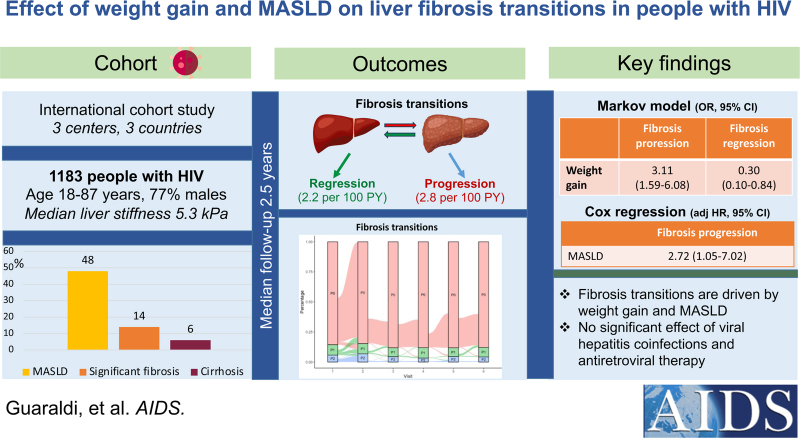
Objective: People with HIV (PWH) have high risk of liver fibrosis. We investigated the effect of weight gain and metabolic dysfunction-associated steatotic liver disease (MASLD) on liver fibrosis dynamics.
Design: Multicenter cohort study.
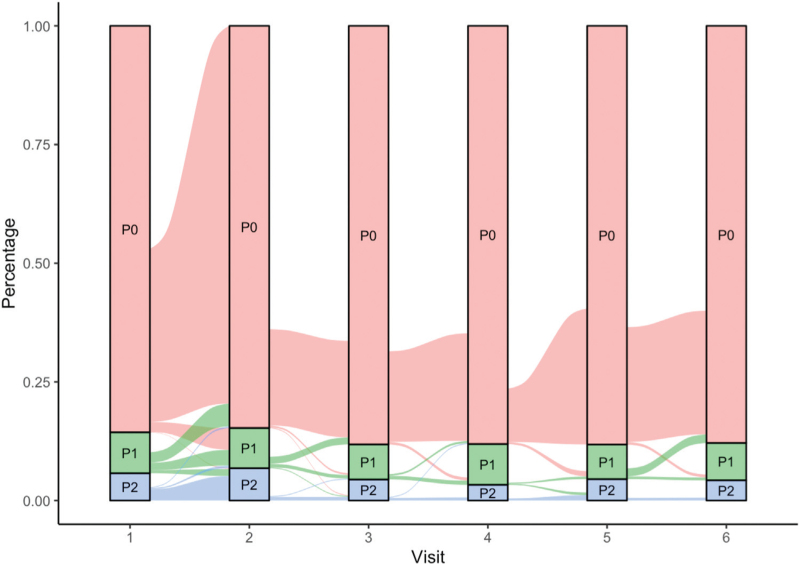
Methods: Fibrosis progression was defined as development of significant fibrosis [liver stiffness measurement (LSM) ≥8 kPa], or transition to cirrhosis (LSM ≥13 kPa), for those with significant fibrosis at baseline. Fibrosis regression was defined as transition to LSM less than 8 kPa, or to LSM less than 13 kPa for those with cirrhosis at baseline. MASLD was defined as hepatic steatosis (controlled attenuation parameter >248 dB/m) with at least one metabolic abnormality. A continuous-time multistate Markov model was used to describe transitions across fibrosis states.
Results: Among 1183 PWH included from three centers (25.2% with viral hepatitis coinfection), baseline prevalence of significant fibrosis and MASLD was 14.4 and 46.8%, respectively. During a median follow-up of 2.5 years (interquartile range 1.9-3.5), the incidence rate of fibrosis progression and regression was 2.8 [95% confidence interval (CI) 2.3-3.4] and 2.2 (95% CI 1.9-2.6) per 100 person-years, respectively. In Markov model, weight gain increased the odds of fibrosis progression [odds ratio (OR) 3.11, 95% CI 1.59-6.08], whereas weight gain (OR 0.30, 95% CI 0.10-0.84) and male sex (OR 0.32, 95% CI 0.14-0.75) decreased the odds of fibrosis regression. On multivariable Cox regression analysis, predictors of fibrosis progression were weight gain [adjusted hazard ratio (aHR) 3.12, 95% CI 1.41-6.90] and MASLD (aHR 2.72, 95% CI 1.05-7.02).
Conclusion: Fibrosis transitions are driven by metabolic health variables in PWH, independently of viral hepatitis coinfection and antiretroviral class therapy.
Copyright © 2024 The Author(s). Published by Wolters Kluwer Health, Inc.
Conflict of interest statement
G.G. received a research grant and speaker honoraria from Gilead, ViiV, Merck and Jansen and attended advisory boards of Gilead, ViiV and Merck. J.R. has received honoraria for consulting or speaking at educational events from Abvie, Boehringer, Galapagos, Gilead, Merck, Janssen, Theratechnologies and ViiV. G.S. has acted as speaker for Merck, Gilead, Abbvie, Novo Nordisk, Pfizer, served as an advisory board member for Pfizer, Merck, Novo Nordisk, Gilead, and has received unrestricted research funding from Theratecnologies Inc. J.M., S.R., F.M., F.C., J.B., A.D., J.C., F.M., M.D.M., D.K., W.E., S.C., C.M. have nothing to disclose.
Figures
Comment in
-
Steatotic liver disease progression in persons with HIV: weighting for answers.AIDS. 2024 Jul 15;38(9):1432-1434. doi: 10.1097/QAD.0000000000003893. Epub 2024 Jun 27. AIDS. 2024. PMID: 38932746 No abstract available.
References
-
- Croxford S, Kitching A, Desai S, Kall M, Edelstein M, Skingsley A, et al. Mortality and causes of death in people diagnosed with HIV in the era of highly active antiretroviral therapy compared with the general population: an analysis of a national observational cohort . Lancet Public Health 2017; 2:e35–e46. - PubMed
-
- Taylor RS, Taylor RJ, Bayliss S, Hagström H, Nasr P, Schattenberg JM, et al. Association between fibrosis stage and outcomes of patients with nonalcoholic fatty liver disease: a systematic review and meta-analysis . Gastroenterology 2020; 158:1611.e12–1625.e12. - PubMed
-
- Kalligeros M, Vassilopoulos A, Shehadeh F, Vassilopoulos S, Lazaridou I, Mylonakis E, et al. Prevalence and characteristics of nonalcoholic fatty liver disease and fibrosis in people living with HIV monoinfection: a systematic review and meta-analysis . Clin Gastroenterol Hepatol 2023; S1542-3565:1708–1722. - PubMed
Publication types
MeSH terms
LinkOut - more resources
Full Text Sources
Medical
Miscellaneous
