Review
. 2024 May;50(5):646-664.
doi: 10.1007/s00134-024-07387-7. Epub 2024 Apr 10.

Contemporary management of aneurysmal subarachnoid haemorrhage. An update for the intensivist

Affiliations
Review

Contemporary management of aneurysmal subarachnoid haemorrhage. An update for the intensivist

Chiara Robba et al. Intensive Care Med. 2024 May.

Abstract

Aneurysmal subarachnoid haemorrhage (aSAH) is a rare yet profoundly debilitating condition associated with high global case fatality and morbidity rates. The key determinants of functional outcome include early brain injury, rebleeding of the ruptured aneurysm and delayed cerebral ischaemia. The only effective way to reduce the risk of rebleeding is to secure the ruptured aneurysm quickly. Prompt diagnosis, transfer to specialized centers, and meticulous management in the intensive care unit (ICU) significantly improved the prognosis of aSAH. Recently, multimodality monitoring with specific interventions to correct pathophysiological imbalances has been proposed. Vigilance extends beyond intracranial concerns to encompass systemic respiratory and haemodynamic monitoring, as derangements in these systems can precipitate secondary brain damage. Challenges persist in treating aSAH patients, exacerbated by a paucity of robust clinical evidence, with many interventions showing no benefit when tested in rigorous clinical trials. Given the growing body of literature in this field and the issuance of contemporary guidelines, our objective is to furnish an updated review of essential principles of ICU management for this patient population. Our review will discuss the epidemiology, initial stabilization, treatment strategies, long-term prognostic factors, the identification and management of post-aSAH complications. We aim to offer practical clinical guidance to intensivists, grounded in current evidence and expert clinical experience, while adhering to a concise format.

Keywords: Aneurysm; Delayed cerebral ischaemia; Intensive care; Outcome; Subarachnoid haemorrhage; Vasospasm.


Conflict of interest statement

CR received fees as a speaker from Masimo and Edwards Lifesciences, Nihon Kohden and BD, all outside the submitted work. GC reports grants and personal fees as a speakers' bureau member and advisory board member from Integra Neurosciences, NeurOptics, Biogen, Invex Ltd and Idorsia, all outside the submitted work. KMB has received honoraria from the American Academy of Neurology for speaking, editing and course directing and is an Associate Editor for Critical Care Medicine. JC is a minority shareholder at iCE Neurosystems.

Figures
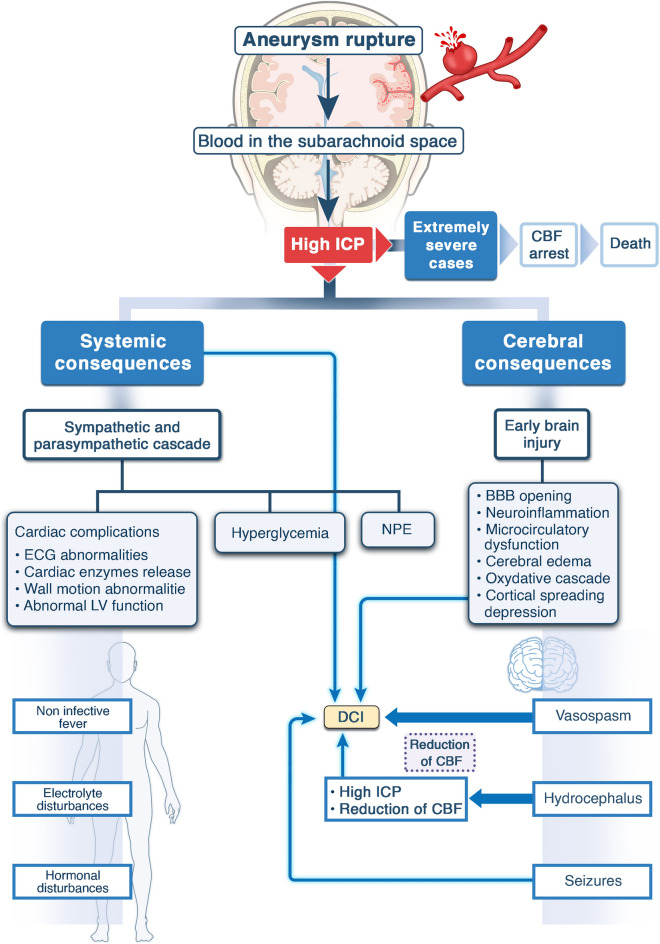
Fig. 1
Fig. 1
After the rupture of an intracranial aneurysm, a cascade of events ensues. Arterial blood under pressure enters the subarachnoid space, inducing swift mechanical effects, such as abrupt increases in intracranial pressure and related cerebral impact. This sets off intracranial repercussions in the form of early brain injury, accompanied by immediate systemic consequences, impacting cardiovascular and respiratory functions. The presence of blood in the subarachnoid space may contribute to cerebral vasospasm, delayed cerebral ischemia, hydrocephalus, and seizures. Systemically, there can be hyperglycaemia, an inflammatory response, electrolyte imbalances (primarily hypo/hypernatremia), and hormonal disturbances. ICP intracranial pressure, CBF cerebral blood flow, NPO neurogenic pulmonary oedema, ECG electrocardiography, BBB brain blood barrier, DCI delayed cerebral ischemia, LV left ventricle
Fig. 2
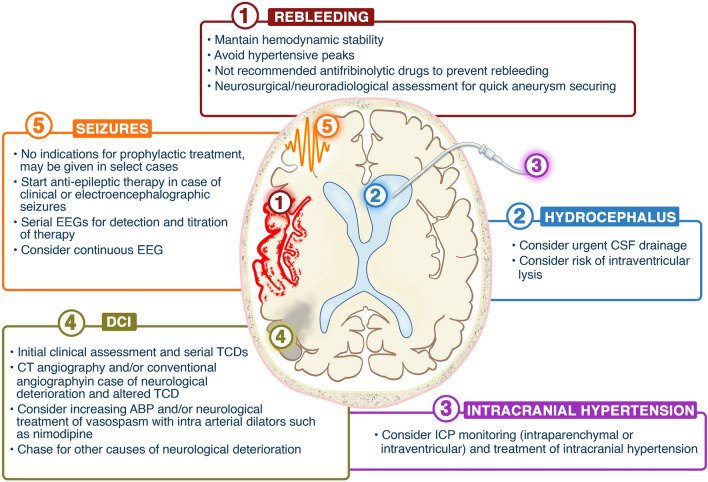
Fig. 2
Intracranial complications after aneurysmal subarachnoid haemorrhage (aSAH) and their management. ICP intracranial pressure, EVD external ventricular drain, DCI delayed cerebral ischemia, TCD transcranial doppler, TC computed tomography, CSF cerebrospinal fluid, EEG electroencephalography, MRI magnetic resonance imaging, ABP arterial blood pressure
Fig. 3
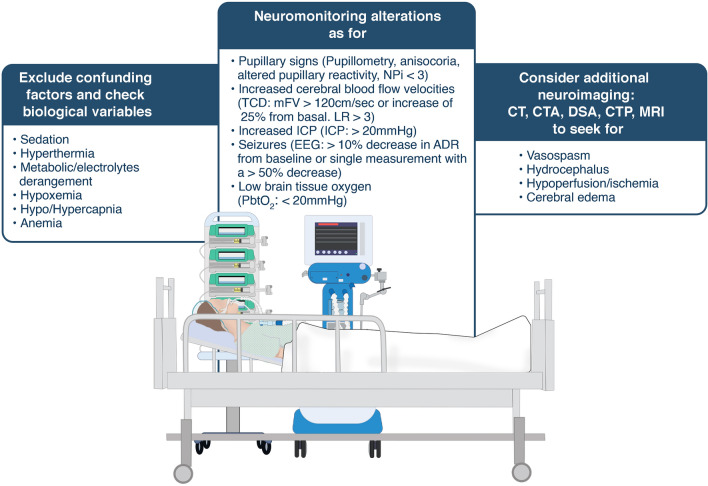
Fig. 3
Detection of causes of delayed cerebral ischemia (DCI). CT computed tomography, CTA CT angiography, DSA digital subtraction angiography, CTP  perfusion computed tomography, MRI magnetic resonance imaging, TCD transcranial Doppler, PbtO2 brain tissue oxygen, ICP intracranial pressure, EEG electroencephalography, NPi neurological pupillary index, ADR alpha/delta ratio, LR Lindegaard ratio
Fig. 4
Fig. 4
Extracranial complications after aneurysmal subarachnoid haemorrhage. T temperature, ABG arterial blood gases, MAP mean arterial pressure, ECG electrocardiography, PBW predicted body weight, DP driving pressure, Pplateau Plateau pressure, PEEP positive end-expiratory pressure, TV tidal volume, PPlat plateau pressure, SpO2 oxygen saturation, NPO neurogenic pulmonary oedema, VAP ventilator-associated pneumonia, ARDS acute respiratory distress syndrome, PE pulmonary embolism, DVT deep venous thrombosis, SIADH syndrome of inappropriate antidiuretic hormone, CWS cerebral salt-wasting, CXR chest X-ray, CT computed tomography, LMWH low molecular weight heparin

References

    1. Etminan N, Chang H-S, Hackenberg K, De Rooij NK, Vergouwen MDI, Rinkel GJE, Algra A. Worldwide incidence of aneurysmal subarachnoid haemorrhage according to region, time period, blood pressure, and smoking prevalence in the population: a systematic review and meta-analysis. JAMA Neurol. 2019;76:588. doi: 10.1001/jamaneurol.2019.0006. - DOI - PMC - PubMed
    1. Rinkel GJE, Djibuti M, Algra A, Van Gijn J. Prevalence and risk of rupture of intracranial aneurysms: a systematic review. Stroke. 1998;29:251–256. doi: 10.1161/01.STR.29.1.251. - DOI - PubMed
    1. Lovelock CE, Rinkel GJE, Rothwell PM. Time trends in outcome of subarachnoid haemorrhage: population-based study and systematic review. Neurology. 2010;74:1494–1501. doi: 10.1212/WNL.0b013e3181dd42b3. - DOI - PMC - PubMed
    1. Rivero-Arias O, Gray A, Wolstenholme J. Burden of disease and costs of aneurysmal subarachnoid haemorrhage (aSAH) in the United Kingdom. Cost Eff Resour Alloc. 2010;8:6. doi: 10.1186/1478-7547-8-6. - DOI - PMC - PubMed
    1. Roos YBWEM. Complications and outcome in patients with aneurysmal subarachnoid haemorrhage: a prospective hospital based cohort study in The Netherlands. J Neurol Neurosurg Psychiatry. 2000;68:337–341. doi: 10.1136/jnnp.68.3.337. - DOI - PMC - PubMed

MeSH terms