Prevalence of tick-borne pathogens in ticks collected from the wild mountain ungulates mouflon and chamois in 4 regions of France
- PMID: 38602373
- PMCID: PMC11008225
- DOI: 10.1051/parasite/2024011
Prevalence of tick-borne pathogens in ticks collected from the wild mountain ungulates mouflon and chamois in 4 regions of France
Abstract
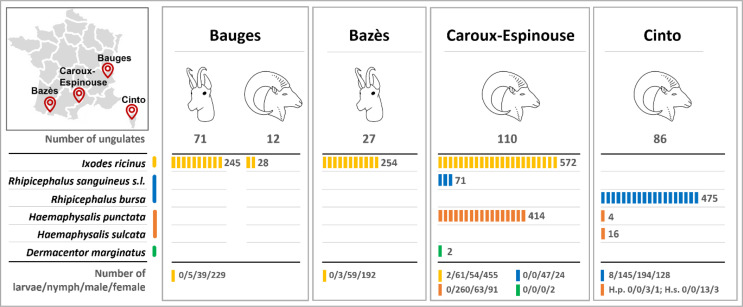
Ticks are major vectors of various pathogens of health importance, such as bacteria, viruses and parasites. The problems associated with ticks and vector-borne pathogens are increasing in mountain areas, particularly in connection with global climate change. We collected ticks (n = 2,081) from chamois and mouflon in 4 mountainous areas of France. We identified 6 tick species: Ixodes ricinus, Rhipicephalus bursa, Rh. sanguineus s.l., Haemaphysalis sulcata, H. punctata and Dermacentor marginatus. We observed a strong variation in tick species composition among the study sites, linked in particular to the climate of the sites. We then analysed 791 ticks for DNA of vector-borne pathogens: Babesia/Theileria spp., Borrelia burgdorferi s.l., Anaplasma phagocytophilum, A. marginale, A. ovis, and Rickettsia of the spotted fever group (SFG). Theileria ovis was detected only in Corsica in Rh. bursa. Babesia venatorum (2 sites), Borrelia burgdorferi s.l. (B. afzelii and B. garinii; 2 sites) and Anaplasma phagocytophilum (3 sites) were detected in I. ricinus. Anaplasma ovis was detected at one site in I. ricinus and Rh. sanguineus s.l. SFG Rickettsia were detected at all the study sites: R. monacensis and R. helvetica in I. ricinus at the 3 sites where this tick is present; R. massiliae in Rh. sanguineus s.l. (1 site); and R. hoogstraalii and Candidatus R. barbariae in Rh. bursa in Corsica. These results show that there is a risk of tick-borne diseases for humans and domestic and wild animals frequenting these mountain areas.
Title: Prévalence d’agents pathogènes vectorisés chez des tiques collectées chez des ongulés sauvages (mouflons, chamois) dans 4 zones montagneuses en France.
Abstract: Les tiques sont des vecteurs majeurs de différents agents pathogènes d’importance sanitaire, tels que des bactéries, des virus et des parasites. Les problématiques liées aux tiques et aux pathogènes vectorisés augmentent en zones de montagne, en lien notamment avec le réchauffement climatique. Nous avons collecté des tiques (n = 2 081) sur des chamois et des mouflons dans 4 zones montagneuses en France. Six espèces ont été identifiées : Ixodes ricinus, Rhipicephalus bursa, Rh. sanguineus s.l., Haemaphysalis sulcata, H. punctata et Dermacentor marginatus. Nous avons observé une forte variation de la composition en espèces de tiques entre les sites d’étude, en lien notamment avec le climat des sites. Nous avons ensuite recherché les ADN d’agents pathogènes vectorisés sur 791 tiques : Babesia/Theileria spp, Borrelia burgdorferi s.l., Anaplasma phagocytophilum, A. marginale, A. ovis, et de Rickettsia du groupe des fièvres boutonneuses (SFG). Theileria ovis a été détecté uniquement en Corse chez Rh. bursa. Babesia venatorum (2 sites), Borrelia burgdorferi s.l. (B. afzelii and B. garinii; 2 sites) et Anaplasma phagocytophilum (3 sites) ont été détectés chez I. ricinus. Anaplasma ovis a été détecté dans un site chez I. ricinus et Rh. sanguineus s.l.. Les Rickettsia SFG ont été détectées dans tous les sites d’étude : Rickettsia monacensis et R. helvetica chez I. ricinus dans les 3 sites où cette tique est présente; R. massiliae chez Rh. sanguineus s.l. (1 site); et R. hoogstraalii et Candidatus R. barbariae chez Rh. bursa en Corse. Ces résultats montrent un risque de transmission de maladies par les tiques pour les personnes et les animaux domestiques et sauvages fréquentant ces zones de montagne.
Keywords: Anaplasma; Babesia venatorum; Borrelia; Chamois; Mouflon; Rickettsia hoogstraalii; Theileria ovis.
© J. Habib et al., published by EDP Sciences, 2024.
Conflict of interest statement
The authors declare that they have no competing interests.
Figures
References
-
- Beati L, Raoult D. 1993. Rickettsia massiliae sp. nov., a new spotted fever group Rickettsia. International Journal of Systematic Bacteriology, 43, 839–840. - PubMed
-
- Chisu V, Alberti A, Zobba R, Foxi C, Masala G. 2019. Molecular characterization and phylogenetic analysis of Babesia and Theileria spp. in ticks from domestic and wild hosts in Sardinia. Acta Tropica, 196, 60–65. - PubMed
MeSH terms
LinkOut - more resources
Full Text Sources
Medical
Miscellaneous