


Higher disease burden and lower utilization in Mongolian with breast cancer: a 9-year retrospective cohort study of 18.19 million adults in China
- PMID: 38608032
- PMCID: PMC11325962
- DOI: 10.1097/JS9.0000000000001478
Higher disease burden and lower utilization in Mongolian with breast cancer: a 9-year retrospective cohort study of 18.19 million adults in China
Abstract
Background: Whether health inequalities of disease burden and medical utilization exist by ethnicity in Asian breast cancer (BC) patients remains unclear. The authors aim to measure ethnic disparities in disease burden and utilization among Mongolian and Han female BC patients in China.
Materials and methods: Based on data extracted from Inner Mongolia Regional Health Information Platform, a retrospective cohort study was established during 2012-2021. Disease burden including incidence, 5-year prevalence, mortality, survival rate, and medical cost were analyzed and compared between Han and Mongolian patients.
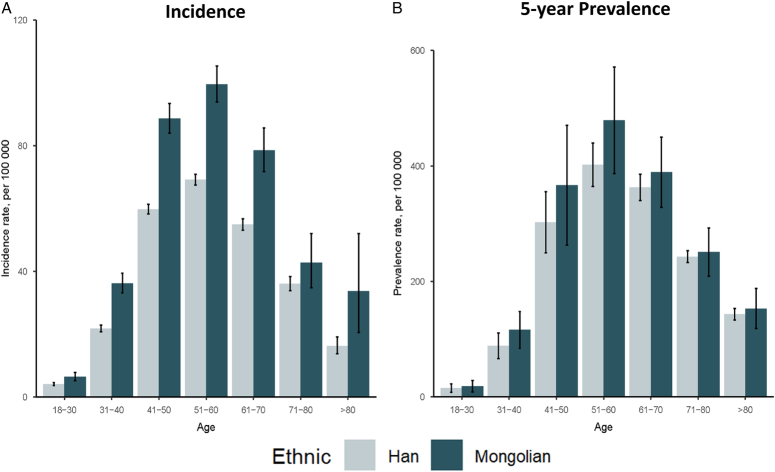
Results: A total of 34 878 female patients [mean (SD) age, 52.34 (10.93) years] were included among 18.19 million Chinese, and 4315 (12.03%) participants were Mongolian. Age-standardized rates of incidence are 32.68 (95% CI: 20.39-44.98) per 100 000. Higher age-specific incidence and 5-year prevalence were observed in Mongolian than in Han. The cost of BC annually per capita was significantly lower for Mongolian than Han [$1948.43 (590.11-4 776.42) vs. $2227.35 (686.65-5929.59), P <0.001]. Mongolian females showed higher all-cause mortality [30.92 (95% CI: 28.15-33.89) vs. 27.78 (95% CI: 26.77-28.83) per 1000, P =0.036] and BC-specific mortality [18.78 (95% CI: 16.64-21.13) vs. 15.22 (95% CI: 14.47-16.00) per 1000, P =0.002] than Han females. After adjusting covariates, Mongolian were associated with increased all-cause mortality [HR, 1.21, (95% CI: 1.09-1.34); P <0.001] and BC-specific mortality [HR, 1.31, (95% CI: 1.14-1.49); P <0.001].
Conclusion: The findings of this cohort study highlight a higher level of disease burden with unmet medical demand in Mongolian patients, suggesting that more practical efforts should be made for the minority. Further research is needed to explore the concrete mechanisms of the disparities as well as eliminate health disproportion.
Copyright © 2024 The Author(s). Published by Wolters Kluwer Health, Inc.
Conflict of interest statement
Dr Shengfeng Wang reports grants from Natural Science Foundation of China (No. 82173616 and No. 72342015) during the conduct of the study. Dr. Shengfeng Wang confirmed that the funders did not play a role in design and conduct of the study; collection, management, analysis, and interpretation of the data; preparation, review, or approval of the manuscript; and the decision to submit the manuscript for publication. No potential conflicts of interest were disclosed for the remaining authors.
Figures
References
-
- Sung H, Ferlay J, Siegel RL, et al. Global cancer statistics 2020: GLOBOCAN estimates of incidence and mortality worldwide for 36 cancers in 185 countries. CA Cancer J Clin 2021;71:209–249. - PubMed
-
- Zhang P, Zhou C, Zhao K, et al. Associations of air pollution and greenness with global burden of breast cancer: an ecological study. Environm Sci Pollut Res 2023;30:103921–103931. - PubMed
MeSH terms
LinkOut - more resources
Full Text Sources
Medical
