. 2024 Apr 12;19(1):236.
doi: 10.1186/s13018-024-04713-z.

Non-traumatic osteonecrosis of the femoral head induced by steroid and alcohol exposure is associated with intestinal flora alterations and metabolomic profiles

Affiliations

Non-traumatic osteonecrosis of the femoral head induced by steroid and alcohol exposure is associated with intestinal flora alterations and metabolomic profiles

Qing-Yuan Zheng et al. J Orthop Surg Res. .

Abstract

Objective: Osteonecrosis of the femoral head (ONFH) is a severe disease that primarily affects the middle-aged population, imposing a significant economic and social burden. Recent research has linked the progression of non-traumatic osteonecrosis of the femoral head (NONFH) to the composition of the gut microbiota. Steroids and alcohol are considered major contributing factors. However, the relationship between NONFH caused by two etiologies and the microbiota remains unclear. In this study, we examined the gut microbiota and fecal metabolic phenotypes of two groups of patients, and analyzed potential differences in the pathogenic mechanisms from both the microbial and metabolic perspectives.

Methods: Utilizing fecal samples from 68 NONFH patients (32 steroid-induced, 36 alcohol-induced), high-throughput 16 S rDNA sequencing and liquid chromatography with tandem mass spectrometry (LC-MS/MS) metabolomics analyses were conducted. Univariate and multivariate analyses were applied to the omics data, employing linear discriminant analysis effect size to identify potential biomarkers. Additionally, functional annotation of differential metabolites and associated pathways was performed using the Kyoto Encyclopedia of Genes and Genomes (KEGG) database. Subsequently, Spearman correlation analysis was employed to assess the potential correlations between differential gut microbiota and metabolites.

Results: High-throughput 16 S rDNA sequencing revealed significant gut microbial differences. At the genus level, the alcohol group had higher Lactobacillus and Roseburia, while the steroid group had more Megasphaera and Akkermansia. LC-MS/MS metabolomic analysis indicates significant differences in fecal metabolites between steroid- and alcohol-induced ONFH patients. Alcohol-induced ONFH (AONFH) showed elevated levels of L-Lysine and Oxoglutaric acid, while steroid-induced ONFH(SONFH) had increased Gluconic acid and Phosphoric acid. KEGG annotation revealed 10 pathways with metabolite differences between AONFH and SONFH patients. Correlation analysis revealed the association between differential gut flora and differential metabolites.

Conclusions: Our results suggest that hormones and alcohol can induce changes in the gut microbiota, leading to alterations in fecal metabolites. These changes, driven by different pathways, contribute to the progression of the disease. The study opens new research directions for understanding the pathogenic mechanisms of hormone- or alcohol-induced NONFH, suggesting that differentiated preventive and therapeutic approaches may be needed for NONFH caused by different triggers.

Keywords: Alcohol; Intestinal flora; Metabolomic profiles; Non-traumatic femoral head necrosis; Steroid.


Conflict of interest statement

The authors declare no competing interests.

Figures
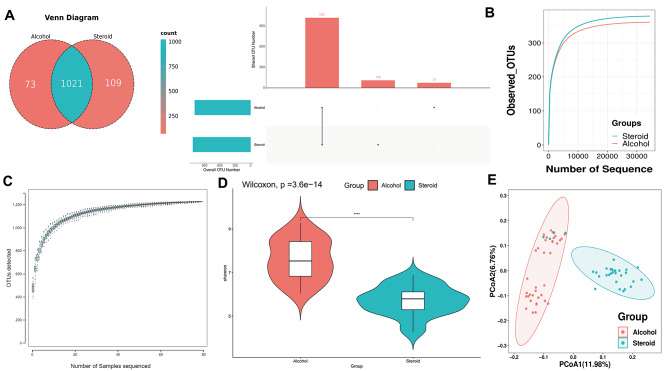
Fig. 1
Fig. 1
The difference in the composition of the GM in fecal samples between SONFH and AONFH patients. (A) Venn diagrams and an upset view illustrating the shared or unique distribution of OTUs in SONFH and AONFH patients. (B) By progressively increasing the sequencing depth of randomly selected samples, sparse curves were obtained for each group. As the sequencing depth of the samples advanced, the curves neared saturation, indicating that the sequencing data were sufficient and stable. (C) The cumulative species curve showed a trend of leveling off at the end, indicating an adequate sample size. (D) Alpha diversity differences between the two groups, as indicated by the Shannon index, revealed meaningful distinctions in alpha diversity between SONFH and AONFH (P < 0.05). (E) PCoA sorting based on Bray-Curtis distances from 16 S rDNA sequencing data showed significant separation between the two groups, suggesting notable variations in beta diversity between the two groups
Fig. 2
Fig. 2
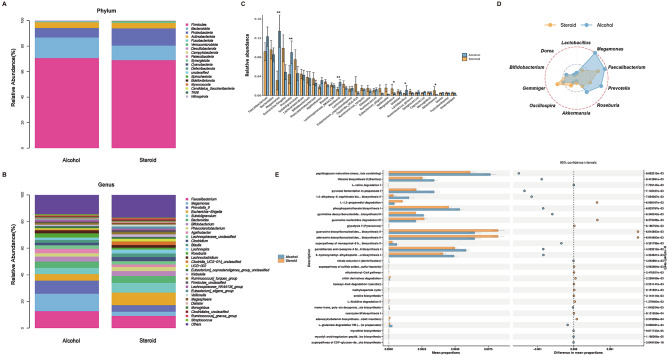
Classification distribution of fecal microbiota in SONFH and AONFH patients. (A) Stacked bar chart illustrating the phylum-level bacterial proportions and composition in both groups. (B) Stacked bar chart depicting the genus-level bacterial proportions and composition in both groups. (C) At the genus level, grouped bar chart displaying the differentially abundant microbiota between SONFH and AONFH. (D) Radar chart depicting the distinct taxonomic compositions of the six significantly different genera. The inner green circle signifies a relative abundance of 0.0014211, the middle blue circle represents a relative abundance of 0.05, and the outer red circle represents a relative abundance of 0.12973.Gemmiger and Akkermansia are dominant in the steroid group, while Megamonas, Prevotella, and others are more abundant in the alcohol group. (E) Bar chart depicting the KEGG pathways that exhibit significant differences between SONFH (yellow) and AONFH (blue)(P<0.05)
Fig. 3
Fig. 3
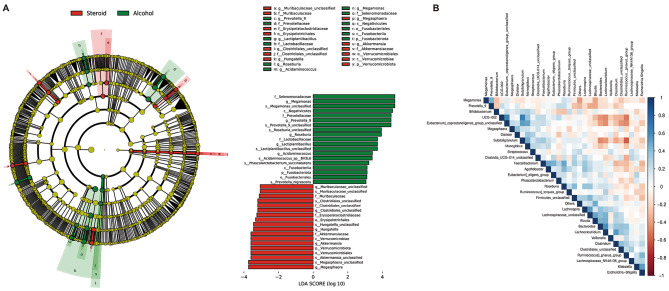
Taxonomic differences between SONFH and AONFH patients. (A) The LEfSe branching diagram and LDA score revealed differences in the composition of taxa, with bacterial taxa notably enriched in the alcohol group (green) and the steroid group (red). (B) This heatmap describes the correlations between the compositions of different taxa. Red denotes an inverse correlation, whereas blue signifies a positive correlation
Fig. 4
Fig. 4
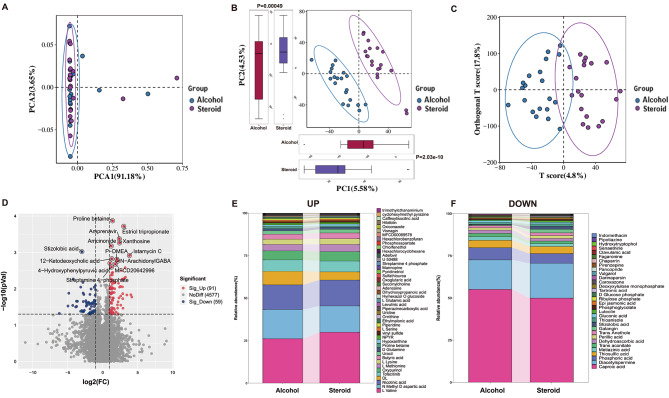
Overall patterns of fecal metabolomes in SONFH and AONFH patients. (A) Principal component analysis (PCA) plot based on non-targeted LC-MS/MS data of fecal samples from the steroid and alcohol groups, depicting the metabolic spectra and features. (B) Scatter plot of PLS-DA identifying metabolic distinctions and separations between the steroid and alcohol groups. p-values of 2.03e − 10 and 0.00049 were obtained for components 1 and 2, respectively. (C) Scatter plot of OPLS-DA showing metabolic distinctions and separations between two groups. (D) Volcano plot illustrating significant changes in fecal metabolites. Metabolites with a p-value <0.05 were deemed significantly different. Upward points suggest a significant rise in the abundance of fecal metabolites in SONFH compared to AONFH; downward points indicate a significant decrease in the abundance of metabolites in SONFH; Some metabolites are labeled with corresponding annotations. (E) Percentage stacked bar chart showing the relative abundance and percentage of significantly increased metabolites in the steroid group compared to both groups. (F) Percentage stacked bar chart showing the proportionate abundance and percentage of significantly decreased metabolites in SONFH compared to AONFH
Fig. 5
Fig. 5
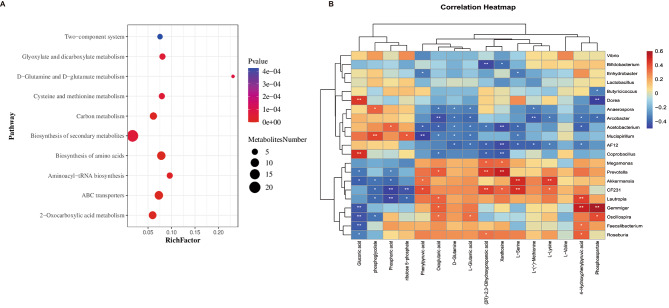
Joint analysis of fecal metabolome and microbiome in SONFH and AONFH patients. (A) Bubble chart illustrating differential metabolic pathways between SONFH and AONFH patients. (B) Relationship between GM and fecal metabolites in patients with SONFH and AONFH. Red denotes a positive correlation between microbial taxa and metabolites, while blue indicates a negative correlation. * p < 0.05; ** p < 0.01, Spearman correlation

References

    1. Sodhi N, Acuna A, Etcheson J, Mohamed N, Davila I, Ehiorobo JO, Jones LC, Delanois RE, Mont MA. Management of osteonecrosis of the femoral head. Bone Joint J. 2020;102–B(7SuppleB):122–8. doi: 10.1302/0301-620X.102B7.BJJ-2019-1611.R1. - DOI - PubMed
    1. Ng MK, Gordon AM, Piuzzi NS, Wong CHJ, Jones LC, Mont MA. Trends in Surgical Management of Osteonecrosis of the femoral head: a 2010 to 2020 Nationwide Study. J Arthroplasty. 2023;38(7S):S51–7. doi: 10.1016/j.arth.2023.03.071. - DOI - PubMed
    1. Necas L, Hrubina M, Melisik M, Cabala J, Cibula Z, Daniel M. Total hip arthroplasty with ultra-short uncemented stem in patients with osteonecrosis of the femoral head: mid-term results. Hip Int. 2023;33(3):463–70. doi: 10.1177/11207000211043481. - DOI - PubMed
    1. Mont MA, Zywiel MG, Marker DR, McGrath MS, Delanois RE. The natural history of untreated asymptomatic osteonecrosis of the femoral head: a systematic literature review. J Bone Joint Surg Am. 2010;15(12):2165–70. doi: 10.2106/JBJS.I.00575. - DOI - PubMed
    1. Rezus E, Tamba BI, Badescu MC, Popescu D, Bratoiu I, Rezus C. Osteonecrosis of the femoral head in patients with hypercoagulability-from pathophysiology to therapeutic implications. Int J Mol Sci. 2021;24(2213):6801. doi: 10.3390/ijms22136801. - DOI - PMC - PubMed

LinkOut - more resources