


Glycated Walnut Meal Peptide-Calcium Chelates: Preparation, Characterization, and Stability
- PMID: 38611413
- PMCID: PMC11011802
- DOI: 10.3390/foods13071109
Glycated Walnut Meal Peptide-Calcium Chelates: Preparation, Characterization, and Stability
Abstract
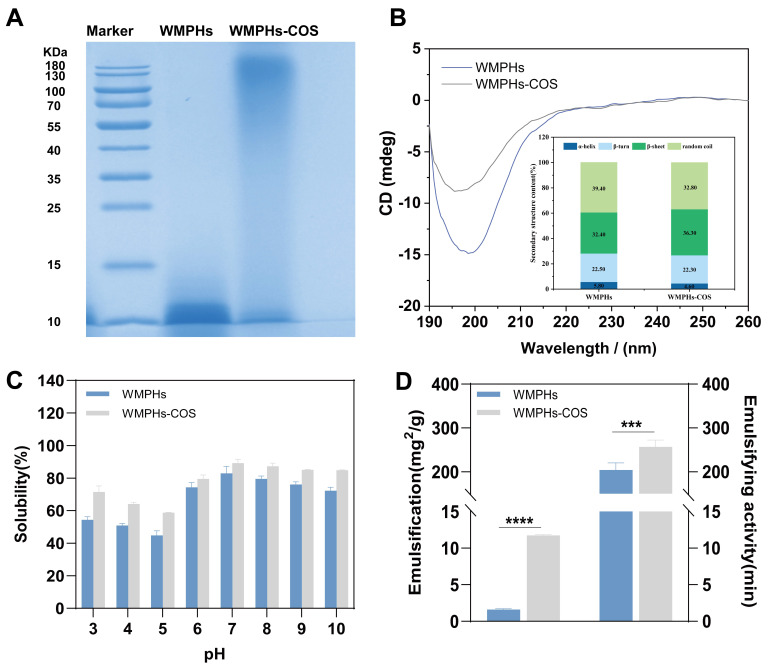
Finding stable and bioavailable calcium supplements is crucial for addressing calcium deficiency. In this study, glycated peptide-calcium chelates (WMPHs-COS-Ca) were prepared from walnut meal protein hydrolysates (WMPHs) and chitosan oligosaccharides (COSs) through the Maillard reaction, and the structural properties and stability of the WMPHs-COS-Ca were characterized. The results showed that WMPHs and COSs exhibited high binding affinities, with a glycation degree of 64.82%. After glycation, Asp, Lys, and Arg decreased by 2.07%, 0.46%, and 1.06%, respectively, which indicated that these three amino acids are involved in the Maillard reaction. In addition, compared with the WMPHs, the emulsifying ability and emulsion stability of the WMPHs-COS increased by 10.16 mg2/g and 52.73 min, respectively, suggesting that WMPHs-COS have better processing characteristics. After chelation with calcium ions, the calcium chelation rate of peptides with molecular weights less than 1 kDa was the highest (64.88%), and the optimized preparation conditions were 5:1 w/w for WMPH-COS/CaCl2s, with a temperature of 50 °C, a chelation time of 50 min, and a pH of 7.0. Scanning electron microscopy showed that the "bridging role" of WMPHs-COS changed to a loose structure. UV-vis spectroscopy and Fourier transform infrared spectrometry results indicated that the amino nitrogen atoms, carboxyl oxygen atoms, and carbon oxygen atoms in WMPHs-COS chelated with calcium ions, forming WMPHs-COS-Ca. Moreover, WMPHs-COS-Ca was relatively stable at high temperatures and under acidic and alkaline environmental and digestion conditions in the gastrointestinal tract, indicating that WMPHs-COS-Ca have a greater degree of bioavailability.
Keywords: glycated peptide–calcium chelates; physicochemical properties; stability; structural characterizations; walnut meal protein hydrolysates.
Conflict of interest statement
The authors declare no conflicts of interest.
Figures




References
-
- Christopoulos M.V., Tsantili E. Oil composition in stored walnut cultivars—Quality and nutritional value. J. Eur. J. Lipid Sci. Technol. 2015;117:338–348. doi: 10.1002/ejlt.201400082. - DOI
-
- Zhang L., Zhao X., Tao G., Chen J., Zheng Z. Investigating the inhibitory activity and mechanism differences between norartocarpetin and luteolin for tyrosinase: A combinatory kinetic study and computational simulation analysis. Food Chem. 2017;223:40–48. doi: 10.1016/j.foodchem.2016.12.017. - DOI - PubMed
Grants and funding
LinkOut - more resources
Full Text Sources
