


Utility of Dual-Energy Computed Tomography in Clinical Conundra
- PMID: 38611688
- PMCID: PMC11012177
- DOI: 10.3390/diagnostics14070775
Utility of Dual-Energy Computed Tomography in Clinical Conundra
Abstract
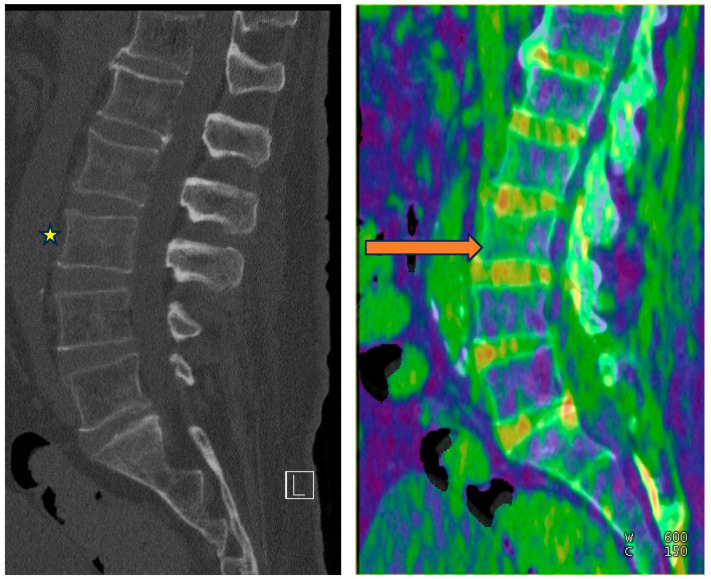
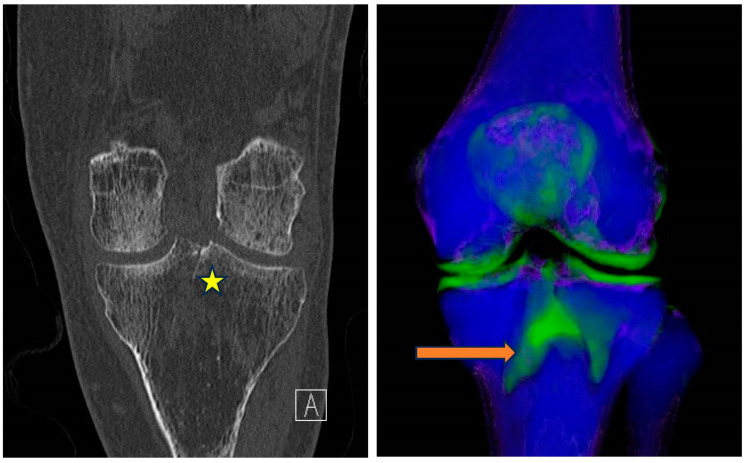
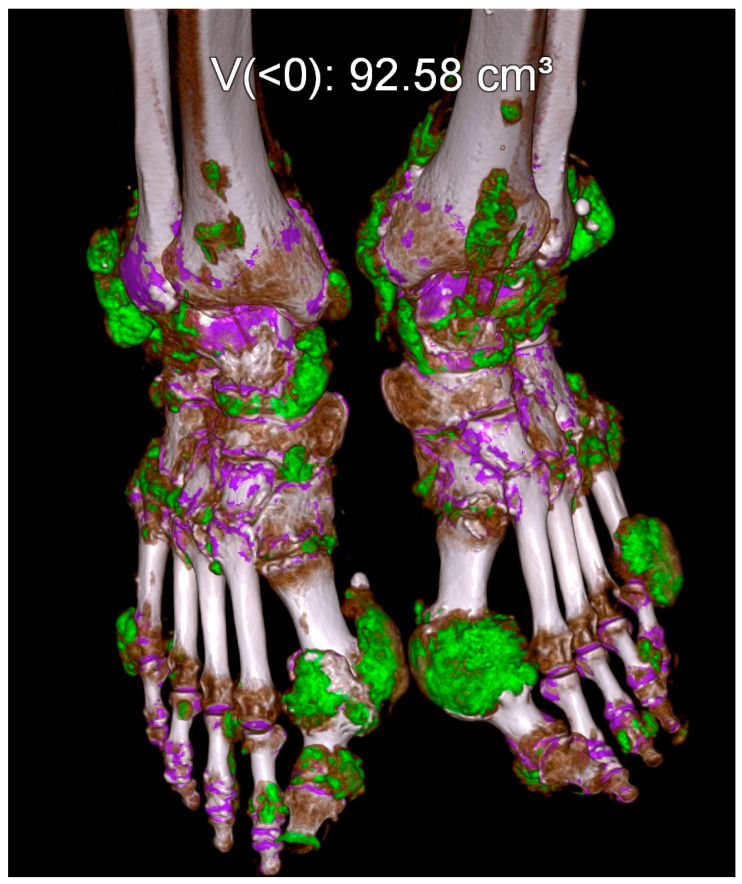
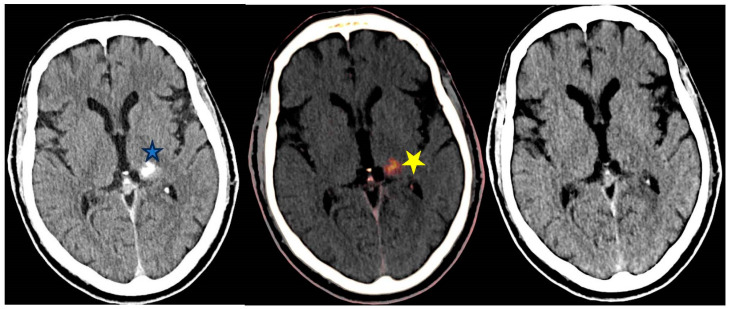
Advancing medical technology revolutionizes our ability to diagnose various disease processes. Conventional Single-Energy Computed Tomography (SECT) has multiple inherent limitations for providing definite diagnoses in certain clinical contexts. Dual-Energy Computed Tomography (DECT) has been in use since 2006 and has constantly evolved providing various applications to assist radiologists in reaching certain diagnoses SECT is rather unable to identify. DECT may also complement the role of SECT by supporting radiologists to confidently make diagnoses in certain clinically challenging scenarios. In this review article, we briefly describe the principles of X-ray attenuation. We detail principles for DECT and describe multiple systems associated with this technology. We describe various DECT techniques and algorithms including virtual monoenergetic imaging (VMI), virtual non-contrast (VNC) imaging, Iodine quantification techniques including Iodine overlay map (IOM), and two- and three-material decomposition algorithms that can be utilized to demonstrate a multitude of pathologies. Lastly, we provide our readers commentary on examples pertaining to the practical implementation of DECT's diverse techniques in the Gastrointestinal, Genitourinary, Biliary, Musculoskeletal, and Neuroradiology systems.
Keywords: dual energy CT application; dual energy CT system; dual energy scanned projection radiography; gastrointestinal; genitourinary; musculoskeletal; neuroradiology.
Conflict of interest statement
Faisal Khosa is the recipient of the Michael Smith Health research BC award (2023-2028). Vicenza Granata is involved with the following study: PRESTO-1 STUDY: precision therapeutic strategies for the treatment of colorectal cancer and HCC. The remaining authors declare that the research was conducted in the absence of any commercial or financial relationships that could be construed as a potential conflict of interest.
Figures
Similar articles
-
The Role of Dual-Energy CT in Solid Organ Injury.Can Assoc Radiol J. 2024 May;75(2):417-427. doi: 10.1177/08465371231215669. Epub 2023 Dec 25. Can Assoc Radiol J. 2024. PMID: 38146203 Review.
-
Noise reduction approach in pediatric abdominal CT combining deep learning and dual-energy technique.Eur Radiol. 2021 Apr;31(4):2218-2226. doi: 10.1007/s00330-020-07349-9. Epub 2020 Oct 8. Eur Radiol. 2021. PMID: 33030573
-
Quantitative accuracy and dose efficiency of dual-contrast imaging using dual-energy CT: a phantom study.Med Phys. 2020 Feb;47(2):441-456. doi: 10.1002/mp.13912. Epub 2019 Dec 10. Med Phys. 2020. PMID: 31705664 Free PMC article.
-
Split-filter dual energy computed tomography radiotherapy: From calibration to image guidance.Phys Imaging Radiat Oncol. 2023 Sep 25;28:100495. doi: 10.1016/j.phro.2023.100495. eCollection 2023 Oct. Phys Imaging Radiat Oncol. 2023. PMID: 37876826 Free PMC article.
-
Dual-Energy Computed Tomography: Technological Considerations.Radiol Clin North Am. 2023 Nov;61(6):945-961. doi: 10.1016/j.rcl.2023.05.002. Epub 2023 Jul 31. Radiol Clin North Am. 2023. PMID: 37758362 Review.
Cited by
-
CTA Imaging of Peripheral Arterial Injuries.Diagnostics (Basel). 2024 Jun 26;14(13):1356. doi: 10.3390/diagnostics14131356. Diagnostics (Basel). 2024. PMID: 39001246 Free PMC article. Review.
-
The Role of Dual-Energy CT in Differentiating Adrenal Adenomas from Metastases: A Comprehensive Narrative Review.J Pers Med. 2025 Mar 28;15(4):131. doi: 10.3390/jpm15040131. J Pers Med. 2025. PMID: 40278310 Free PMC article. Review.
-
The diagnosis value of dual-energy computed tomography (DECT) multi-parameter imaging in lung adenocarcinoma and squamous cell carcinoma.BMC Pulm Med. 2024 Oct 30;24(1):545. doi: 10.1186/s12890-024-03370-6. BMC Pulm Med. 2024. PMID: 39478525 Free PMC article.
-
Diagnostic Role of Multi-Detector Computed Tomography in Acute Mesenteric Ischemia.Diagnostics (Basel). 2024 Jun 7;14(12):1214. doi: 10.3390/diagnostics14121214. Diagnostics (Basel). 2024. PMID: 38928630 Free PMC article. Review.
-
Application of virtual monochromatic images in bone mineral density measurements: a phantom study.Sci Rep. 2025 Jul 2;15(1):22896. doi: 10.1038/s41598-025-06014-9. Sci Rep. 2025. PMID: 40596116 Free PMC article.
References
-
- Coursey C.A., Nelson R.C., Boll D.T., Paulson E.K., Ho L.M., Neville A.M., Marin D., Gupta R.T., Schindera S.T. Dual-energy multidetector CT: How does it work, what can it tell us, and when can we use it in abdominopelvic imaging? Radiographics. 2010;30:1037–1055. doi: 10.1148/rg.304095175. - DOI - PubMed
-
- Macari M., Spieler B., Kim D., Graser A., Megibow A.J., Babb J., Chandarana H. Dual-source dual-energy MDCT of pancreatic adenocarcinoma: Initial observations with data generated at 80 kVp and at simulated weighted-average 120 kVp. Am. J. Roentgenol. 2010;194:W27–W32. doi: 10.2214/AJR.09.2737. - DOI - PubMed
-
- Bushberg J.T., Seibert J.A., Leidholdt E.M., Jr., Boone J.M. The Essential Physics of Medical Imaging. 3rd ed. Lippincott Williams & Wilkins; Philadelphia, PA, USA: 2012.
Publication types
LinkOut - more resources
Full Text Sources
