Review
. 2024 Mar 22;25(7):3585.
doi: 10.3390/ijms25073585.

Regulating Protein-RNA Interactions: Advances in Targeting the LIN28/Let-7 Pathway

Affiliations
Review

Regulating Protein-RNA Interactions: Advances in Targeting the LIN28/Let-7 Pathway

Greater Kayode Oyejobi et al. Int J Mol Sci. .

Abstract

Originally discovered in C. elegans, LIN28 is an evolutionarily conserved zinc finger RNA-binding protein (RBP) that post-transcriptionally regulates genes involved in developmental timing, stem cell programming, and oncogenesis. LIN28 acts via two distinct mechanisms. It blocks the biogenesis of the lethal-7 (let-7) microRNA (miRNA) family, and also directly binds messenger RNA (mRNA) targets, such as IGF-2 mRNA, and alters downstream splicing and translation events. This review focuses on the molecular mechanism of LIN28 repression of let-7 and current strategies to overcome this blockade for the purpose of cancer therapy. We highlight the value of the LIN28/let-7 pathway as a drug target, as multiple oncogenic proteins that the pathway regulates are considered undruggable due to their inaccessible cellular location and lack of cavities for small molecule binding.

Keywords: LIN28; gene therapy; let-7; miRNA; oncogene; small-molecule inhibitor.


Conflict of interest statement

P.S. holds positions and intellectual property at 28/7 Therapeutics, a company aimed at developing inhibitors of the LIN28/let-7 pathway.

Figures
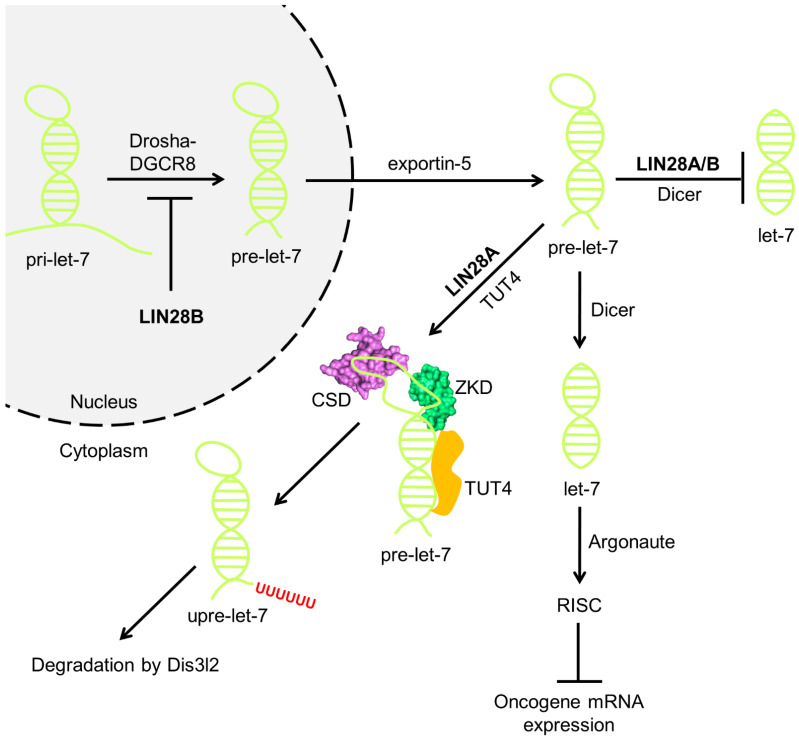
Figure 1
Figure 1
LIN28 Inhibits let-7 miRNA Biogenesis and Contributes to Cancer. In the nucleus, human LIN28B sequesters pri-let-7 and as a result, the Drosha-DGCR8 microprocessor fails to generate pre-let-7, thereby arresting let-7 biogenesis. LIN28A (CSD—cold-shock domain; ZKD—zinc knuckle domain) binds to pre-let-7 after its nuclear export. Given the cytoplasmic localization of LIN28B in some cell types, LIN28B inhibition of mature let-7 biogenesis can also occur in the cytoplasm. LIN28A/B recruits TUT4/Zcchc11, which oligouridylates pre-let-7 at its 3′ end. Oligouridylated pre-let-7 then undergoes exonuclease degradation by DIS3L2. LIN28A/B binding to pre-let-7 could interfere with Dicer cleavage, providing the mechanism for TUTase-independent repression. Without this inhibition, pre-let-7 undergoes processing by Dicer to yield mature let-7 miRNA, which constitutes part of RISC and inhibits multiple oncogenes through RNAi.
Figure 2
Figure 2
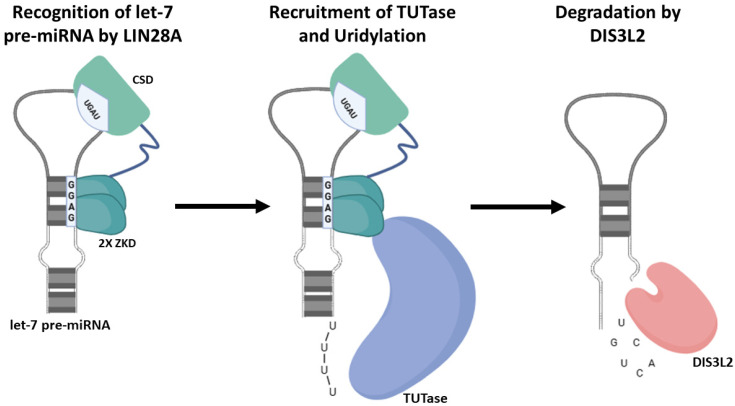
Involvement of LIN28A CSD and ZKD in let-7 pre-miRNA binding and processing. Using their CSD and ZKD binding elements, let-7 miRNA precursor recruits LIN28A, resulting to their 3ʹuridylation by TUTase and eventual degradation by DIS3L2.
Figure 3
Figure 3
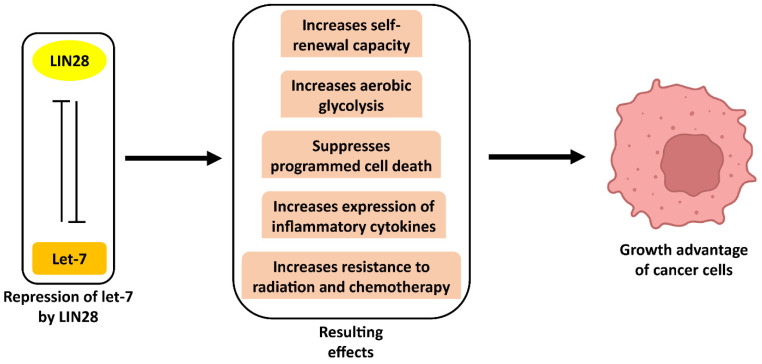
Some effects of the repression of let-7 by LIN28 on cancer cells.
Figure 4
Figure 4
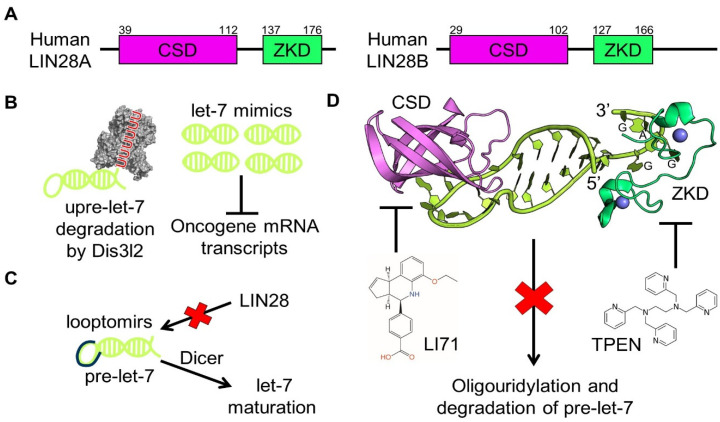
Pharmacological inhibition of LIN28-driven oncogenesis. (A) Domain architecture of human LIN28A and LIN28B, which share an N-terminal CSD (magenta) and a C-terminal ZKD (green) The residue numbers are denoted atop. (B) Let-7 mimics enhance tumor suppression by replenishing let-7, the level of which is decreased by LIN28-mediated oligouridylation and degradation by nuclease DIS3L2 (grey) (PDB ID: 4PMW). (C) Looptomirs hinder (red cross) LIN28 binding to pre-let-7 without blocking downstream pre-let-7 processing by Dicer, thereby promoting let-7 maturation. (D) Small molecules LI71 and TPEN inhibit (red cross) LIN28 by targeting its CSD and ZKD, respectively. Crystal structure of human LIN28A in complex with pre-let-7f-1 (yellow) (PDB ID: 5UDZ). Zn2+ ions (blue) are visible near the ZKD. The GGAG motif in pre-let-7f-1 is indicated near its 3′ end.

References

    1. Ruiz-Arroyo V.M., Nam Y. Dynamic Protein-RNA recognition in primary MicroRNA processing. Curr. Opin. Struct. Biol. 2022;76:102442. doi: 10.1016/j.sbi.2022.102442. - DOI - PMC - PubMed
    1. Partin A.C., Ngo T.D., Herrell E., Jeong B.-C., Hon G., Nam Y. Heme enables proper positioning of Drosha and DGCR8 on primary microRNAs. Nat. Commun. 2017;8:1737. doi: 10.1038/s41467-017-01713-y. - DOI - PMC - PubMed
    1. Partin A.C., Zhang K., Jeong B.-C., Herrell E., Li S., Chiu W., Nam Y. Cryo-EM structures of human Drosha and DGCR8 in complex with primary microRNA. Mol. Cell. 2020;78:411–422.e414. doi: 10.1016/j.molcel.2020.02.016. - DOI - PMC - PubMed
    1. Wu K., He J., Pu W., Peng Y. The Role of Exportin-5 in MicroRNA Biogenesis and Cancer. Genom. Proteom. Bioinform. 2018;16:120–126. doi: 10.1016/j.gpb.2017.09.004. - DOI - PMC - PubMed
    1. Xie M., Steitz J.A. Versatile microRNA biogenesis in animals and their viruses. RNA Biol. 2014;11:673–681. doi: 10.4161/rna.28985. - DOI - PMC - PubMed

LinkOut - more resources