Review
. 2024 Apr 13;7(1):457.
doi: 10.1038/s42003-024-06148-y.

Neural circuits regulating visceral pain

Affiliations
Review

Neural circuits regulating visceral pain

Xiaoli Chang et al. Commun Biol. .

Abstract

Visceral hypersensitivity, a common clinical manifestation of irritable bowel syndrome, may contribute to the development of chronic visceral pain, which is a major challenge for both patients and health providers. Neural circuits in the brain encode, store, and transfer pain information across brain regions. In this review, we focus on the anterior cingulate cortex and paraventricular nucleus of the hypothalamus to highlight the progress in identifying the neural circuits involved in visceral pain. We also discuss several neural circuit mechanisms and emphasize the importance of cross-species, multiangle approaches and the identification of specific neurons in determining the neural circuits that control visceral pain.


Conflict of interest statement

The authors declare no competing interests.

Figures

Fig. 1
Fig. 1. Top-down corticospinal pain and potential neural circuits underlying visceral pain associated with the ACC.
a Afferent sensory neurons carry information toward the dorsal root ganglion followed by the somatic and visceral nuclei in the dorsal horn. These sensory neurons project directly to the thalamus but also indirectly to the ACC via the PBN and amygdala. Conversely, the ACC can modulate spinal dorsal horn neurons both directly and indirectly via the PAG and RVM. In addition, the ACC also has extensive connections with other nuclei and is involved in regulating pain-related sensory and emotional information. The black arrows indicate ascending projections from the dorsal horn to higher brain structures. The red arrows indicate the indirect and direct descending pathways from the ACC to the dorsal horn. b The input brain regions connected to the ACC regulate visceral pain in rodents. The ACC receives inputs from BLA, MT, CL, LC, and NTS neurons and integrates pain perception, aversion, depression, attention, and other information to control visceral pain. Each oval represents a brain area. DRG: dorsal root ganglion; PBN parabrachial nucleus; PAG: periaqueductal gray; ACC: anterior cingulate cortex; RVM rostral ventromedial medulla; PFC prefrontal cortex; S1 somatosensory cortex 1; S2 somatosensory cortex 2; BLA basolateral nucleus of the amygdala; MT medial thalamus, CL claustrum; LC: locus coeruleus; NTS nucleus tractus solitarius (The illustration was created by Xiaoli Chang using BioRender.com under a publishing license).
Fig. 2
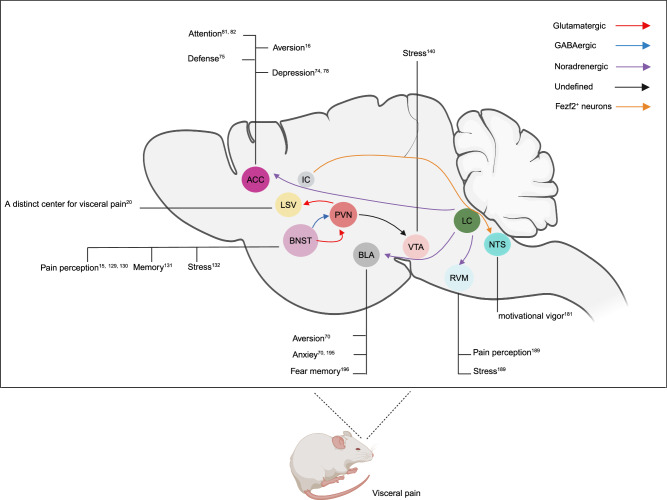
Fig. 2. Typical neural circuits involved in visceral pain in rodents.
The PVN receives glutamatergic and GABAergic inputs from the BNST; provides inputs to the LSV and VTA; and integrates pain perception, stress and memory to regulate visceral pain. LC noradrenergic neurons can form complex neural circuits by projecting to multiple brain regions, such as the RVM, BLA, and ACC, to jointly regulate pain perception and emotion and thus play an important role in visceral pain. Insular cortex neurons expressing Fezf2 selectively control motivational vigor and invigorate need-seeking behavior through projections to the brainstem NTS, which may also be involved in the regulation of visceral pain. Each oval represents a brain region, and different line colors represent different projection types. PVN Paraventricular nucleus of the hypothalamus, BNST Bed nucleus of the stria terminalis, LSV Ventral of lateral septal, VTA Ventral tegmental area, LC Locus coeruleus, RVM Rostral ventromedial medulla, BLA Basolateral nucleus of the amygdala, ACC anterior cingulate cortex, NTS Nucleus tractus solitarius, IC Insular cortex (The illustration was created by Xiaoli Chang using BioRender.com under a publishing license).

References

    1. Ford AC, Sperber AD, Corsetti M, Camilleri M. Irritable bowel syndrome. Lancet (Lond., Engl.) 2020;396:1675–1688. doi: 10.1016/S0140-6736(20)31548-8. - DOI - PubMed
    1. Camilleri M. Diagnosis and Treatment of Irritable Bowel Syndrome: A Review. Jama. 2021;325:865–877. doi: 10.1001/jama.2020.22532. - DOI - PubMed
    1. Enck P, et al. Irritable bowel syndrome. Nat. Rev. Dis. Prim. 2016;2:16014. doi: 10.1038/nrdp.2016.14. - DOI - PMC - PubMed
    1. Corder G, et al. An amygdalar neural ensemble that encodes the unpleasantness of pain. Sci. (N.Y., N.Y.) 2019;363:276–281. doi: 10.1126/science.aap8586. - DOI - PMC - PubMed
    1. Aziz MNM, Kumar J, Muhammad Nawawi KN, Raja Ali RA, Mokhtar NM. Irritable Bowel Syndrome, Depression, and Neurodegeneration: A Bidirectional Communication from Gut to Brain. Nutrients. 2021;13:3061. doi: 10.3390/nu13093061. - DOI - PMC - PubMed

Publication types