. 2024 Apr 16;123(4):182.
doi: 10.1007/s00436-024-08170-9.

High prevalence of haemosporidian parasites in Eurasian jays

Affiliations

High prevalence of haemosporidian parasites in Eurasian jays

Yvonne R Schumm et al. Parasitol Res. .

Abstract

Avian haemosporidians are vector-borne parasites, infecting a great variety of birds. The order Passeriformes has the highest average infection probability; nevertheless, some common species of Passeriformes have been rather poorly studied. We investigated haemosporidians in one such species, the Eurasian jay Garrulus glandarius (Corvidae), from a forest population in Hesse, Central Germany. All individuals were infected with at least one haemosporidian genus (overall prevalence: 100%). The most common infection pattern was a mixed Haemoproteus and Leucocytozoon infection, whereas no Plasmodium infection was detected. Results on lineage diversity indicate a rather pronounced host-specificity of Haemoproteus and Leucocytozoon lineages infecting birds of the family Corvidae.

Keywords: Garrulus glandarius; Avian malaria-like pathogens; Blood parasites; Corvidae; Disease ecology.


Conflict of interest statement

The authors declare no competing interests.

Figures
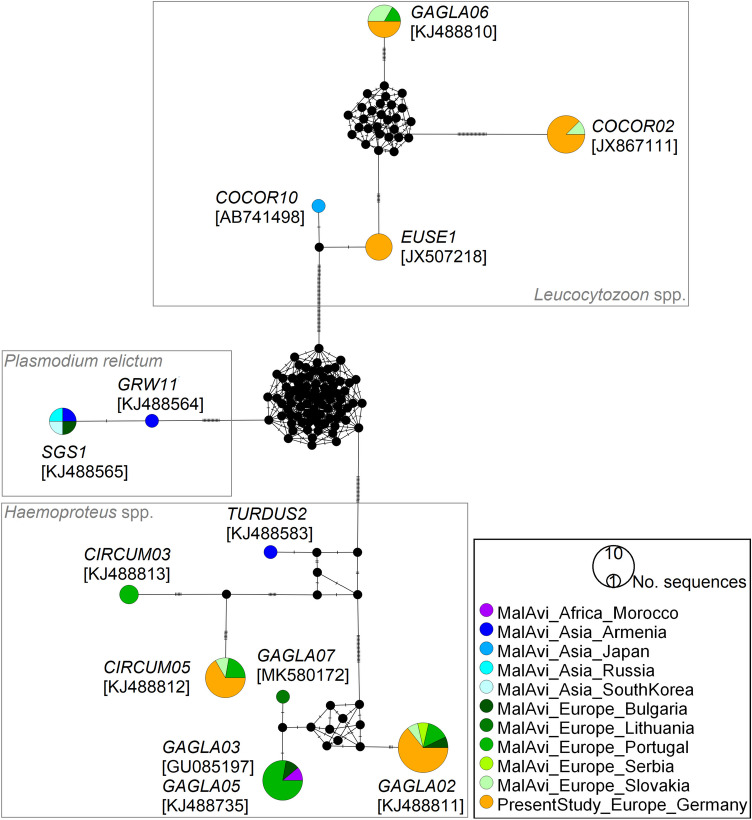
Fig. 1
Fig. 1
Median-joining network of mitochondrial cytochrome b lineages (476 bp, n = 60 sequences) of haemosporidian parasites found in Eurasian jays Garrulus glandarius. Circle size is proportional to the lineage frequency. Lineage names are noted at the associated circles together with one exemplary GenBank association number in parentheses. One hatch mark represents one mutation. Sample origins are represented by different colours, ‘MalAvi’ referring to sequences from other studies deposited in the MalAvi database (MalAvi 2023). Morphospecies names for GAGLA07 (H. homopicae) and TURDUS2 (H. minutus) are not provided within the figure

References

    1. Ágh N, Csörgő T, Szöllősi E. Delay in arrival: lineage-specific influence of haemosporidians on autumn migration of European robins. Parasitol Res. 2022;121:2831–2840. doi: 10.1007/s00436-022-07621-5. - DOI - PMC - PubMed
    1. Asghar M, Hasselquist D, Hansson B, Zehtindjiev P, Westerdahl H, Bensch S. Hidden costs of infection: chronic malaria accelerates telomere degradation and senescence in wild birds. Science. 2015;347:436–438. doi: 10.1126/science.126112. - DOI - PubMed
    1. Beadell JS, Ishtiaq F, Covas R, et al. Global phylogeographic limits of Hawaii’s avian malaria. Proc R Soc B. 2006;273:2935–2944. doi: 10.1098/rspb.2006.3671. - DOI - PMC - PubMed
    1. Bensch S, Hellgren O, Peréz-Tris J. MalAvi: a public database of malaria parasites and related haemosporidians in avian hosts based on mitochondrial cytochrome b lineages. Mol Ecol Resour. 2009;9:1353–1358. doi: 10.1111/j.1755-0998.2009.02692.x. - DOI - PubMed
    1. Bernotienė R, Palinauskas V, Iezhova T, Murauskaitė D, Valkiūnas G. Avian haemosporidian parasites (Haemosporida): a comparative analysis of different polymerase chain reaction assays in detection of mixed infections. Exp Parasitol. 2016;163:31–37. doi: 10.1016/j.exppara.2016.01.009. - DOI - PubMed

LinkOut - more resources
