


Domestic politics and the WHO's International Health Regulations: Explaining the use of trade and travel barriers during disease outbreaks
- PMID: 38624276
- PMCID: PMC7149042
- DOI: 10.1007/s11558-016-9260-1
Domestic politics and the WHO's International Health Regulations: Explaining the use of trade and travel barriers during disease outbreaks
Abstract
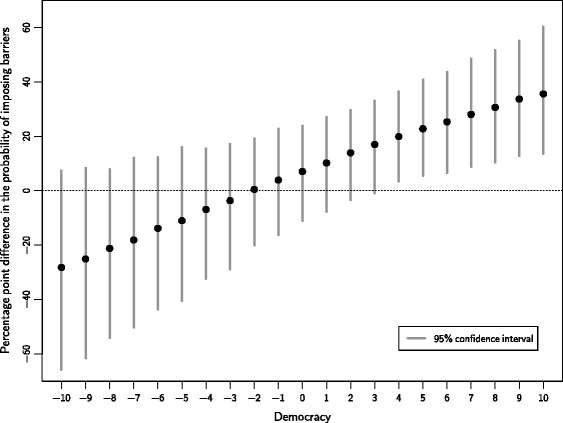
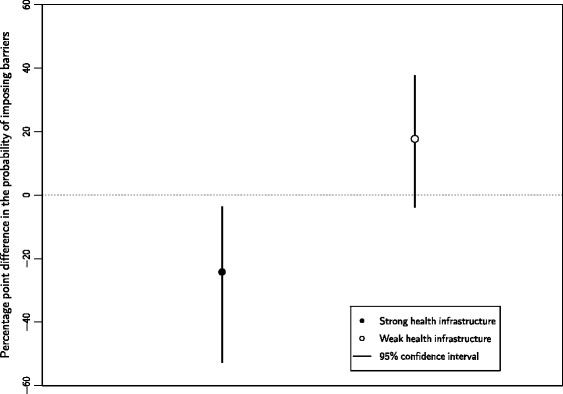
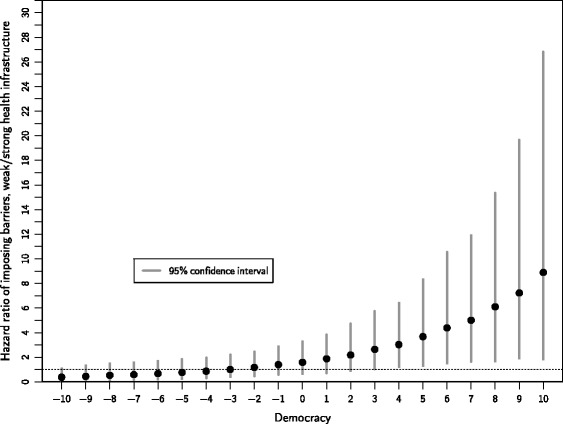
During the 2009 H1N1 pandemic, the World Health Organization (WHO), acting under the authority of the International Health Regulations (IHR), recommended against the imposition of trade or travel restrictions because, according to WHO, these barriers would not prevent disease spread. Why did 47 states impose barriers anyway? This article argues that states use barriers as political cover to prevent a loss of domestic political support. This logic suggests that governments anticipating high domestic political benefits for imposing barriers during an outbreak will be likely to do so. Logistic regression and duration analysis of an original dataset coding state behavior during H1N1 provide support for this argument: democracies with weak health infrastructure-those that stand to gain the most from imposing barriers during an outbreak because they are particularly vulnerable to a negative public reaction-are more likely than others to impose barriers and to do so quickly.
Keywords: Compliance; Domestic politics; Global health; International organizations; World Health Organization.
© Springer Science+Business Media New York 2016.
Figures
References
-
- Abbott, K. W., & Snidal, D. (2000). Hard and soft law in international governance. International Organization, 54(3), 421–456. - DOI
-
- Allee, T. L., & Huth, P. K. (2006). Legitimizing dispute settlement: International legal rulings as domestic political cover. American Political Science Review, 100(2), 219. - DOI
-
- Beck, T., Clarke, G., Groff, A., Keefer, P., & Walsh, P. (2001). New tools in comparative political economy: the database of political institutions. The World Bank Economic Review, 15(1), 165–176. - DOI
-
- Beecroft, A. R. (2009a). Demarche delivered on removal of Jordanian trade bans on pork due to H1N1. WikiLeaks. WikiLeaks cable: 09AMMAN1058_a. https://wikileaks.org/plusd/cables/09AMMAN1058_a.html. Accessed 4 March 2014.
-
- Beecroft, A. R. (2009b). Jordan to lift trade ban on pork. WikiLeaks. WikiLeaks cable: 09AMMAN1418_a. https://wikileaks.org/plusd/cables/09AMMAN1418_a.html. Accessed 4 March 2014.
LinkOut - more resources
Full Text Sources