


Patient Safety in Ambulatory Pediatrics
- PMID: 38624507
- PMCID: PMC7553853
- DOI: 10.1007/s40746-020-00213-4
Patient Safety in Ambulatory Pediatrics
Abstract
Purpose of review: The majority of patient care occurs in the ambulatory setting, and pediatric patients are at high risk of medical error and harm. Prior studies have described various safety threats in ambulatory pediatrics, and little is known about effective strategies to minimize error. The purpose of this review is to identify best practices for optimizing safety in ambulatory pediatrics.
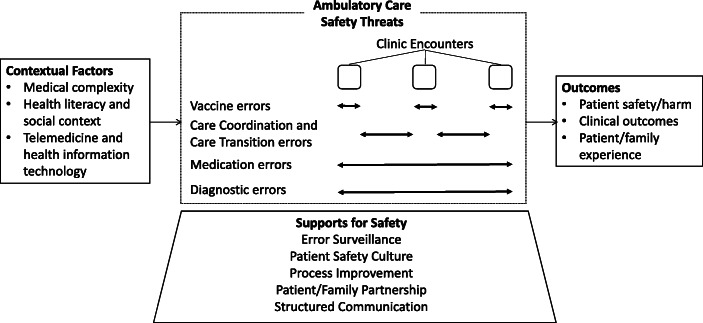
Recent findings: The majority of the patient safety literature in ambulatory pediatrics describes frequencies and types of medical errors. Study of effective interventions to reduce error, and particularly to reduce harm, have been limited. There is evidence that medical complexity and social context are important modifiers of risk. Telemedicine has emerged as a care delivery model with potential to ameliorate and exacerbate safety threats. Though there is variation across studies, developing a safety culture, partnerships with patients and families, and use of structured communication are strategies that support patient safety.
Summary: There is no standardized taxonomy for errors in ambulatory pediatrics, but errors related to medications, vaccines, diagnosis, and care coordination and care transitions are commonly described. Evidence-based approaches to optimize safety include standardized prescribing and medication reconciliation practices, appropriate use of decision support tools in the electronic health record, and communication strategies like teach-back. Further high-quality intervention studies in pediatric ambulatory care that assess impact on patient harm and clinical outcomes should be prioritized.
Keywords: Ambulatory care; Medical errors; Patient safety.
© Springer Nature Switzerland AG 2020.
Figures
References
References and Recommended Reading
Papers of particular interest, published recently, have been highlighted as: • Of importance •• Of major importance
-
- Committee on Quality of Health Care in America. In: Kohn LT, Corrigan JM, Donaldson MS, editors. To err is human: building a safer health system. Washington, DC: National Academy Press; 2000. 10.17226/9728. - PubMed
-
- Neuspiel DR, Stubbs EH. Patient safety in ambulatory care. Pediatr Clin N Am. 2012;59(6):1341–54. 10.1016/j.pcl.2012.08.006. - PubMed
-
- Mohr JJ, Lannon CM, Thoma KA, et al. Learning from errors in ambulatory pediatrics. Adv Patient Saf From Res to Implement (Volume 1 Res Find. 2005. http://www.ncbi.nlm.nih.gov/pubmed/21249808. - PubMed
Publication types
LinkOut - more resources
Full Text Sources
Research Materials