. 2024 Dec;13(1):2337678.
doi: 10.1080/22221751.2024.2337678. Epub 2024 Apr 20.

Transmission of blaNDM in Enterobacteriaceae among animals, food and human

Affiliations

Transmission of blaNDM in Enterobacteriaceae among animals, food and human

Bo Fu et al. Emerg Microbes Infect. 2024 Dec.

Abstract

Despite carbapenems not being used in animals, carbapenem-resistant Enterobacterales (CRE), particularly New Delhi metallo-β-lactamase-producing CRE (NDM-CRE), are prevalent in livestock. Concurrently, the incidence of human infections caused by NDM-CRE is rising, particularly in children. Although a positive association between livestock production and human NDM-CRE infections at the national level was identified, the evidence of direct transmission of NDM originating from livestock to humans remains largely unknown. Here, we conducted a cross-sectional study in Chengdu, Sichuan Province, to examine the prevalence of NDM-CRE in chickens and pigs along the breeding-slaughtering-retail chains, in pork in cafeterias of schools, and in colonizations and infections from children's hospital and examined the correlation of NDM-CRE among animals, foods and humans. Overall, the blaNDM increases gradually along the chicken and pig breeding (4.70%/2.0%) -slaughtering (7.60%/22.40%) -retail (65.56%/34.26%) chains. The slaughterhouse has become a hotspot for cross-contamination and amplifier of blaNDM. Notably, 63.11% of pork from the school cafeteria was positive for blaNDM. The prevalence of blaNDM in intestinal and infection samples from children's hospitals was 21.68% and 19.80%, respectively. whole genome sequencing (WGS) analysis revealed the sporadic, not large-scale, clonal spread of NDM-CRE along the chicken and pig breeding-slaughtering-retail chain, with further spreading via IncX3-blaNDM plasmid within each stage of whole chains. Clonal transmission of NDM-CRE is predominant in children's hospitals. The IncX3-blaNDM plasmid was highly prevalent among animals and humans and accounted for 57.7% of Escherichia coli and 91.3% of Klebsiella pneumoniae. Attention should be directed towards the IncX3 plasmid to control the transmission of blaNDM between animals and humans.

Keywords: IncX3; NDM-CRE; child; food chain; livestock.


Conflict of interest statement

No potential conflict of interest was reported by the author(s).

Figures
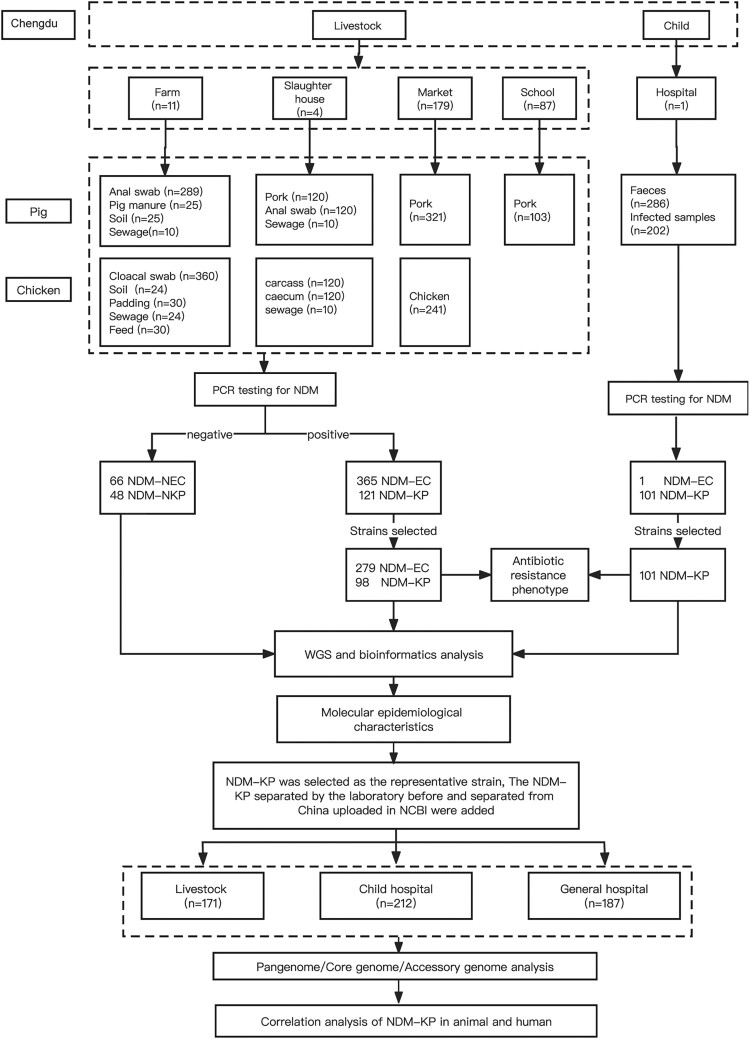
Figure 1.
Figure 1.
Schematic diagram of the research workflow.
Figure 2.
Figure 2.
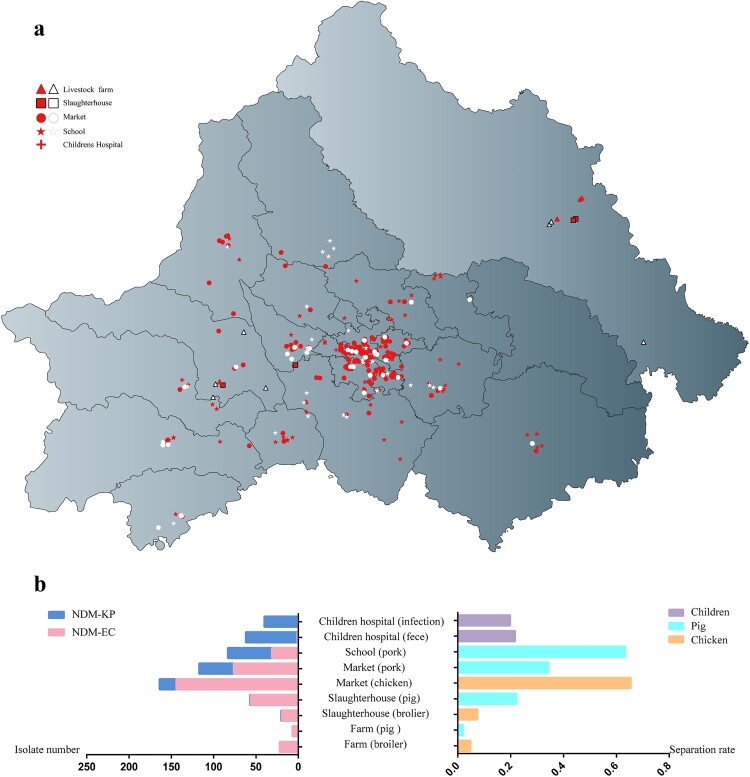
(a) Geographical distribution of farms, slaughterhouses, market, school and hospital collecting sample during from August 2020 to March 2021 in Chengdu, China. (b) Number of NDM-KP and NDM-EC isolates (left) and separation rate of blaNDM positive samples (right) in different procedures of food chain and children's hospital.
Figure 3.
Figure 3.
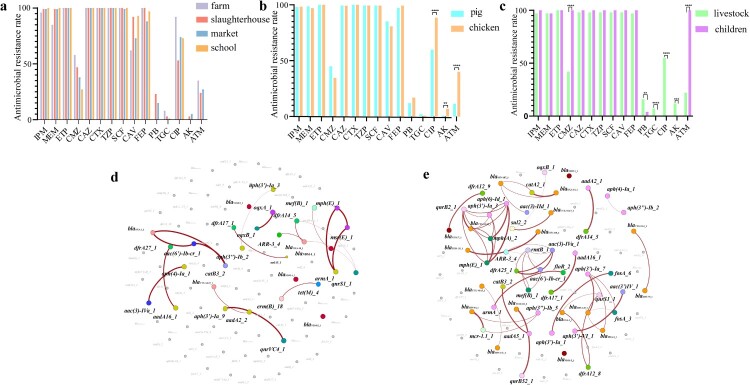
(a) Comparison of antimicrobial resistance rates for NDM-EC along the livestock breeding–slaughtering–retail chains. (b) Comparison of antimicrobial resistance rates for NDM-EC in pigs and chickens. (c) Comparison of antimicrobial resistance rates for NDM-KP in livestock and children. (d) Coexistence network of ARGs in NDM-EC from livestock. (e) Coexistence network of ARGs in NDM-KP from livestock.
Figure 4.
Figure 4.
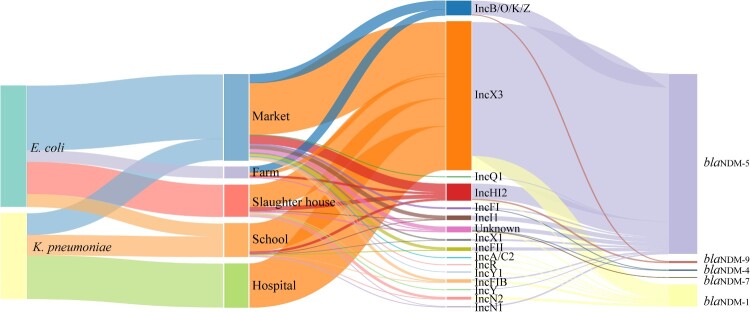
The distribution and linkages among isolate species, isolate sources, blaNDM-carrying plasmid types and NDM protein subtypes.
Figure 5.
Figure 5.
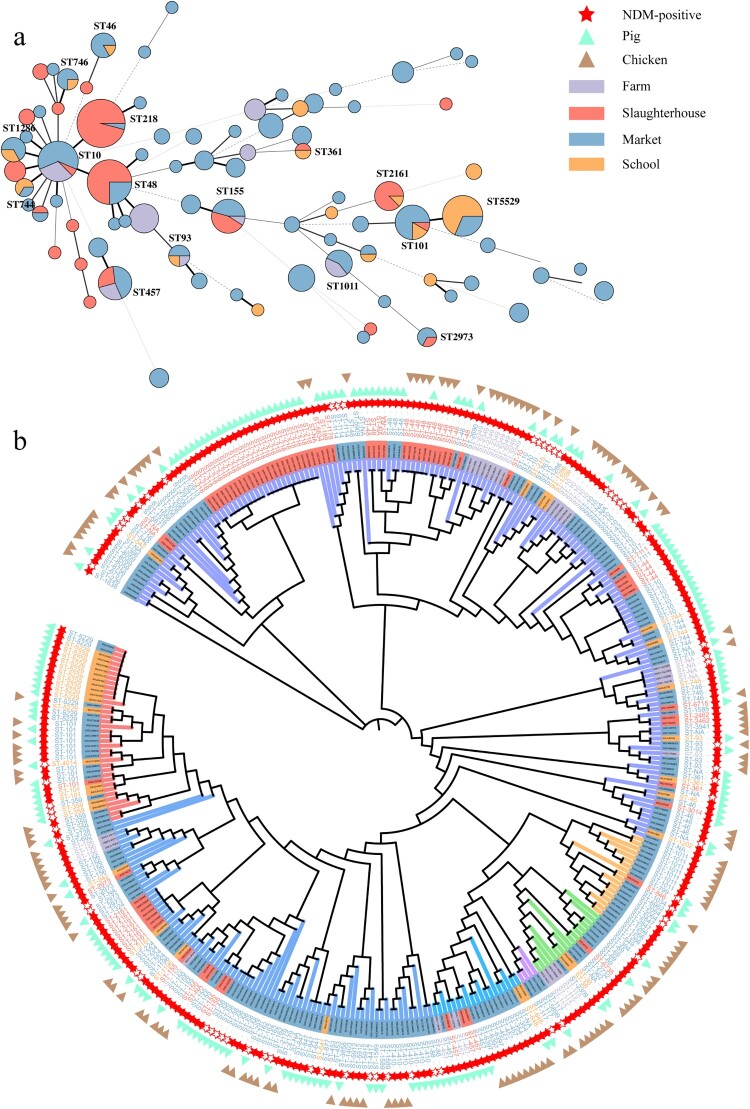
(a) MLST of NDM-CRE from livestock sources. (b) Phylogenic tree of E. coli from livestock based on core-genome SNPs.
Figure 6.
Figure 6.
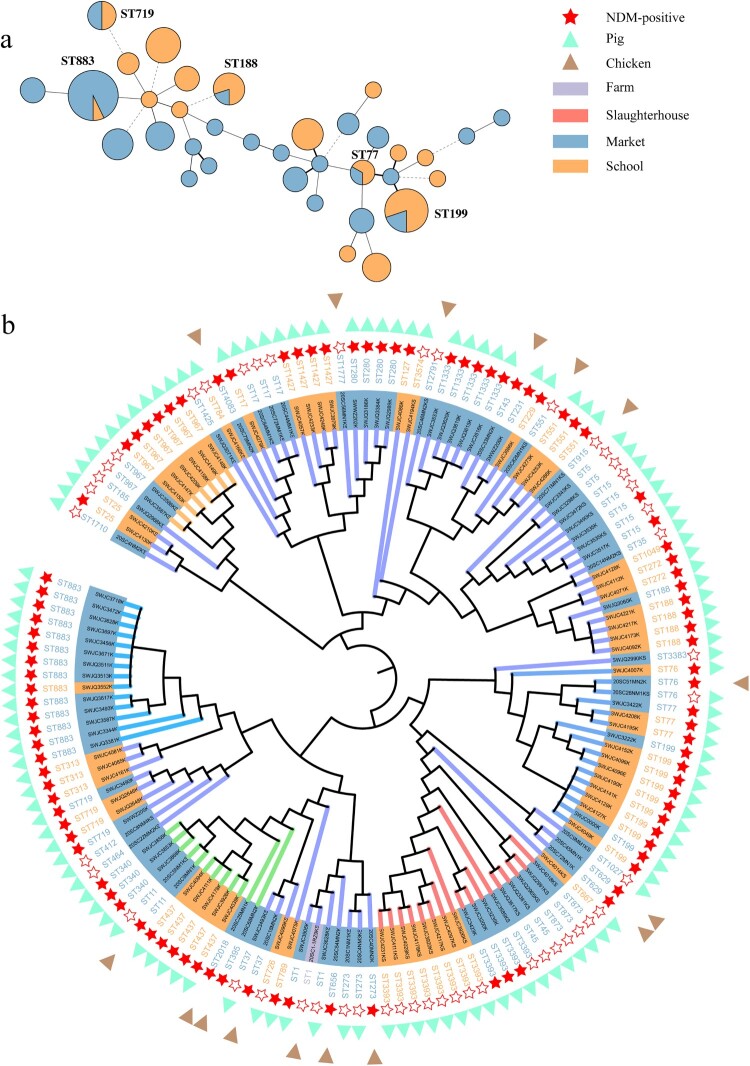
(a) MLST of NDM-KP from livestock sources. (b) Phylogenic tree of K. pneumoniae from livestock based on core-genome SNPs.
Figure 7.
Figure 7.
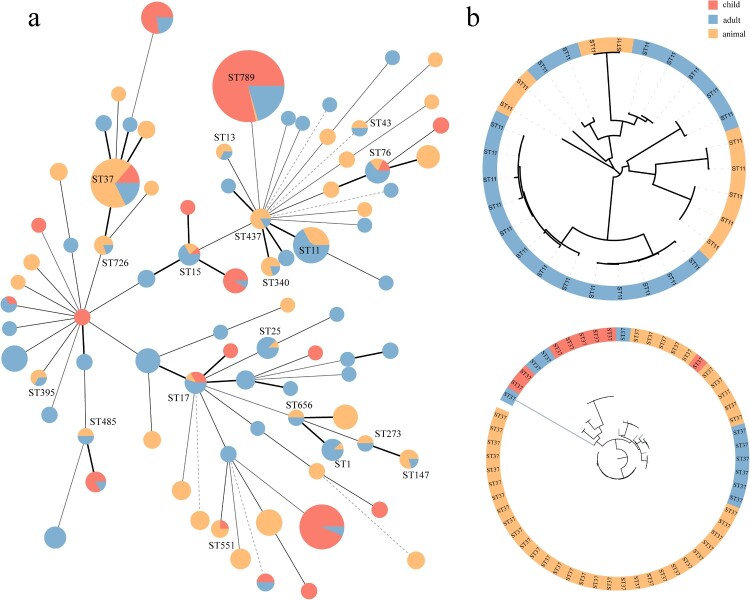
(a) MLST of NDM-KP from livestock, child and adult sources. (b) Phylogenic tree of NDM-KP ST11 and ST37 based on core-genome SNPs.

References

    1. Guh AY, Bulens SN, Mu Y, et al. . Epidemiology of carbapenem-resistant Enterobacteriaceae in 7 US communities, 2012-2013. JAMA. 2015;314:1479–1487. doi:10.1001/jama.2015.12480 - DOI - PMC - PubMed
    1. Fu B, Yin D, Sun C, et al. . Clonal and horizontal transmission of blaNDM among Klebsiella pneumoniae in children’s intensive care units. Microbiol Spectr. 2022;10:e01574–21. - PMC - PubMed
    1. David S, Reuter S, Harris SR, et al. . Epidemic of carbapenem-resistant Klebsiella pneumoniae in Europe is driven by nosocomial spread. Nat Microbiol. 2019;4:1919–1929. doi:10.1038/s41564-019-0492-8 - DOI - PMC - PubMed
    1. Köck R, Daniels-Haardt I, Becker K, et al. . Carbapenem-resistant Enterobacteriaceae in wildlife, food-producing, and companion animals: a systematic review. Clin Microbiol Infect. 2018;24:1241–1250. doi:10.1016/j.cmi.2018.04.004 - DOI - PubMed
    1. Wang Y, Zhang R, Li J, et al. . Comprehensive resistome analysis reveals the prevalence of NDM and MCR-1 in Chinese poultry production. Nat Microbiol. 2017;2:16260. doi:10.1038/nmicrobiol.2016.260 - DOI - PubMed