


Development of the Squaramide Scaffold for High Potential and Multielectron Catholytes for Use in Redox Flow Batteries
- PMID: 38629752
- PMCID: PMC11066874
- DOI: 10.1021/jacs.3c14776
Development of the Squaramide Scaffold for High Potential and Multielectron Catholytes for Use in Redox Flow Batteries
Abstract
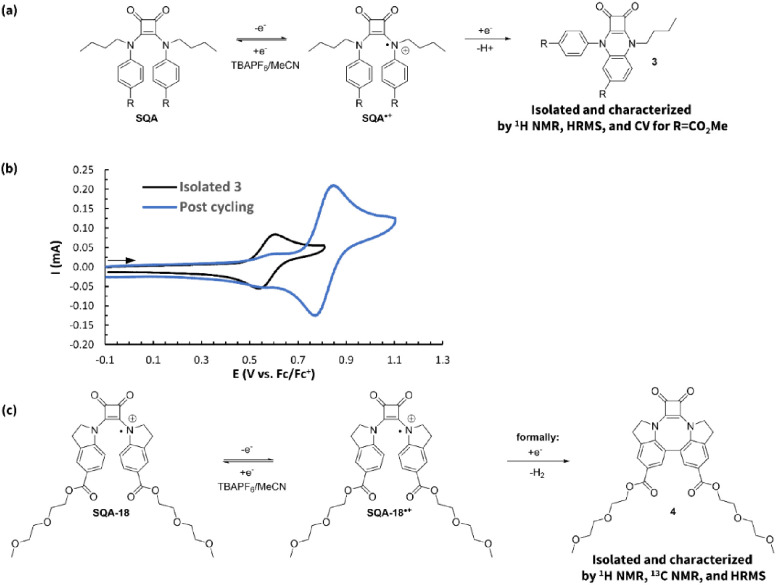
Nonaqueous organic redox flow batteries (N-ORFBs) are a promising technology for grid-scale storage of energy generated from intermittent renewable sources. Their primary benefit over traditional aqueous RFBs is the wide electrochemical stability window of organic solvents, but the design of catholyte materials, which can exploit the upper range of this window, has proven challenging. We report herein a new class of N-ORFB catholytes in the form of squaric acid quinoxaline (SQX) and squaric acid amide (SQA) materials. Mechanistic investigation of decomposition in battery-relevant conditions via NMR, HRMS, and electrochemical methods enabled a rational design approach to optimizing these scaffolds. Three lead compounds were developed: a highly stable one-electron SQX material with an oxidation potential of 0.51 V vs Fc/Fc+ that maintained 99% of peak capacity after 102 cycles (51 h) when incorporated into a 1.58 V flow battery; a high-potential one-electron SQA material with an oxidation potential of 0.81 V vs Fc/Fc+ that demonstrated negligible loss of redox active material as measured by pre- and postcycling CV peak currents when incorporated in a 1.63 V flow battery for 110 cycles over 29 h; and a proof-of-concept two-electron SQA catholyte material with oxidation potentials of 0.48 and 0.85 V vs Fc/Fc+ that demonstrated a capacity fade of just 0.56% per hour during static H-cell cycling. These findings expand the previously reported space of high-potential catholyte materials and showcase the power of mechanistically informed synthetic design for N-ORFB materials development.
Conflict of interest statement
The authors declare no competing financial interest.
Figures




References
-
- Calvin K.; Dasgupta D.; Krinner G.; Mukherji A.; Thorne P. W.; Trisos C.; Romero J.; Aldunce P.; Barrett K.; Blanco G., et al. IPCC, 2023: Climate Change 2023: Synthesis Report. Contribution of Working Groups I, II and III to the Sixth Assessment Report of the Intergovernmental Panel on Climate Change. In First Intergovernmental Panel on Climate Change (IPCC), The Core Writing Team Lee H.; Romero J., Eds.; IPCC: Geneva, Switzerland, 2023.
-
- Technical Summary. In Climate Change 2022 - Mitigation of Climate Change; Intergovernmental Panel on Climate Change (IPCC), The Core Writing Team; Lee H.; Romero J., Eds.; Cambridge University Press, 2023; pp. 51–148..
-
- Luz T.; Moura P. 100% Renewable Energy Planning with Complementarity and Flexibility Based on a Multi-Objective Assessment. Appl. Energy 2019, 255, 113819. 10.1016/j.apenergy.2019.113819. - DOI
-
- Jafari M.; Botterud A.; Sakti A. Decarbonizing Power Systems: A Critical Review of the Role of Energy Storage. Renew. Sustainable Energy Rev. 2022, 158, 112077. 10.1016/j.rser.2022.112077. - DOI
-
- Teleke S.; Baran M. E.; Bhattacharya S.; Huang A. Q. Rule-Based Control of Battery Energy Storage for Dispatching Intermittent Renewable Sources. IEEE Trans. Sustainable Energy 2010, 1, 117–124. 10.1109/TSTE.2010.2061880. - DOI
