


Profiles of intuitive eating in adults: the role of self-esteem, interoceptive awareness, and motivation for healthy eating
- PMID: 38632564
- PMCID: PMC11022488
- DOI: 10.1186/s12888-024-05722-2
Profiles of intuitive eating in adults: the role of self-esteem, interoceptive awareness, and motivation for healthy eating
Abstract
Objective: Intuitive eating is an eating behavior that has recently come to use mainly in the young population. Knowing that the Lebanese cultural diet differs from other countries, the purpose of this study was to investigate if there is a relationship between self-esteem, interoceptive awareness, and motivation for healthy eating in a sample of Lebanese adults using a Latent Profile Analysis approach.
Design: Cross-sectional study.
Setting: Lebanese governorates.
Participants: 359 Lebanese participants enrolled in this study (mean age: 22.75 ± 7.04 years, 40.1% males), through convenience sampling in several Lebanese governorates. Participants were asked to fill anonymously the following scales: The Intuitive Eating Scale (IES-2), the Rosenberg Self-Esteem Scale, the Multidimensional Assessment of Interoceptive Awareness Scale (MAIA), and the Motivation for Healthy Eating Scale (MHES).
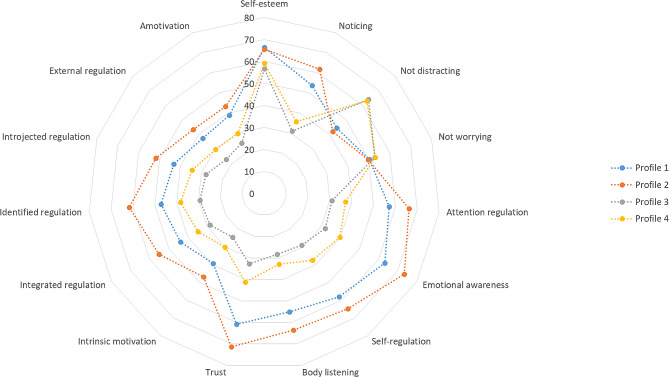
Results: Our findings revealed four profiles: profile 1 (n = 67; 18.66%) characterized by high SE and intermediate interoceptive awareness and motivation for healthy eating; profile 2 (n = 86; 23.97%) presented high SE, interoceptive awareness, and motivation for healthy eating; profile 3 (n = 86; 23.96%) characterized by high SE, interoceptive awareness, and motivation for healthy eating; class 4 (n = 108; 30.08) described by low SE, intermediate interoceptive awareness, and motivation for healthy eating One-way analysis of variance did not observe a significant difference between the four profiles based on intuitive eating (F = 1.810; p = 0.145; ɳp2 = 0.015).
Conclusions: Among a sample of Lebanese people, four profiles of interoceptive awareness, motivation for healthy eating, and self-esteem were observed, with no difference concerning intuitive eating.
Keywords: Healthy eating; Interoceptive awareness; Intuitive eating; Latent profile analysis; Self-esteem.
© 2024. The Author(s).
Conflict of interest statement
The authors have no competing/conflict of interest to declare.
Figures
References
-
- Hazzard VM, Telke SE, Simone M, Anderson LM, Larson NI, Neumark-Sztainer D. Intuitive eating longitudinally predicts better psychological health and lower use of disordered eating behaviors: findings from EAT 2010–2018. Eat Weight Disorders. 2021;26(1):287–94. doi: 10.1007/s40519-020-00852-4. - DOI - PMC - PubMed
MeSH terms
Supplementary concepts
LinkOut - more resources
Full Text Sources
