


Health impacts of a cold wave and its economic loss assessment in China's high-altitude city, Xining
- PMID: 38632636
- PMCID: PMC11025205
- DOI: 10.1186/s13690-024-01284-7
Health impacts of a cold wave and its economic loss assessment in China's high-altitude city, Xining
Abstract
Objective: Amidst climate change, extensive research has centered on the health impacts of heatwaves, yet the consequences of cold spells, particularly in cooler, higher-altitude regions, remain under-explored.
Methods: Analyzing climatic data and non-accidental mortality in Xining, China's second-highest provincial capital, from 2016 to 2020, this study defines cold spells as daily mean temperatures below the 10th, 7.5th, or 5th percentiles for 2-4 consecutive days. A time-stratified case-crossover approach and distributional lag nonlinear modeling were used to assess the link between cold spells and mortality, calculating attributable fractions (AFs) and numbers (ANs) of deaths. The study also examined the impact of cold spells over different periods and analyzed the value of a statistical life (VSL) loss in 2018, a year with frequent cold spells. Stratified analyses by sex, age, and education level were conducted.
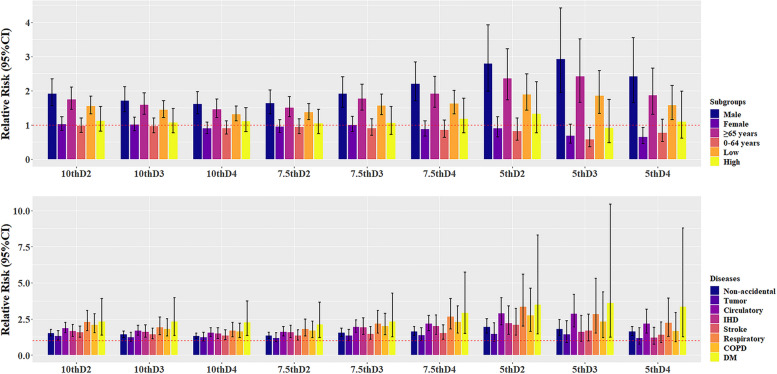
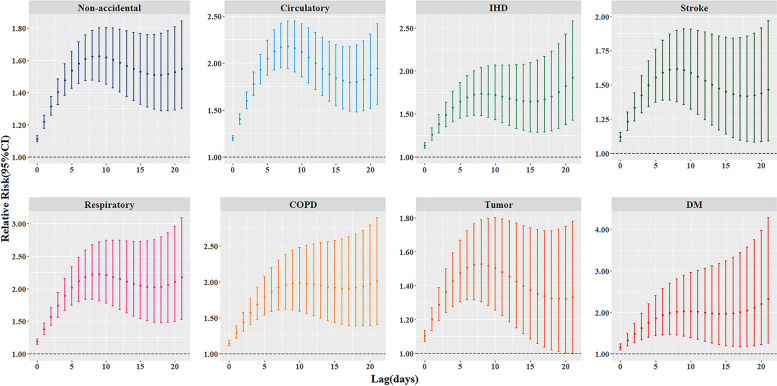
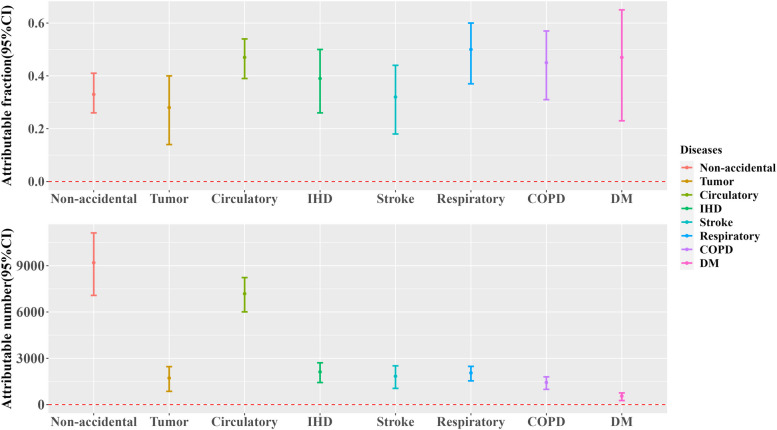
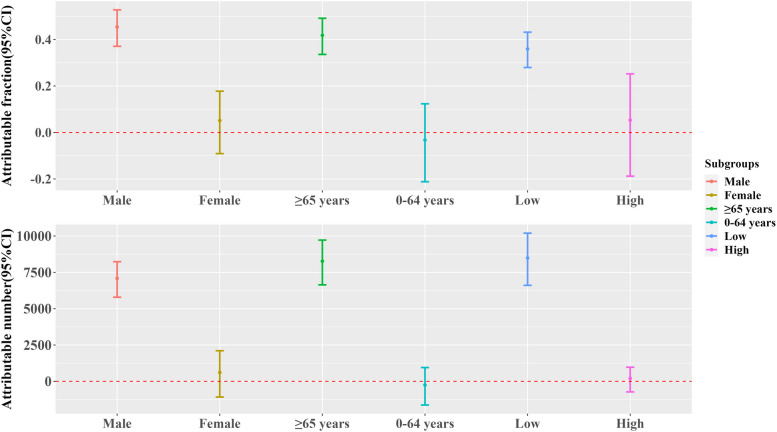
Results: A significant association was found between cold spells and non-accidental mortality, with a relative risk of 1.548 (95% CI: 1.300, 1.845). The AF was 33.48%, with an AN of 9,196 deaths during the study's cold period. A declining trend in mortality risk was observed from 2019-2020. The 2018 VSL was approximately 2.875 billion CNY, about 1.75% of Xining's GDP. Higher risks were noted among males, individuals aged ≥ 65, and those with lower education levels.
Conclusion: The findings underscore the vulnerability and economic losses of high-altitude cities to cold spells. Implementing interventions such as improved heating, educational programs, and community support is vital for mitigating these adverse health effects.
Keywords: Climate change; Cold spell; Non-accidental mortality; VSL; health risk.
© 2024. The Author(s).
Conflict of interest statement
The authors declare no competing interests.
Figures
References
-
- Burkart KG, Brauer M, Aravkin AY, Godwin WW, Hay SI, He J, Iannucci VC, Larson SL, Lim SS, Liu J, Murray CJL, Zheng P, Zhou M, Stanaway JD. Estimating the cause-specific relative risks of non-optimal temperature on daily mortality: a two-part modelling approach applied to the Global Burden of Disease Study. Lancet. 2021;398(10301):685–697. doi: 10.1016/s0140-6736(21)01700-1. - DOI - PMC - PubMed
-
- Liu J, Liu T, Burkart KG, Wang H, He G, Hu J, Xiao J, Yin P, Wang L, Liang X, Zeng F, Stanaway JD, Brauer M, Ma W, Zhou M. Mortality burden attributable to high and low ambient temperatures in China and its provinces: Results from the Global Burden of Disease Study 2019. The Lancet Regional Health - Western Pacific. 2022;24:100493. doi: 10.1016/j.lanwpc.2022.100493. - DOI - PMC - PubMed
LinkOut - more resources
Full Text Sources
