


Macrolide resistance of Mycoplasma pneumoniae in several regions of China from 2013 to 2019
- PMID: 38634450
- PMCID: PMC11094376
- DOI: 10.1017/S0950268824000323
Macrolide resistance of Mycoplasma pneumoniae in several regions of China from 2013 to 2019
Abstract
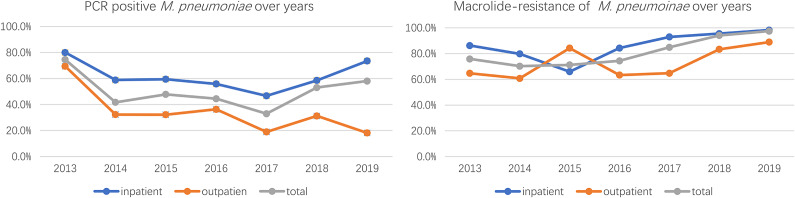
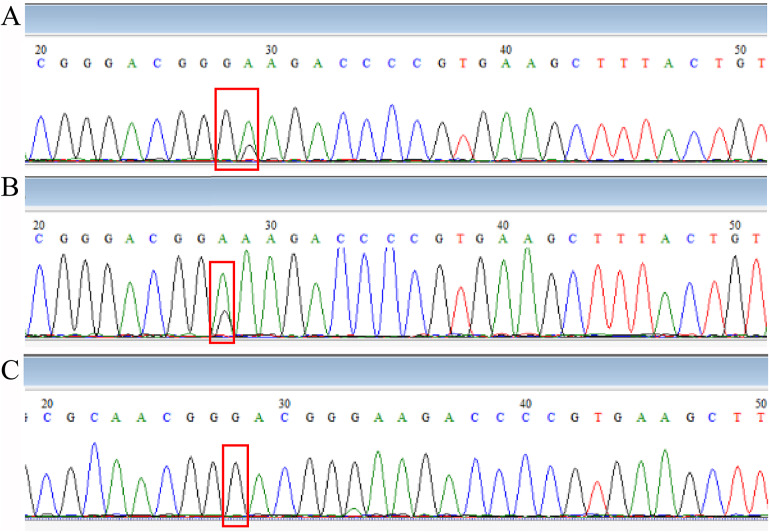
This paper retrospectively analysed the prevalence of macrolide-resistant Mycoplasma pneumoniae (MRMP) in some parts of China. Between January 2013 and December 2019, we collected 4,145 respiratory samples, including pharyngeal swabs and alveolar lavage fluid. The highest PCR-positive rate of M. pneumoniae was 74.5% in Beijing, the highest resistance rate was 100% in Shanghai, and Gansu was the lowest with 20%. The highest PCR-positive rate of M. pneumoniae was 74.5% in 2013, and the highest MRMP was 97.4% in 2019; the PCR-positive rate of M. pneumoniae for adults in Beijing was 17.9% and the MRMP was 10.48%. Among the children diagnosed with community-acquired pneumonia (CAP), the PCR-positive and macrolide-resistant rates of M. pneumoniae were both higher in the severe ones. A2063G in domain V of 23S rRNA was the major macrolide-resistant mutation, accounting for more than 90%. The MIC values of all MRMP to erythromycin and azithromycin were ≥ 64 μg/ml, and the MICs of tetracycline and levofloxacin were ≤ 0.5 μg/ml and ≤ 1 μg/ml, respectively. The macrolide resistance varied in different regions and years. Among inpatients, the macrolide-resistant rate was higher in severe pneumonia. A2063G was the common mutation, and we found no resistance to tetracycline and levofloxacin.
Keywords: Mycoplasma pneumoniae; clinical features; drug-resistant; epidemic; macrolide.
Conflict of interest statement
The authors declare that the research was conducted in the absence of any commercial or financial relationships that could be construed as a potential conflict of interest.
Figures
Similar articles
-
Macrolide-Resistant Mycoplasma pneumoniae in the United States as Determined from a National Surveillance Program.J Clin Microbiol. 2019 Oct 23;57(11):e00968-19. doi: 10.1128/JCM.00968-19. Print 2019 Nov. J Clin Microbiol. 2019. PMID: 31484701 Free PMC article.
-
[Survey of macrolide resistance in Mycoplasma pneumoniae in adult patients with community-acquired pneumonia in Beijing, China].Zhonghua Jie He He Hu Xi Za Zhi. 2013 Dec;36(12):954-8. Zhonghua Jie He He Hu Xi Za Zhi. 2013. PMID: 24503430 Chinese.
-
Prevalence and Clinical Features of Community-Acquired Pneumonia Caused by Macrolide-Resistant Mycoplasma pneumoniae Isolated from Adults in Jeju Island.Microb Drug Resist. 2019 May;25(4):577-581. doi: 10.1089/mdr.2018.0295. Epub 2018 Nov 28. Microb Drug Resist. 2019. PMID: 30484744
-
Expert consensus on the diagnosis and treatment of macrolide-resistant Mycoplasma pneumoniae pneumonia in children.World J Pediatr. 2024 Sep;20(9):901-914. doi: 10.1007/s12519-024-00831-0. Epub 2024 Aug 14. World J Pediatr. 2024. PMID: 39143259 Free PMC article. Review.
-
Overview of antimicrobial options for Mycoplasma pneumoniae pneumonia: focus on macrolide resistance.Clin Respir J. 2017 Jul;11(4):419-429. doi: 10.1111/crj.12379. Epub 2015 Oct 13. Clin Respir J. 2017. PMID: 26365811 Review.
Cited by
-
Macrolide resistance in Mycoplasma pneumoniae in adult patients.Front Cell Infect Microbiol. 2025 Mar 4;15:1496521. doi: 10.3389/fcimb.2025.1496521. eCollection 2025. Front Cell Infect Microbiol. 2025. PMID: 40166372 Free PMC article.
-
Case Report: Positive Mycoplasma pneumoniae IgM does not necessarily indicate acute infection: two case studies.Front Pediatr. 2025 May 30;13:1520021. doi: 10.3389/fped.2025.1520021. eCollection 2025. Front Pediatr. 2025. PMID: 40519549 Free PMC article.
-
Case Report: A neonatal case of severe congenital Mycoplasma pneumoniae pneumonia with atelectasis and macrolide resistance.Front Pediatr. 2025 Jun 11;13:1561097. doi: 10.3389/fped.2025.1561097. eCollection 2025. Front Pediatr. 2025. PMID: 40567524 Free PMC article.
-
Compassionate Use of Omadacycline in a Down Syndrome Pre-Schooler With Critically Ill Atypical Pneumonia Caused by Macrolide-Resistant Mycoplasma Pneumoniae.Infect Drug Resist. 2025 Jan 21;18:391-400. doi: 10.2147/IDR.S500982. eCollection 2025. Infect Drug Resist. 2025. PMID: 39867285 Free PMC article.
-
Characterizing the epidemiology of Mycoplasma pneumoniae infections in China in 2022-2024: a nationwide cross-sectional study of over 1.6 million cases.Emerg Microbes Infect. 2025 Dec;14(1):2482703. doi: 10.1080/22221751.2025.2482703. Epub 2025 Apr 6. Emerg Microbes Infect. 2025. PMID: 40146610 Free PMC article.
References
-
- Waites KB and Atkinson TP (2009) The role of mycoplasma in upper respiratory infections. Current Infectious Disease Reports 11(3), 198–206. - PubMed
-
- Edelstein IA, Ivanova OV, Romashov OI and Kozlov RS (2023) Course of lower respiratory tract infection in young people treated at the military Hospital of Smolensk Garrison with detected mycoplasma pneumoniae carrying a macrolide-resistant mutation in 23S rRNA gene. Pathogens 12(1), 103. - PMC - PubMed
Publication types
MeSH terms
Substances
Grants and funding
LinkOut - more resources
Full Text Sources
Medical
Miscellaneous
