


Wallace's line structures seagrass microbiota and is a potential barrier to the dispersal of marine bacteria
- PMID: 38637894
- PMCID: PMC11027274
- DOI: 10.1186/s40793-024-00568-3
Wallace's line structures seagrass microbiota and is a potential barrier to the dispersal of marine bacteria
Abstract
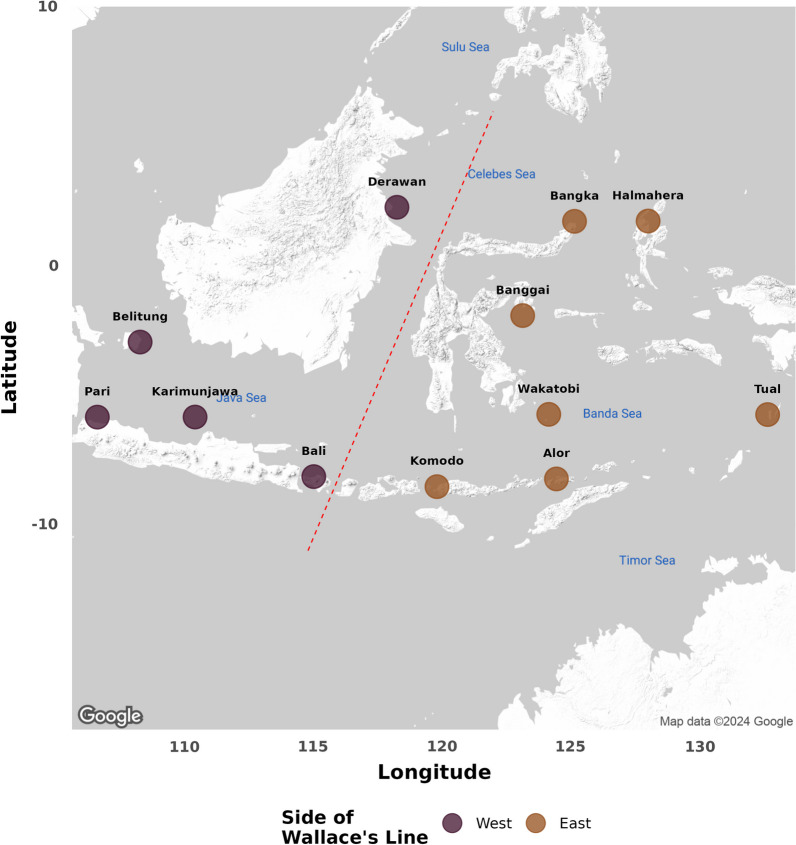
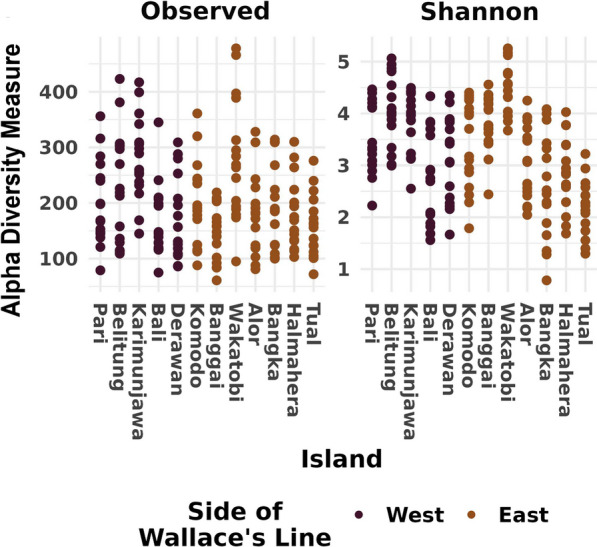
Background: The processes that shape microbial biogeography are not well understood, and concepts that apply to macroorganisms, like dispersal barriers, may not affect microorganisms in the same predictable ways. To better understand how known macro-scale biogeographic processes can be applied at micro-scales, we examined seagrass associated microbiota on either side of Wallace's line to determine the influence of this cryptic dispersal boundary on the community structure of microorganisms. Communities were examined from twelve locations throughout Indonesia on either side of this theoretical line.
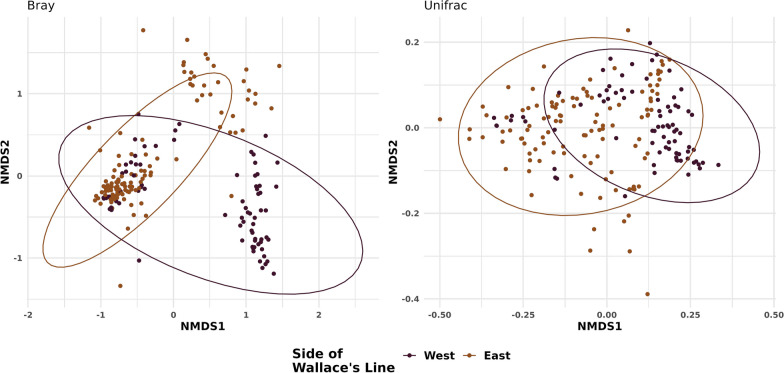
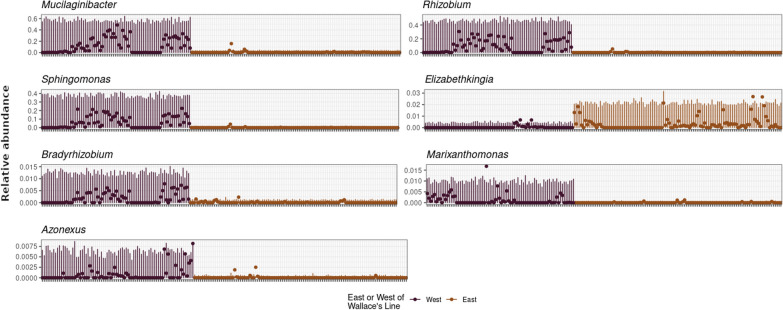
Results: We found significant differences in microbial community structure on either side of this boundary (R2 = 0.09; P = 0.001), and identified seven microbial genera as differentially abundant on either side of the line, six of these were more abundant in the West, with the other more strongly associated with the East. Genera found to be differentially abundant had significantly smaller minimum cell dimensions (GLM: t923 = 59.50, P < 0.001) than the overall community.
Conclusion: Despite the assumed excellent dispersal ability of microbes, we were able to detect significant differences in community structure on either side of this cryptic biogeographic boundary. Samples from the two closest islands on opposite sides of the line, Bali and Komodo, were more different from each other than either was to its most distant island on the same side. We suggest that limited dispersal across this barrier coupled with habitat differences are primarily responsible for the patterns observed. The cryptic processes that drive macroorganism community divergence across this region may also play a role in the bigeographic patterns of microbiota.
Keywords: Marine biogeography; Metabarcoding; Microbial dispersal; Microbiome; Seagrass; Wallace’s line.
© 2024. The Author(s).
Conflict of interest statement
The authors declare no competing interests.
Figures
References
-
- Wallace AR. On the physical geography of the Malay Archipelago. J R Geograph Soc London. 1863;33:217–234. doi: 10.2307/1798448. - DOI
-
- Huxley T. On the classification and distribution of the Alectoromorphae and Heteromorphae. 33:217–34. (1863)
-
- Ali JR, Aitchison JC, Meiri S. Redrawing Wallace’s Line based on the fauna of Christmas Island, eastern Indian Ocean. Biol J Lin Soc. 2020;130:225–237. doi: 10.1093/biolinnean/blaa018. - DOI
LinkOut - more resources
Full Text Sources