


Exploring adolescent mental health during the COVID-19 crisis - strengths and difficulties
- PMID: 38638467
- PMCID: PMC11024382
- DOI: 10.3389/fpubh.2024.1357766
Exploring adolescent mental health during the COVID-19 crisis - strengths and difficulties
Abstract
Introduction: The SARS-CoV-2 pandemic has significantly impacted children and adolescents, leading to mental health challenges. Knowledge on their resources and difficulties is crucial and there is a need for valid instruments to assess their psychosocial condition especially in this exceptional situation. We assessed psychopathological symptoms using the SDQ during the pandemic, comparing to pre-pandemic data. Our study aims to understand adolescents' strengths and difficulties amidst COVID-19, evaluating the SDQ's utility in crisis settings.
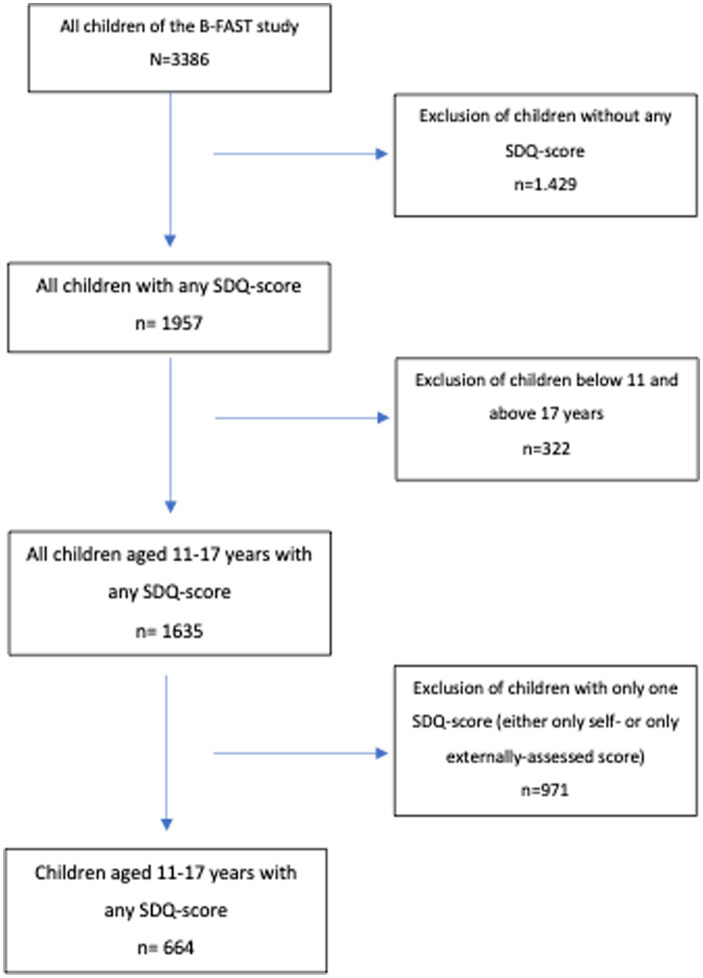
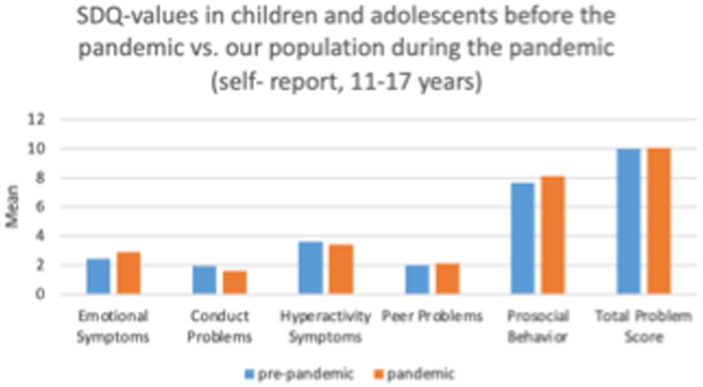
Methods: Within the German school-based surveillance study ("B-Fast"), we assessed behavioral strengths and difficulties in 664 adolescents aged 11-17 years during the peak of the German COVID-19 pandemic using the validated Strengths and Difficulties Questionnaire (SDQ) for both external and self-assessed data collection. Data were collected between November 2020 and April 2021. We compared self-assessed SDQ-scores to pre-pandemic data from a comparable sample and examined adolescent classification as "normal" or "borderline/abnormal" based on both external and self-assessed SDQ subscale scores using established cut-off values. Additionally, we conducted sex and rater-based score comparisons.
Results: In our study, we observed a significant worsening of "Emotional Symptoms" compared to pre-pandemic levels, while "Conduct Problems" and "Prosocial Behavior" showed improvement. Variations in classification to "normal" and "abnormal" emerged when applying German versus British cut-off values. Females scored higher on "Emotional Symptoms" while males scored higher on "Hyperactivity Symptoms." Correlations between external and self-assessed SDQ ratings ranged from 0.43 (p < 0.001) for "Prosocial Behavior" among girls to 0.62 (p < 0.001) for "Peer Problems" among boys, indicating moderate to high consistency.
Discussion/conclusion: Our study contributes to understanding the psychosocial impact of the COVID-19 pandemic on German adolescents. Compared to other symptoms, we observed a particular worsening in "Emotional Symptoms" based on our data. Despite the moderate correlation between parental and self-reported evaluations, there appears to be a certain discrepancy in the perception of adolescent quality of life. Therefore, it seems prudent to assess both the external and self-reported evaluations and amalgamate the results from both parties to obtain a comprehensive problem profile of the individual. These findings underscore the importance of using country-specific cutoff values and reaffirm the utility of the SDQ as a valuable assessment tool, even within the unique circumstances posed by a pandemic.
Keywords: COVID-19 pandemic; SDQ-questionnaire; adolescents; crisis; mental health; mental health assessment.
Copyright © 2024 Loy, Klam, Dötsch, Frank and Bender.
Conflict of interest statement
The authors declare that the research was conducted in the absence of any commercial or financial relationships that could be construed as a potential conflict of interest. The author(s) declared that they were an editorial board member of Frontiers, at the time of submission. This had no impact on the peer review process and the final decision.
Figures
References
Publication types
MeSH terms
LinkOut - more resources
Full Text Sources
Medical
Miscellaneous
