


Comparison of Clinical and Radiological Outcomes Between Different (Balloon) Guide Catheter With and Without Inflated Balloon in Acute Ischemic Stroke Patients: A MaSQ-Registry Study
- PMID: 38639780
- PMCID: PMC11239717
- DOI: 10.1007/s00270-024-03718-9
Comparison of Clinical and Radiological Outcomes Between Different (Balloon) Guide Catheter With and Without Inflated Balloon in Acute Ischemic Stroke Patients: A MaSQ-Registry Study
Abstract
Purpose: Balloon guide catheters (BGCs) are used in endovascular treatment (EVT) for ischemic stroke. Previous literature did not distinguish between BGC use with and without inflated balloon. This study aims to compare outcomes between non-BCG and BGC use with and without inflated balloon during EVT.
Methods: Patients who underwent EVT for anterior circulation ischemic stroke between September 2020 and February 2023 were analyzed. Patients were divided into three groups: non-BGC, BGC with inflated balloon, or BGC without inflated balloon. The primary outcome was the ordinal modified Rankin Scale (mRS) at 90-day follow-up. Secondary outcomes included expanded Thrombolysis In Cerebral Ischemia score (eTICI) and periprocedural complications. Regression analyses with BGC with inflated balloon as comparator were performed with adjustments. Subgroup analyses were conducted based on first-line thrombectomy technique.
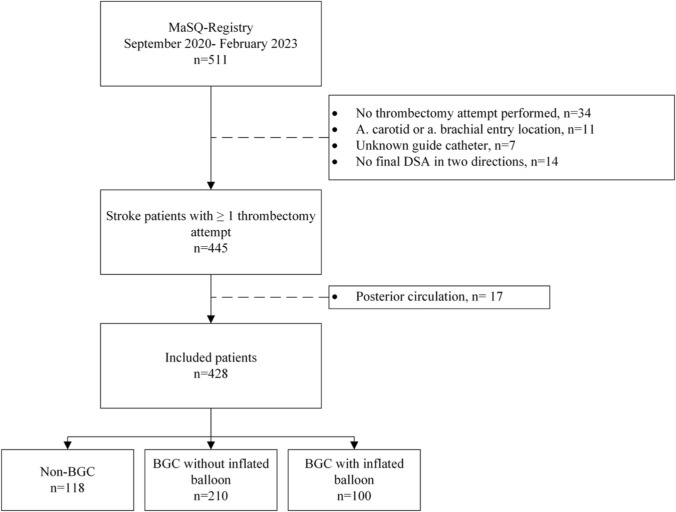
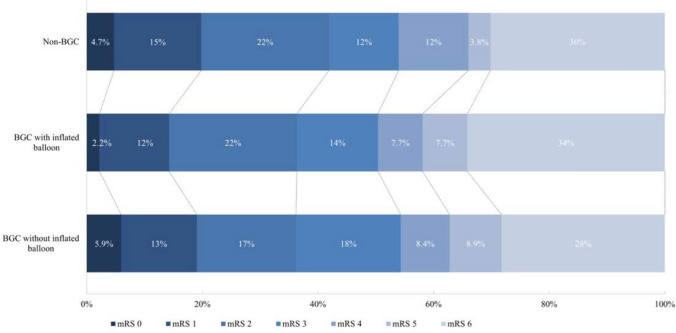
Results: Out of 511 patients, 428 patients were included. Compared to BCG with inflated balloon, the mRS at 90 days did not differ in the group without inflated balloon (adjusted common [ac]OR: 1.07, 95%CI 0.67-1.73) or non-BGC (acOR: 1.42, 95%CI 0.83-2.42). Compared to patients treated with a BGC with inflated balloon, those treated with BGC without inflated balloon had lower eTICI scores (acOR: 0.59, 95%CI 0.37-0.94), and patients treated with non-BGC had lower chances of periprocedural complications (aOR: 0.41, 95%CI 0.20-0.86).
Conclusions: This study shows no clinical differences in ischemic stroke patients treated with BGC with inflated balloon compared to non-BGC and BGC without inflated balloon, despite lower periprocedural complication rates in the non-BGC group and lower eTICI scores in the BGC without inflated balloon group.
Level of evidence: Level 3, non-controlled retrospective cohort study.
Keywords: Acute ischemic stroke (AIS); Balloon guide catheter (BGC); Endovascular treatment (EVT); Stroke.
© 2024. The Author(s).
Conflict of interest statement
WHvZ reports speaker fees from Stryker, Cerenovus, and Nicolab, and consulting fees from Philips (all paid to institution); participated in the advisory boards of WeTrust (Philips) and ANAIS (Anaconda) (all paid to institution); and participated in the advisory boards of InEcxtremis (CHU Montpellier, Montpellier, France) and DISTAL (University Hospital Basel, Basel, Switzerland), studies for which no payments were received. All other authors declare no competing interests.
Figures
References
-
- Schonfeld MH, Kabiri R, Kniep HC, Meyer L, McDonough R, Sedlacik J, Ernst M, Broocks G, Faizy T, Schon G, et al. Effect of balloon guide catheter utilization on the incidence of sub-angiographic peripheral emboli on high-resolution DWI after thrombectomy: a prospective observational study. Front Neurol. 2020;11:386. doi: 10.3389/fneur.2020.00386. - DOI - PMC - PubMed
Publication types
MeSH terms
LinkOut - more resources
Full Text Sources
Medical
Research Materials
