


Atherosclerotic burden and cerebral small vessel disease: exploring the link through microvascular aging and cerebral microhemorrhages
- PMID: 38639833
- PMCID: PMC11336042
- DOI: 10.1007/s11357-024-01139-7
Atherosclerotic burden and cerebral small vessel disease: exploring the link through microvascular aging and cerebral microhemorrhages
Abstract
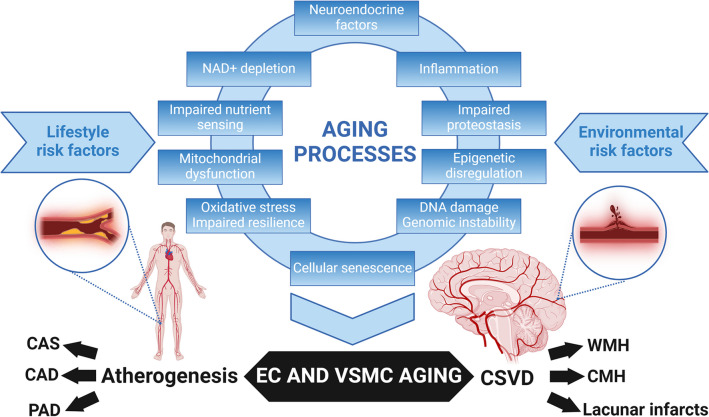
Cerebral microhemorrhages (CMHs, also known as cerebral microbleeds) are a critical but frequently underestimated aspect of cerebral small vessel disease (CSVD), bearing substantial clinical consequences. Detectable through sensitive neuroimaging techniques, CMHs reveal an extensive pathological landscape. They are prevalent in the aging population, with multiple CMHs often being observed in a given individual. CMHs are closely associated with accelerated cognitive decline and are increasingly recognized as key contributors to the pathogenesis of vascular cognitive impairment and dementia (VCID) and Alzheimer's disease (AD). This review paper delves into the hypothesis that atherosclerosis, a prevalent age-related large vessel disease, extends its pathological influence into the cerebral microcirculation, thereby contributing to the development and progression of CSVD, with a specific focus on CMHs. We explore the concept of vascular aging as a continuum, bridging macrovascular pathologies like atherosclerosis with microvascular abnormalities characteristic of CSVD. We posit that the same risk factors precipitating accelerated aging in large vessels (i.e., atherogenesis), primarily through oxidative stress and inflammatory pathways, similarly instigate accelerated microvascular aging. Accelerated microvascular aging leads to increased microvascular fragility, which in turn predisposes to the formation of CMHs. The presence of hypertension and amyloid pathology further intensifies this process. We comprehensively overview the current body of evidence supporting this interconnected vascular hypothesis. Our review includes an examination of epidemiological data, which provides insights into the prevalence and impact of CMHs in the context of atherosclerosis and CSVD. Furthermore, we explore the shared mechanisms between large vessel aging, atherogenesis, microvascular aging, and CSVD, particularly focusing on how these intertwined processes contribute to the genesis of CMHs. By highlighting the role of vascular aging in the pathophysiology of CMHs, this review seeks to enhance the understanding of CSVD and its links to systemic vascular disorders. Our aim is to provide insights that could inform future therapeutic approaches and research directions in the realm of neurovascular health.
Keywords: Aging; Arteriosclerosis; Atherosclerosis; Blood–brain barrier; Leukoaraiosis; Microbleed; Peripheral artery disease; Stroke; Vascular dementia; White matter hyperintensities; White matter injury.
© 2024. The Author(s).
Conflict of interest statement
Dr. Anna Csiszar serves as Associate Editor for The Journal of Gerontology, Series A: Biological Sciences and Medical Sciences and GeroScience. Dr. Zoltan Ungvari serves as Editor-in-Chief for GeroScience and has personal relationships with individuals involved in the submission of this paper. Dr. Stefano Tarantini, Dr. Calin Prodan, Dr. Eric Liotta, Dr. Farzaneh Sorond, and Dr. Andriy Yabluchanskiy serve as Associate Editors for GeroScience.
Figures
References
-
- Rosenberg GA, Wallin A, Wardlaw JM, Markus HS, Montaner J, Wolfson L, Iadecola C, Zlokovic BV, Joutel A, Dichgans M, et al. Consensus statement for diagnosis of subcortical small vessel disease. J Cereb Blood Flow Metab. 2016;36:6–25. 10.1038/jcbfm.2015.172. 10.1038/jcbfm.2015.172 - DOI - PMC - PubMed
Publication types
MeSH terms
Grants and funding
LinkOut - more resources
Full Text Sources
Medical
