


Development of a Management App for Postviral Fibromyalgia-Like Symptoms: Patient Preference-Guided Approach
- PMID: 38639986
- PMCID: PMC11069091
- DOI: 10.2196/50832
Development of a Management App for Postviral Fibromyalgia-Like Symptoms: Patient Preference-Guided Approach
Abstract
Background: Persistent fibromyalgia-like symptoms have been increasingly reported following viral infections, including SARS-CoV-2. About 30% of patients with post-COVID-19 syndrome fulfill the fibromyalgia criteria. This complex condition presents significant challenges in terms of self-management. Digital health interventions offer a viable means to assist patients in managing their health conditions. However, the challenge of ensuring their widespread adoption and adherence persists. This study responds to this need by developing a patient-centered digital health management app, incorporating patient preferences to enhance usability and effectiveness, ultimately aiming to improve patient outcomes and quality of life.
Objective: This research aims to develop a digital health self-management app specifically for patients experiencing postviral fibromyalgia-like symptoms. By prioritizing patient preferences and engagement through the app's design and functionality, the study intends to facilitate better self-management practices and improve adherence.
Methods: Using an exploratory study design, the research used patient preference surveys and usability testing as primary tools to inform the development process of the digital health solution. We gathered and analyzed patients' expectations regarding design features, content, and usability to steer the iterative app development.
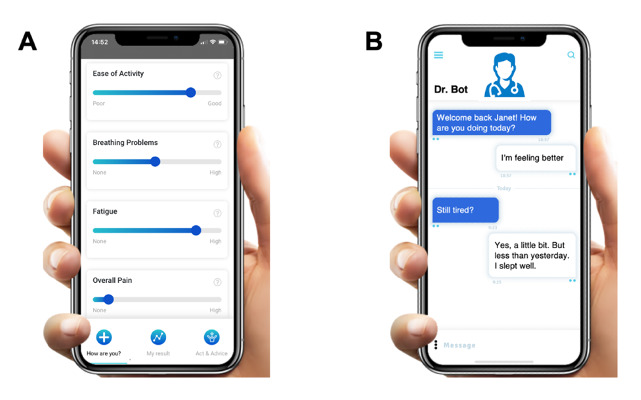
Results: The study uncovered crucial insights from patient surveys and usability testing, which influenced the app's design and functionality. Key findings included a preference for a symptom list over an automated chatbot, a desire to report on a moderate range of symptoms and activities, and the importance of an intuitive onboarding process. While usability testing identified some challenges in the onboarding process, it also confirmed the importance of aligning the app with patient needs to enhance engagement and satisfaction.
Conclusions: Incorporating patient feedback has been a significant factor in the development of the digital health app. Challenges encountered with user onboarding during usability testing have highlighted the importance of this process for user adoption. The study acknowledges the role of patient input in developing digital health technologies and suggests further research to improve onboarding procedures, aiming to enhance patient engagement and their ability to manage digital health resources effectively.
International registered report identifier (irrid): RR2-10.2196/32193.
Keywords: development; digital health; digital health solution; fibromyalgia; musculoskeletal; patient outcome; patient preference; patient-centricity; platform; quality of life; self-management; usability testing; user experience.
©Marc Blanchard, Cinja Nadana Koller, Pedro Ming Azevedo, Tiffany Prétat, Thomas Hügle. Originally published in JMIR Formative Research (https://formative.jmir.org), 19.04.2024.
Conflict of interest statement
Conflicts of Interest: MB and TH are shareholders and board members of ATREON SA. TH has also received speaker fees and unsrestricted grants from Pfizer, Novartis, BMS, GSK, Galapagos and Roche.
Figures
References
-
- Vernon SD, Whistler T, Cameron B, Hickie IB, Reeves WC, Lloyd A. Preliminary evidence of mitochondrial dysfunction associated with post-infective fatigue after acute infection with Epstein Barr virus. BMC Infect Dis. 2006;6:15. doi: 10.1186/1471-2334-6-15. https://bmcinfectdis.biomedcentral.com/articles/10.1186/1471-2334-6-15 1471-2334-6-15 - DOI - DOI - PMC - PubMed
-
- Ayres JG, Flint N, Smith EG, Tunnicliffe WS, Fletcher TJ, Hammond K, Ward D, Marmion BP. Post-infection fatigue syndrome following Q fever. QJM. 1998;91(2):105–123. doi: 10.1093/qjmed/91.2.105. https://watermark.silverchair.com/910105.pdf?token=AQECAHi208BE49Ooan9kk... - DOI - PubMed
-
- Ong KC, Ng AWK, Lee LSU, Kaw G, Kwek SK, Leow MKS, Earnest A. Pulmonary function and exercise capacity in survivors of severe acute respiratory syndrome. Eur Respir J. 2004 Sep;24(3):436–42. doi: 10.1183/09031936.04.00007104. http://erj.ersjournals.com/cgi/pmidlookup?view=long&pmid=15358703 24/3/436 - DOI - PubMed
-
- Raveendran AV, Jayadevan R, Sashidharan S. Long COVID: an overview. Diabetes Metab Syndr. 2021;15(3):869–875. doi: 10.1016/j.dsx.2021.04.007. https://europepmc.org/abstract/MED/33892403 S1871-4021(21)00119-3 - DOI - PMC - PubMed
-
- World Health Organization. [2024-04-04]. https://www.who.int/
LinkOut - more resources
Full Text Sources
Miscellaneous
