


Assessing Quality of Life, Economic Burden, and Independence Across the Alzheimer's Disease Continuum Using Patient-Caregiver Dyad Surveys
- PMID: 38640156
- PMCID: PMC11091631
- DOI: 10.3233/JAD-231259
Assessing Quality of Life, Economic Burden, and Independence Across the Alzheimer's Disease Continuum Using Patient-Caregiver Dyad Surveys
Abstract
Background: Alzheimer's disease (AD) and mild cognitive impairment (MCI) have negative quality of life (QoL) and economic impacts on patients and their caregivers and may increase along the disease continuum from MCI to mild, moderate, and severe AD.
Objective: To assess how patient and caregiver QoL, indirect and intangible costs are associated with MCI and AD severity.
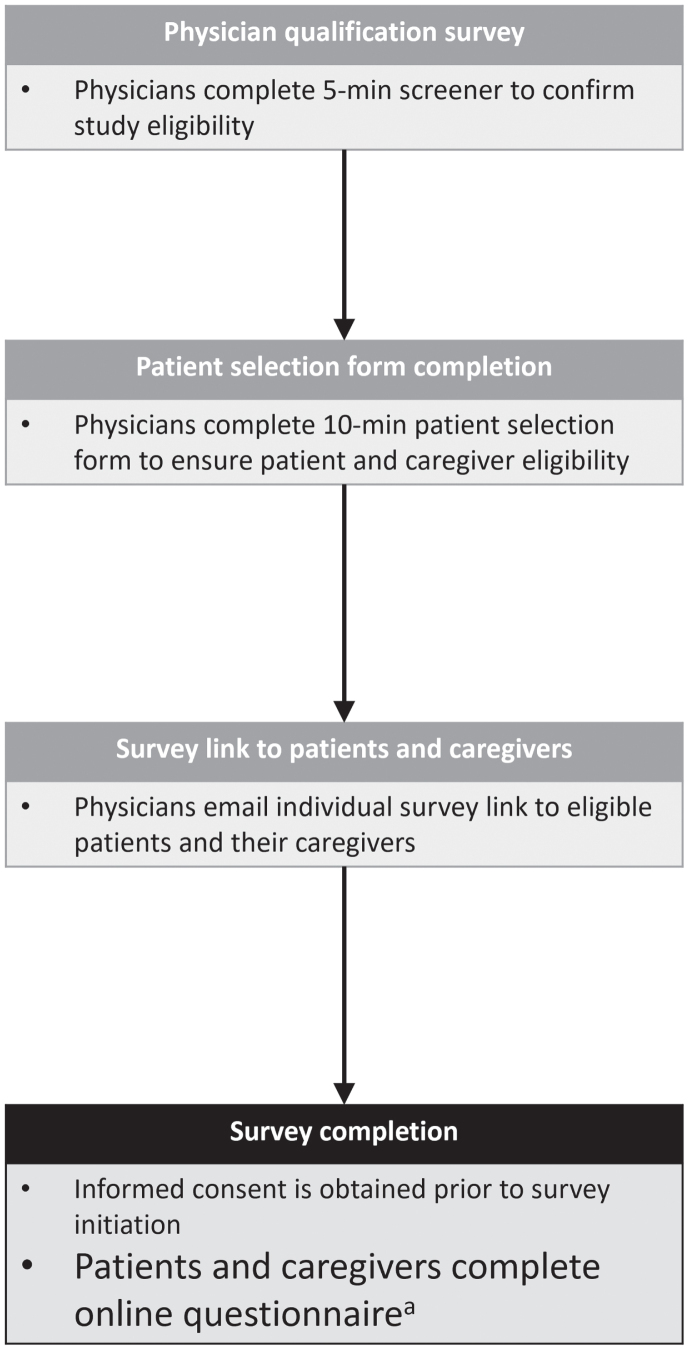
Methods: An on-line survey of physician-identified patient-caregiver dyads living in the United States was conducted from June-October 2022 and included questions to both patients and their caregivers. Dementia Quality of Life Proxy, the Care-related Quality of Life, Work Productivity and Activity Impairment, and Dependence scale were incorporated into the survey. Regression analyses investigated the association between disease severity and QoL and cost outcomes with adjustment for baseline characteristics.
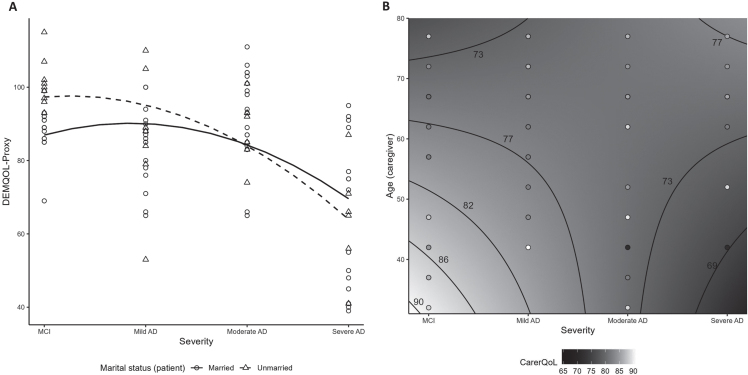
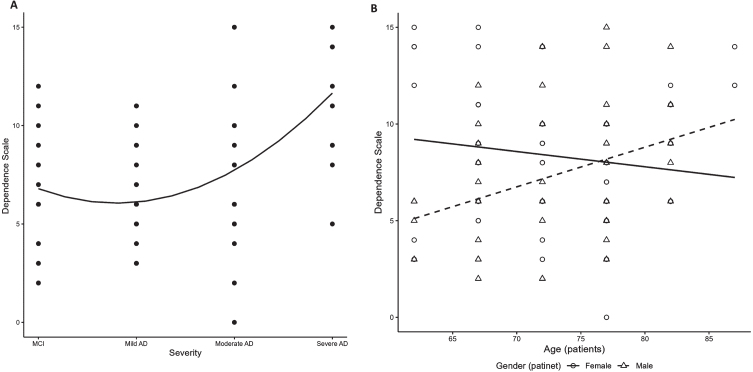
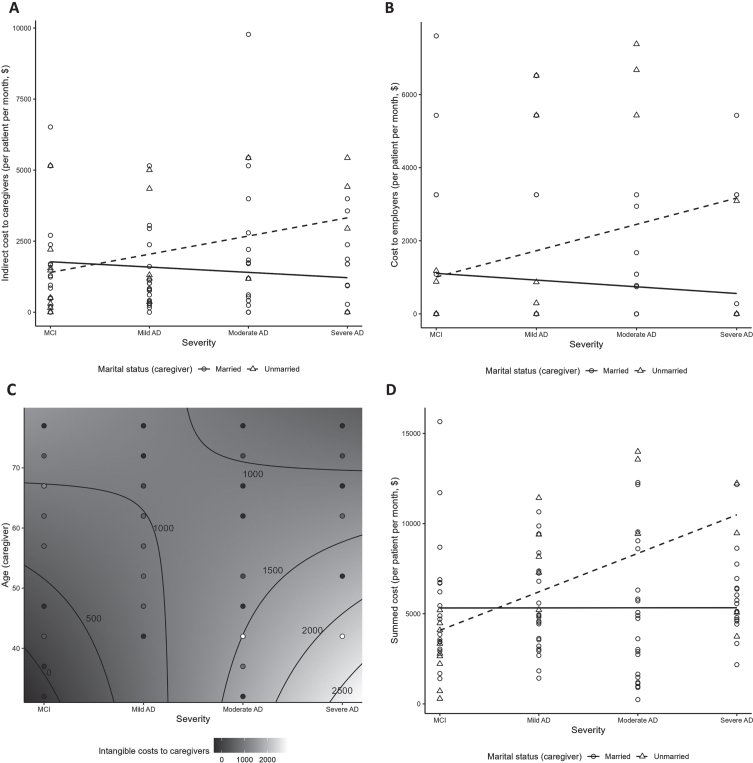
Results: One-hundred patient-caregiver dyads were assessed with the survey (MCI, n = 27; mild AD, n = 27; moderate AD, n = 25; severe AD, n = 21). Decreased QoL was found with worsening severity in patients (p < 0.01) and in unpaid (informal) caregivers (n = 79; p = 0.02). Dependence increased with disease severity (p < 0.01). Advanced disease severity was associated with higher costs to employers (p = 0.04), but not with indirect costs to caregivers. Patient and unpaid caregiver intangible costs increased with disease severity (p < 0.01). A significant trend of higher summed costs (indirect costs to caregivers, costs to employers, intangible costs to patients and caregivers) in more severe AD was observed (p < 0.01).
Conclusions: Patient QoL and functional independence and unpaid caregiver QoL decrease as AD severity increases. Intangible costs to patients and summed costs increase with disease severity and are highest in severe AD.
Keywords: Alzheimer’s disease; cost of illness; employer health costs; global burden of disease; health expenditure; indirect expenditure; intangible cost; mild cognitive impairment; quality of life.
Conflict of interest statement
Amir Abbas Tahami Monfared is an employee of Eisai Inc. He serves as Associate Editor for the Journal of Alzheimer’s Disease but was not involved in the peer-review process nor had access to any information regarding its peer-review. Quanwu Zhang and Raymond Zhang are employees of Eisai Inc. Noemi Hummel, Artak Khachatryan, Agnieszka Kopiec and Marta Martinez are employees of Certara, which is a paid consultant to Eisai. Kulvinder K Singh received funding from Eisai for providing medical writing support.
Figures
References
-
- Gauthier S, Webster C, Servaes S, Morais J, Rosa-Neto P World Alzheimer Report 2022: Life after diagnosis: Navigating treatment, care and support, Alzheimer’s Disease International, https://www.alzint.org/u/World-Alzheimer-Report-2022.pdf, Accessed August 15, 2023.
-
- WHO, Dementia fact sheet, https://www.who.int/newsroom/fact-sheets/detail/dementia, Accessed August 14, 2023.
-
- Alzheimer’s Association (2023) 2023 Alzheimer’s disease facts and figures. Alzheimers Dement 19, 1598–1695. - PubMed
-
- Tahami Monfared AA, Stern Y, Doogan S, Irizarry M, Zhang Q (2022) Stakeholder insights in Alzheimer’s disease: Natural languageprocessing of social media conversations. J Alzheimers Dis 89, 695–708. - PubMed
Publication types
MeSH terms
LinkOut - more resources
Full Text Sources
Medical
