


Effectiveness of workplace interventions with digital elements to reduce sedentary behaviours in office employees: a systematic review and meta-analysis
- PMID: 38641816
- PMCID: PMC11031993
- DOI: 10.1186/s12966-024-01595-6
Effectiveness of workplace interventions with digital elements to reduce sedentary behaviours in office employees: a systematic review and meta-analysis
Abstract
Background: Digital interventions are potential tools for reducing and limiting occupational sedentary behaviour (SB) in sedentary desk-based jobs. Given the harmful effects of sitting too much and sitting for too long while working, the aim of this systematic review and meta-analysis was to examine the effectiveness of workplace interventions, that incorporated digital elements, to reduce the time spent in SB in office workers.
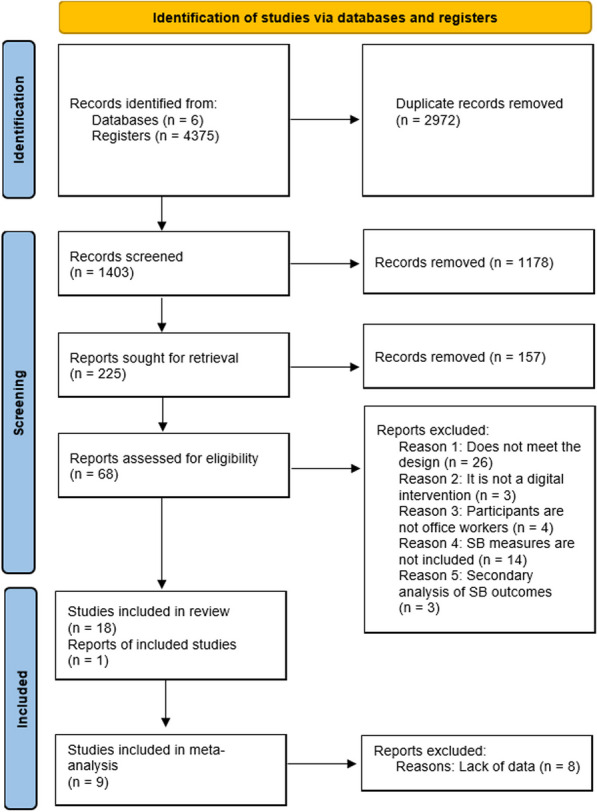
Methods: Randomised control trials that evaluated the implementation of workplace interventions that incorporated digital elements for breaking and limiting SB among desk-based jobs were identified by literature searches in six electronic databases (PubMed, Web of Science, Scopus, CINAHL, PsycINFO and PEDro) published up to 2023. Studies were included if total and/or occupational SB were assessed. Only studies that reported pre- and postintervention mean differences and standard deviations or standard errors for both intervention arms were used for the meta-analysis. The meta-analysis was conducted using Review Manager 5 (RevMan 5; Cochrane Collaboration, Oxford, UK). Risk of bias was assessed using the Standard Quality Assessment Criteria for Evaluating Primary Research Papers from a Variety of Fields QUALSYST tool.
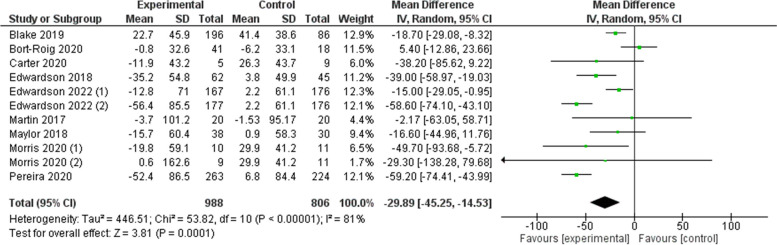
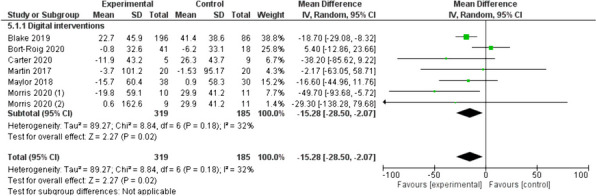
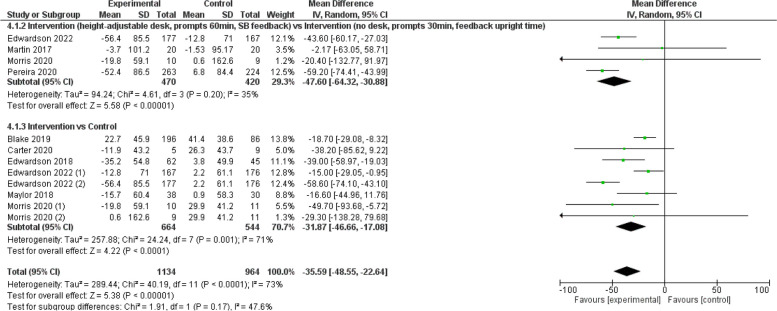
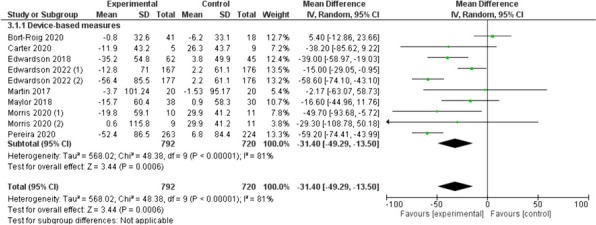
Results: Nineteen studies were included in the systematic review. The most employed digital elements were information delivery and mediated organisational support and social influences. Multicomponent, information, and counselling interventions measuring total and/or occupational/nonoccupational SB time by self-report or via device-based measures were reported. Multicomponent interventions were the most represented. Eleven studies were included in the meta-analysis, which presented a reduction of 29.9 (95% CI: -45.2, -14.5) min/8 h workday in SB (overall effect: Z = 3.81).
Conclusions: Multicomponent interventions, using a wide range of digital features, have demonstrated effectiveness in reducing time spent in SB at the workplace among desk-based employees. However, due to hybrid work (i.e., work in the office and home) being a customary mode of work for many employees, it is important for future studies to assess the feasibility and effectiveness of these interventions in the evolving work landscape.
Trial registration: The review protocol was registered in the Prospero database (CRD42022377366).
Keywords: Home-office; Office work; Sedentary behaviour; Technology; Teleworking; Workplace.
© 2024. The Author(s).
Conflict of interest statement
The authors declare that they have no known competing financial interests or personal relationships that could influence the work reported in this article.
Figures
References
-
- Puig-Ribera A, Martínez-Lemos I, Giné-Garriga M, González-Suárez ÁM, Bort-Roig J, Fortuño J, Muñoz-Ortiz L, McKenna J, Gilson ND. Self-reported sitting time and physical activity: interactive associations with mental well-being and productivity in office employees. BMC Public Health. 2015;15:72. doi: 10.1186/s12889-015-1447-5. - DOI - PMC - PubMed
Publication types
MeSH terms
Grants and funding
LinkOut - more resources
Full Text Sources
Medical
