


Per- and polyfluoroalkyl substances (PFAS), perceived stress, and depressive symptoms in a prospective cohort study of black women
- PMID: 38642767
- PMCID: PMC11109747
- DOI: 10.1016/j.scitotenv.2024.172445
Per- and polyfluoroalkyl substances (PFAS), perceived stress, and depressive symptoms in a prospective cohort study of black women
Abstract
Background: Per- and polyfluoroalkyl substances (PFAS) are endocrine-disrupting chemicals with neurotoxic properties. PFAS have been associated with depressive symptoms among women in some studies, but little research has evaluated the effects of PFAS mixtures. Further, no study has investigated interactions of PFAS-depression associations by perceived stress, which has been shown to modify the effects of PFAS on other health outcomes.
Objective: In a prospective cohort study of reproductive-aged Black women, we investigated associations between PFAS and depressive symptoms and the extent to which perceived stress modified these associations.
Methods: We analyzed data from 1499 participants (23-35 years) in the Study of Environment, Lifestyle, and Fibroids. We quantified concentrations of nine PFAS in baseline plasma samples using online solid-phase extraction-liquid chromatography-isotope dilution tandem mass spectrometry. Participants reported perceived stress via the Perceived Stress Scale (PSS-4; range = 0-16) at baseline and depressive symptoms via the Center for Epidemiologic Studies Depression Scale (CESD; range = 0-44) at the 20-month follow-up visit. We used Bayesian Kernel Machine Regression to estimate associations between PFAS concentrations, individually and as a mixture, and depressive symptoms, and to assess effect modification by PSS-4 scores, adjusting for confounders.
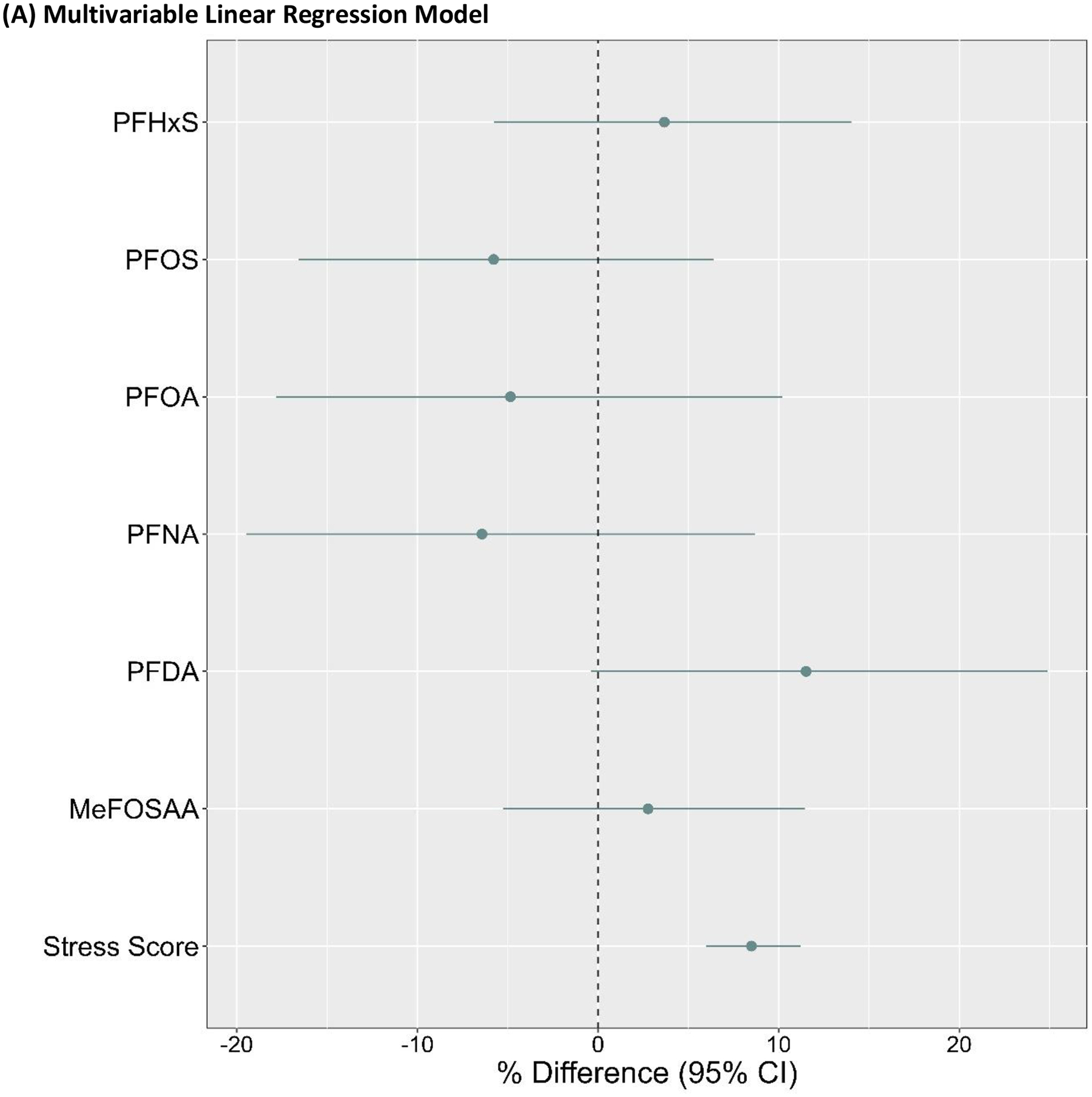
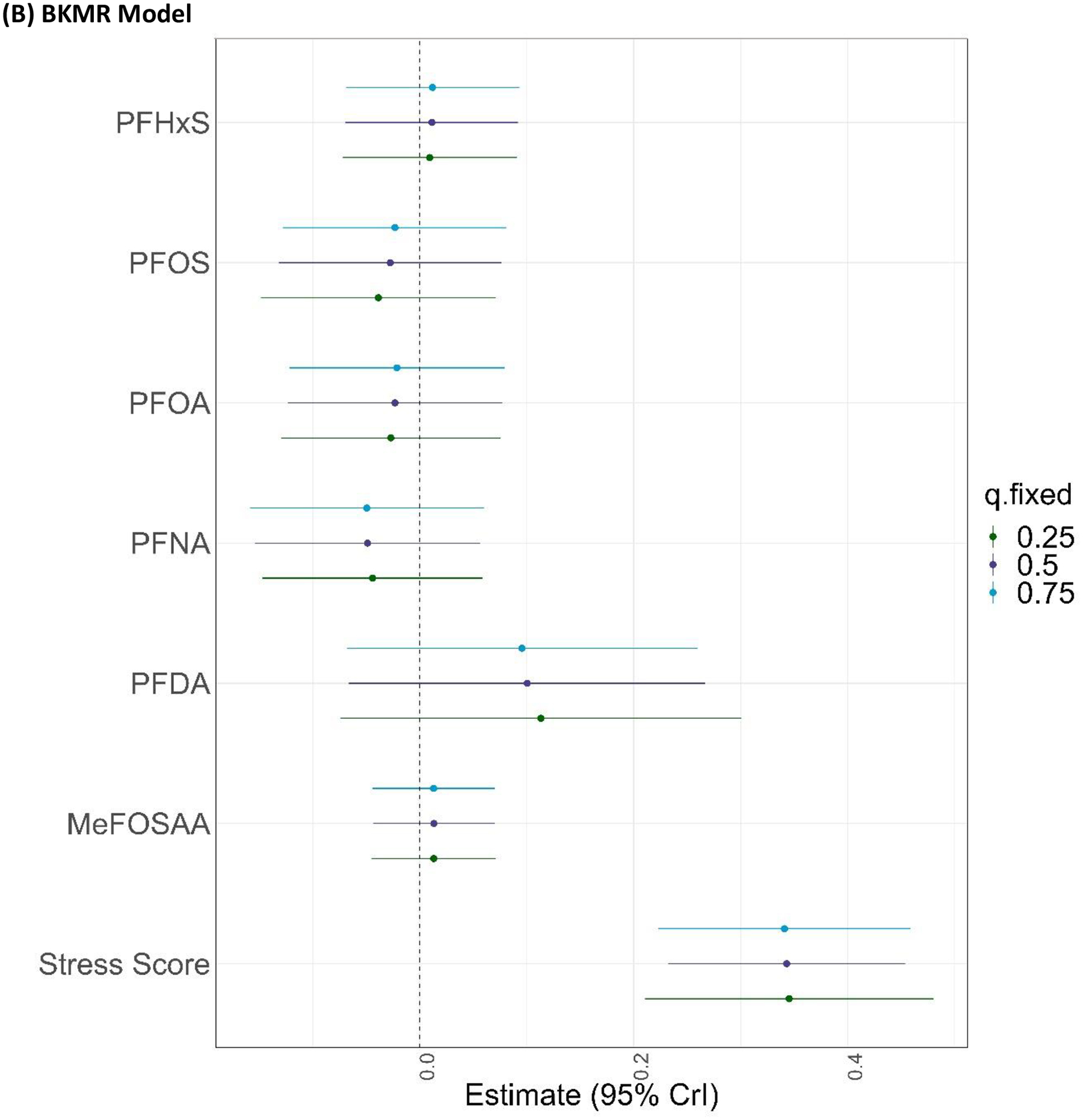
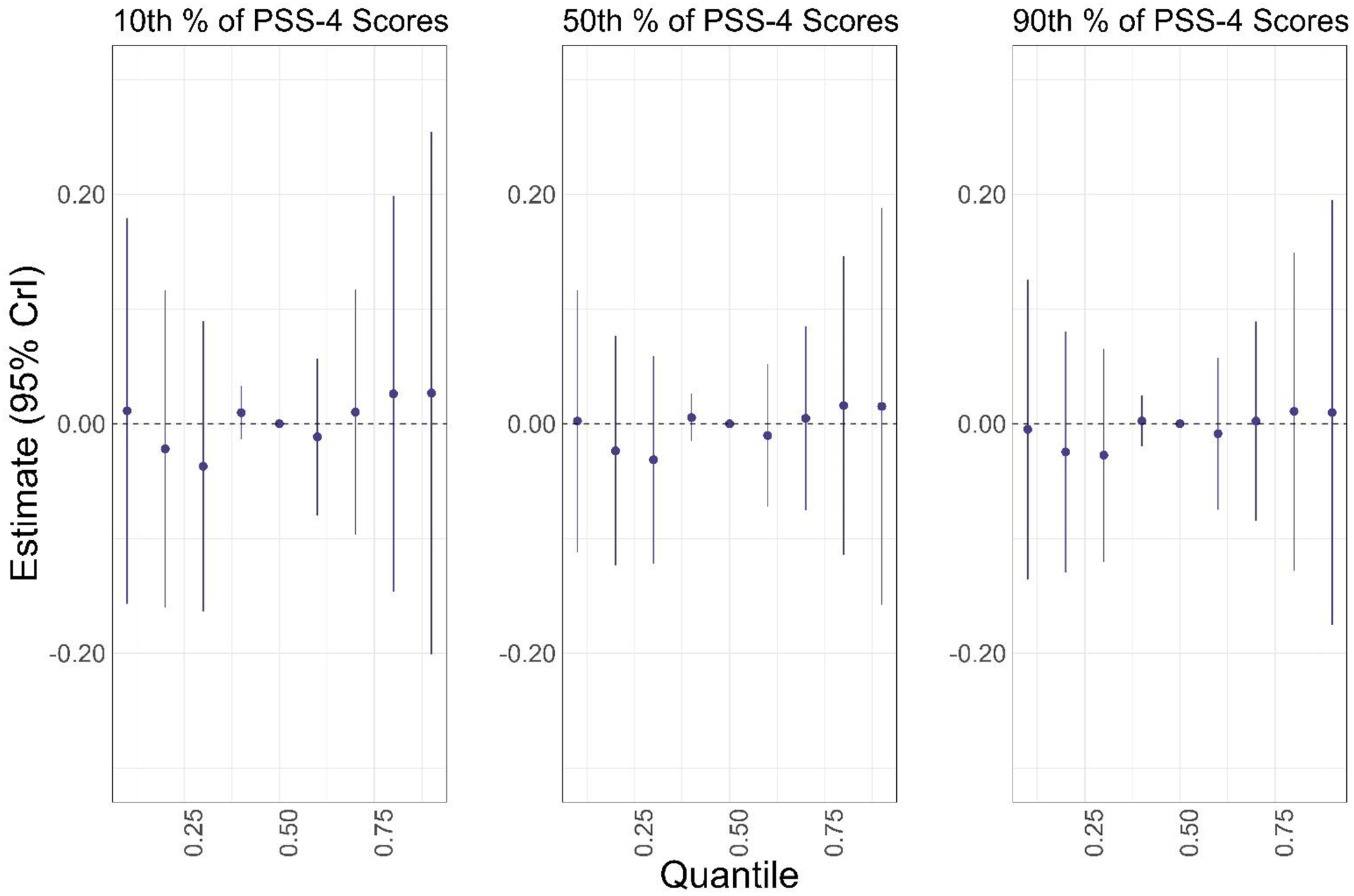
Results: Baseline perfluorodecanoic acid concentrations were associated with greater depressive symptoms at the 20-month follow-up, but associations for other PFAS were null. The PFAS were not associated with depressive symptoms when evaluated as a mixture. The association between the 90th percentile (vs. 50th percentile) of the PFAS mixture with CES-D scores was null at the 10th (β = 0.03; 95 % CrI = 0.20, 0.25), 50th (β = 0.02; 95 % CrI = -0.16, 0.19), and 90th (β = 0.01; 95 % CrI = 0.18, 0.20) percentiles of PSS-4 scores, suggesting perceived stress did not modify the PFAS mixture.
Conclusion: In this prospective cohort study, PFAS concentrations-assessed individually or as a mixture-were not appreciably associated with depressive symptoms, and there was no evidence of effect modification by perceived stress.
Keywords: Black women; Depression; EDCs; Mixtures; PFAS; Stress.
Copyright © 2024 Elsevier B.V. All rights reserved.
Conflict of interest statement
Declaration of competing interest The authors declare that they have no known competing financial interests or personal relationships that could have appeared to influence the work reported in this paper.
Figures
References
-
- Adam Emma K, Heissel JA, Zeiders KH, Richeson JA, Ross EC, Ehrlich KB, Levy DJ, Kemeny M, Brodish AB, Malanchuk O, Peck SC, Fuller-Rowell TE, Eccles JS, Adam EK, 2015. Developmental histories of perceived racial discrimination and diurnal cortisol profiles in adulthood: A 20-year prospective study. Psychoneuroendocrinology 62, 279–291. 10.1016/j.psyneuen.2015.08.018 - DOI - PMC - PubMed
-
- Agency for Toxic Substances and Disease Registry, 2021. Toxicological Profile for Perfluoroalkyls [WWW Document]. URL https://www.atsdr.cdc.gov/toxprofiles/tp.asp?id=1117&tid=237 (accessed 8.16.20). - PubMed
-
- Aung MT, Eick SM, Padula AM, Smith S, Park JS, DeMicco E, Woodruff TJ, Morello-Frosch R, 2023. Maternal per- and poly-fluoroalkyl substances exposures associated with higher depressive symptom scores among immigrant women in the Chemicals in Our Bodies cohort in San Francisco. Environ Int 172, 107758. 10.1016/J.ENVINT.2023.107758 - DOI - PMC - PubMed
MeSH terms
Substances
Grants and funding
LinkOut - more resources
Full Text Sources
Medical
