


Eye movement function captured via an electronic tablet informs on cognition and disease severity in Parkinson's disease
- PMID: 38643273
- PMCID: PMC11032372
- DOI: 10.1038/s41598-024-59750-9
Eye movement function captured via an electronic tablet informs on cognition and disease severity in Parkinson's disease
Abstract
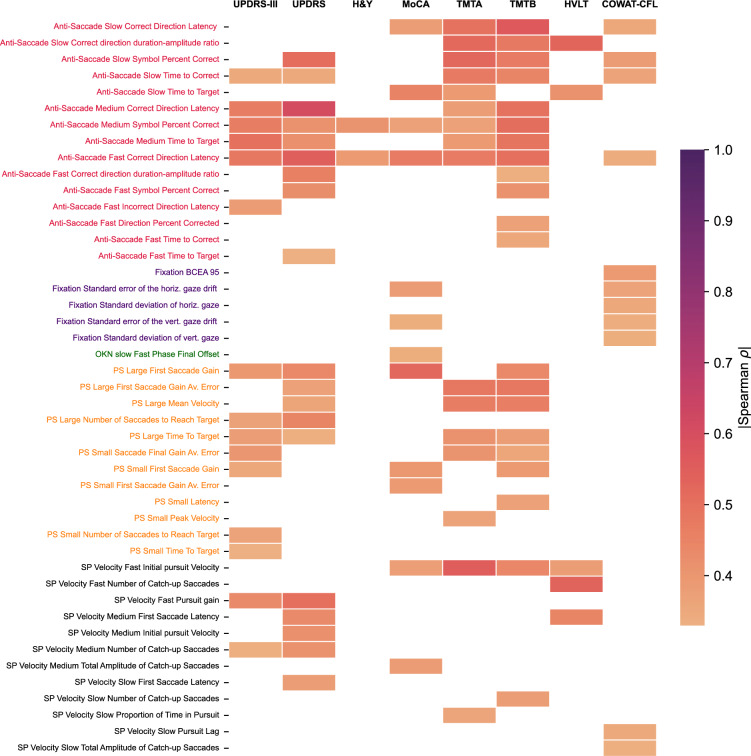
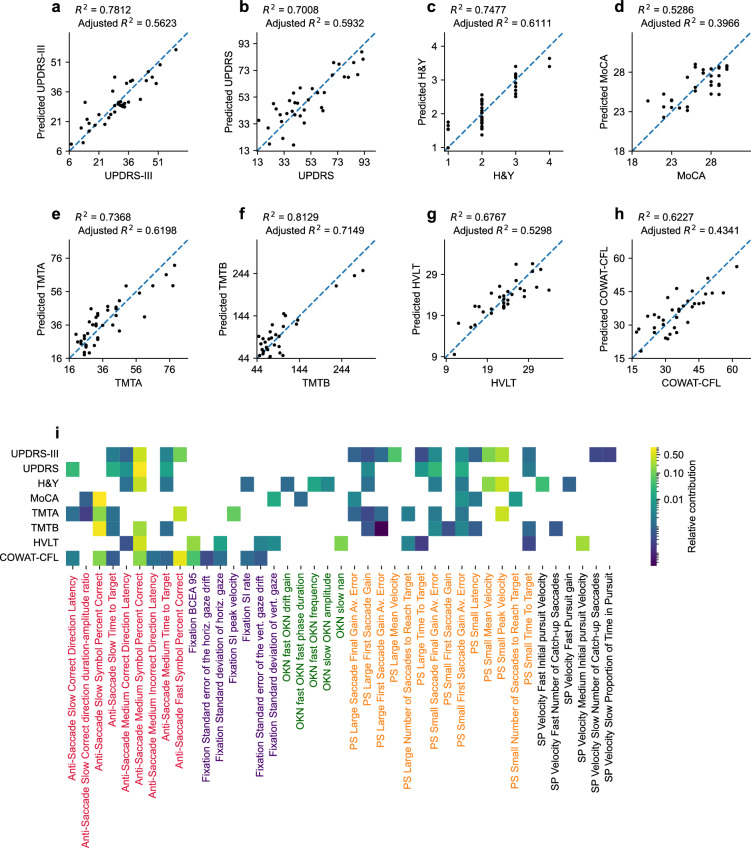
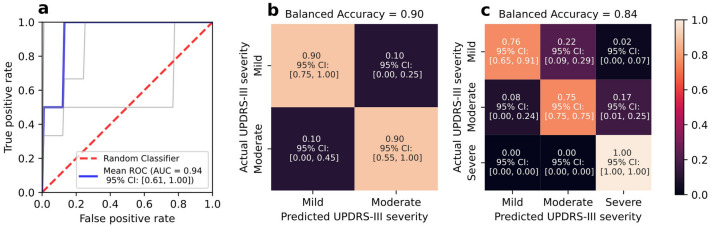
Studying the oculomotor system provides a unique window to assess brain health and function in various clinical populations. Although the use of detailed oculomotor parameters in clinical research has been limited due to the scalability of the required equipment, the development of novel tablet-based technologies has created opportunities for fast, easy, cost-effective, and reliable eye tracking. Oculomotor measures captured via a mobile tablet-based technology have previously been shown to reliably discriminate between Parkinson's Disease (PD) patients and healthy controls. Here we further investigate the use of oculomotor measures from tablet-based eye-tracking to inform on various cognitive abilities and disease severity in PD patients. When combined using partial least square regression, the extracted oculomotor parameters can explain up to 71% of the variance in cognitive test scores (e.g. Trail Making Test). Moreover, using a receiver operating characteristics (ROC) analysis we show that eye-tracking parameters can be used in a support vector classifier to discriminate between individuals with mild PD from those with moderate PD (based on UPDRS cut-off scores) with an accuracy of 90%. Taken together, our findings highlight the potential usefulness of mobile tablet-based technology to rapidly scale eye-tracking use and usefulness in both research and clinical settings by informing on disease stage and cognitive outcomes.
© 2024. The Author(s).
Conflict of interest statement
Author EdV-S is a co-founder of Innodem Neurosciences, which developed the Eye-Tracking Neurological Assessment (ETNA™) technology used in this study. Authors PV and AD-P have ownership options in Innodem Neurosciences. Author NAK is a research intern at Innodem Neurosciences and author JC-F was formerly a part-time employee at Innodem Neurosciences. Author SD has previously served as an advisor to Innodem Neurosciences. The remaining author declares that the research was conducted in the absence of any commercial or financial relationships that could be construed as a potential conflict of interest.
Figures


References
MeSH terms
Grants and funding
LinkOut - more resources
Full Text Sources
Medical
