


Protein intake and cancer: an umbrella review of systematic reviews for the evidence-based guideline of the German Nutrition Society
- PMID: 38643440
- PMCID: PMC11329548
- DOI: 10.1007/s00394-024-03380-4
Protein intake and cancer: an umbrella review of systematic reviews for the evidence-based guideline of the German Nutrition Society
Abstract
Purpose: It has been proposed that a higher habitual protein intake may increase cancer risk, possibly via upregulated insulin-like growth factor signalling. Since a systematic evaluation of human studies on protein intake and cancer risk based on a standardised assessment of systematic reviews (SRs) is lacking, we carried out an umbrella review of SRs on protein intake in relation to risks of different types of cancer.
Methods: Following a pre-specified protocol (PROSPERO: CRD42018082395), we retrieved SRs on protein intake and cancer risk published before January 22th 2024, and assessed the methodological quality and outcome-specific certainty of the evidence using a modified version of AMSTAR 2 and NutriGrade, respectively. The overall certainty of evidence was rated according to predefined criteria.
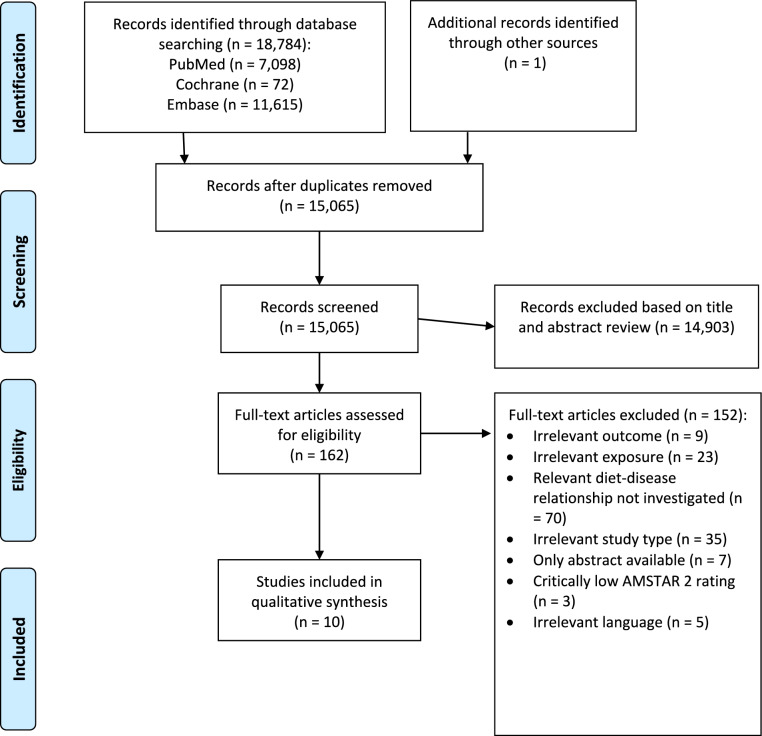
Results: Ten SRs were identified, of which eight included meta-analyses. Higher total protein intake was not associated with risks of breast, prostate, colorectal, ovarian, or pancreatic cancer incidence. The methodological quality of the included SRs ranged from critically low (kidney cancer), low (pancreatic, ovarian and prostate cancer) and moderate (breast and prostate cancer) to high (colorectal cancer). The outcome-specific certainty of the evidence underlying the reported findings on protein intake and cancer risk ranged from very low (pancreatic, ovarian and prostate cancer) to low (colorectal, ovarian, prostate, and breast cancer). Animal and plant protein intakes were not associated with cancer risks either at a low (breast and prostate cancer) or very low (pancreatic and prostate cancer) outcome-specific certainty of the evidence. Overall, the evidence for the lack of an association between protein intake and (i) colorectal cancer risk and (ii) breast cancer risk was rated as possible. By contrast, the evidence underlying the other reported results was rated as insufficient.
Conclusion: The present findings suggest that higher total protein intake may not be associated with the risk of colorectal and breast cancer, while conclusions on protein intake in relation to risks of other types of cancer are restricted due to insufficient evidence.
Keywords: Cancer; Evidence-based guideline; Protein; Umbrella review.
© 2024. The Author(s).
Conflict of interest statement
A list of possible conflicts of interest is provided in Supplementary Material S9.
Figures
References
-
- WHO (World Health Organization) Cancer. Key Facts. https://www.who.int/news-room/fact-sheets/detail/cancer. Accessed 31 Dec 2020
-
- American Cancer Society (2020) The Cancer Atlas. Survivorship. 10.3945/ajcn.115.11208610.3945/ajcn.115.112086 - DOI
Publication types
MeSH terms
Substances
LinkOut - more resources
Full Text Sources
Medical
