


Biochar enhances the growth and physiological characteristics of Medicago sativa, Amaranthus caudatus and Zea mays in saline soils
- PMID: 38644487
- PMCID: PMC11034111
- DOI: 10.1186/s12870-024-04957-1
Biochar enhances the growth and physiological characteristics of Medicago sativa, Amaranthus caudatus and Zea mays in saline soils
Abstract
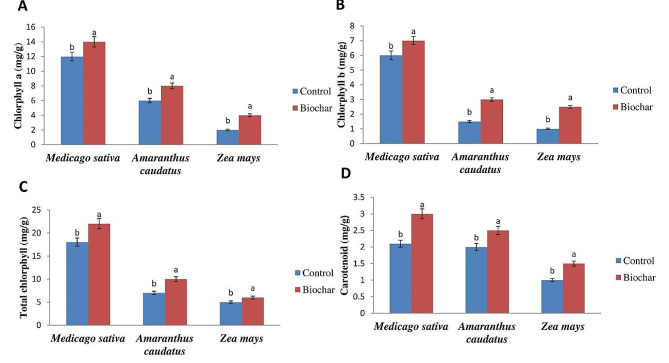
Biochar is a promising solution to alleviate the negative impacts of salinity stress on agricultural production. Biochar derived from food waste effect was investigated on three plant species, Medicago sativa, Amaranthus caudatus, and Zea mays, under saline environments. The results showed that biochar improved significantly the height by 30%, fresh weight of shoot by 35% and root by 45% of all three species compared to control (saline soil without biochar adding), as well as enhanced their photosynthetic pigments and enzyme activities in soil. This positive effect varied significantly between the 3 plants highlighting the importance of the plant-biochar interactions. Thus, the application of biochar is a promising solution to enhance the growth, root morphology, and physiological characteristics of plants under salt-induced stress.
Keywords: Amaranthus caudatus; Medicago sativa; Zea mays; Biochar; Plant growth; Salinity.
© 2024. The Author(s).
Conflict of interest statement
The authors stated that they had no interest which might be perceived as posing a conflict or bias.
Figures
References
-
- Victoria O, Idorenyin U, Asana M, Jia L, Shuoshuo L, Yang S, Okoi IM, Ping A, Egrinya EA. Seed treatment with 24-epibrassinolide improves wheat germination under salinity stress. Asian J Agric Biol. 2023;2023(3). 10.35495/ajab.2022.076.
-
- Vu NT, Bui TK, Vu TTH, Nguyen TH, Le TTC, Tran AT, Jang DC. Biochar Improved Sugarcane Growth and Physiology under salinity stress. Appl Sci. 2023;13(13):7708. doi: 10.3390/app13137708. - DOI
-
- Jateen S, Bharti VS, Prakash S, Krishnan S, Paul T, Kumar S. Sugarcane bagasse biochar-amended sediment improves growth, survival, and physiological profiles of white-leg shrimp, Litopenaeus vannamei (Boone, 1931) reared in inland saline water. Aquaculture International; 2023. pp. 1–20.
MeSH terms
Substances
LinkOut - more resources
Full Text Sources
