


Risk factors and prediction model construction for peripherally inserted central catheter-related infections
- PMID: 38644876
- PMCID: PMC11031796
- DOI: 10.1016/j.heliyon.2024.e29158
Risk factors and prediction model construction for peripherally inserted central catheter-related infections
Abstract
Objective: To establish a predictive modeling for the risk of bloodstream infection associated with peripherally inserted central catheter (PICC).
Methods: Patients receiving PICC treatment in Shenzhen People's Hospital from June 2020 to December 2020 were retrospectively enrolled and divided into the infection group and the non-infection group according to the presence and absence of PICC-related infections. Then, relevant clinical information of patients was collected and the predictors of PICC-related infection were screened by the least absolute shrinkage and selection operator regression (LASSO) model. Besides, multivariate logistic regression was used to analyze the influencing factors of PICC-related infection, A nomogram was constructed based on the results of the multivariate analysis. Ultimately, a receiver operating characteristic (ROC) curve was plotted to analyze the application value of influencing factors to predict PICC-related infections.
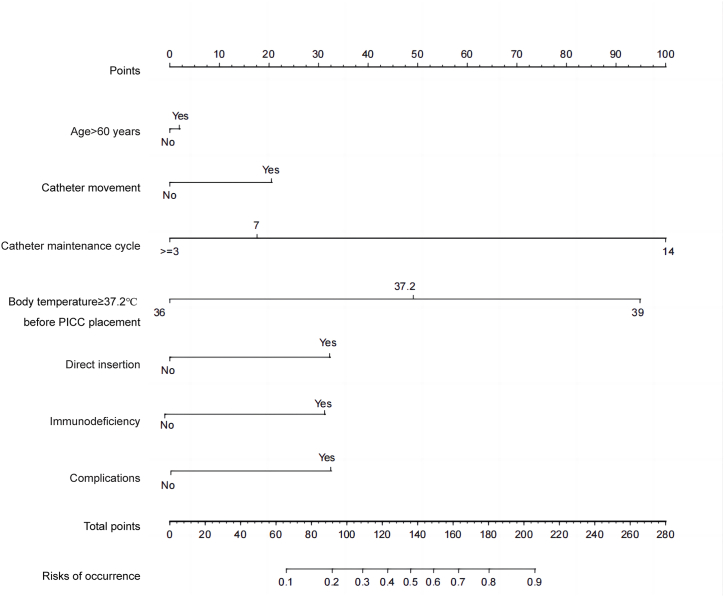
Results: A total of 505 patients were included, including 75 patients with PICC-related infections (14.85%). The main pathogen was gram-positive cocci. The predictors screened by LASSO included age >60 years, catheter movement, catheter maintenance cycle, insertion technique, immune function, complications, and body temperature ≥37.2 °C before PICC placement. Multivariate logistic regression analysis showed that independent risk factors of infections related to PICC included age >60 years [odds ratio (OR) = 1.722; 95% confidence interval (CI) = 1.312-3.579; P = 0.006], catheter movement (OR = 1.313; 95% CI = 1.119-3.240; P = 0.014), catheter maintenance cycle >7 days (OR = 2.199; 95% CI = 1.677-4.653; P = 0.000), direct insertion (OR = 1.036; 95% CI = 1.019-2.743; P = 0.000), poor immune function (OR = 2.322; 95% CI = 2.012-4.579; P = 0.000), complications (OR = 1.611; 95% CI = 1.133-3.454; P = 0.019), and body temperature ≥37.2 °C before PICC placement (OR = 1.713; 95% CI = 1.172-3.654; P = 0.012). Besides, the area under the ROC curve was 0.889.
Conclusion: PICC-related infections are associated with factors such as age >60 years, catheter movement, catheter maintenance cycle, insertion technique, immune function, complications, and body temperature ≥37.2 °C before PICC placement. Additionally, the LASSO model is moderately predictive for predicting the occurrence of PICC-related infections.
Keywords: Catheter-related infection; Peripherally inserted central catheter; Prediction model.
© 2024 Published by Elsevier Ltd.
Conflict of interest statement
The authors declare that they have no known competing financial interests or personal relationships that could have appeared to influence the work reported in this paper.
Figures


References
-
- Gonzalez R., Cassaro S. vol. 4. StatPearls Publishing; 2023. Percutaneous central catheter. (StatPearls. Treasure Island (FL)). September. - PubMed
-
- Lv Y., Huang X., Lan Y., Xia Q., Chen F., Wu J., Li W., Cao H., Xie C., Li L., Han H., Wang H., Xiang Q. Peripherally inserted central catheters have a protective role and the effect of fluctuation curve feature in the risk of bloodstream infection compared with central venous catheters: a propensity-adjusted analysis. BMC Infect. Dis. 2022;26:289. - PMC - PubMed
-
- Lundberg D., Arnlind M.H. Advantages and disadvantages of peripherally inserted central venous catheters (PICC) compared to other central venous lines: a systematic review of the literature. Acta Oncol. 2013;52:886–892. - PubMed
LinkOut - more resources
Full Text Sources
