


This is a preprint.
Single Cell Analysis of Treatment-Resistant Prostate Cancer: Implications of Cell State Changes for Cell Surface Antigen Targeted Therapies
- PMID: 38645034
- PMCID: PMC11030323
- DOI: 10.1101/2024.04.09.588340
Single Cell Analysis of Treatment-Resistant Prostate Cancer: Implications of Cell State Changes for Cell Surface Antigen Targeted Therapies
Update in
-
Single-cell analysis of treatment-resistant prostate cancer: Implications of cell state changes for cell surface antigen-targeted therapies.Proc Natl Acad Sci U S A. 2024 Jul 9;121(28):e2322203121. doi: 10.1073/pnas.2322203121. Epub 2024 Jul 5. Proc Natl Acad Sci U S A. 2024. PMID: 38968122 Free PMC article.
Abstract
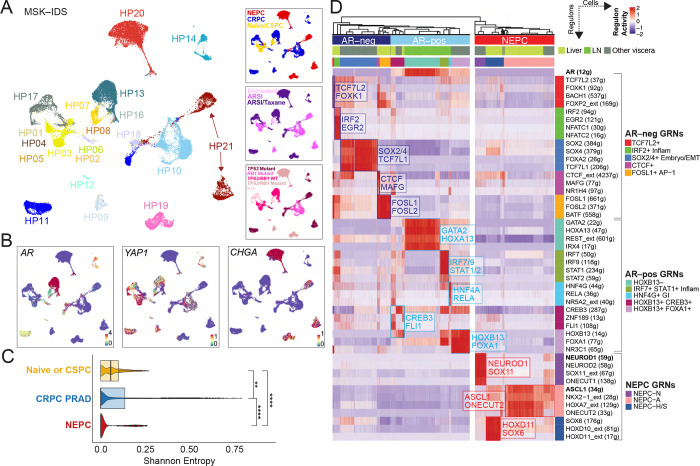
Targeting cell surface molecules using radioligand and antibody-based therapies has yielded considerable success across cancers. However, it remains unclear how the expression of putative lineage markers, particularly cell surface molecules, varies in the process of lineage plasticity, wherein tumor cells alter their identity and acquire new oncogenic properties. A notable example of lineage plasticity is the transformation of prostate adenocarcinoma (PRAD) to neuroendocrine prostate cancer (NEPC)--a growing resistance mechanism that results in the loss of responsiveness to androgen blockade and portends dismal patient survival. To understand how lineage markers vary across the evolution of lineage plasticity in prostate cancer, we applied single cell analyses to 21 human prostate tumor biopsies and two genetically engineered mouse models, together with tissue microarray analysis (TMA) on 131 tumor samples. Not only did we observe a higher degree of phenotypic heterogeneity in castrate-resistant PRAD and NEPC than previously anticipated, but also found that the expression of molecules targeted therapeutically, namely PSMA, STEAP1, STEAP2, TROP2, CEACAM5, and DLL3, varied within a subset of gene-regulatory networks (GRNs). We also noted that NEPC and small cell lung cancer (SCLC) subtypes shared a set of GRNs, indicative of conserved biologic pathways that may be exploited therapeutically across tumor types. While this extreme level of transcriptional heterogeneity, particularly in cell surface marker expression, may mitigate the durability of clinical responses to novel antigen-directed therapies, its delineation may yield signatures for patient selection in clinical trials, potentially across distinct cancer types.
Conflict of interest statement
Competing Interests: P.S.N. has received consulting fees from Janssen, Merck and Bristol Myers Squibb and research support from Janssen for work unrelated to the present studies. S.Z. has received consulting fees from Guidepoint and GLG consulting. M.C.H served as a paid consultant/received honoraria from Pfizer and has received research funding from Merck, Novartis, Genentech, Promicell and Bristol Myers Squibb. C.L.S is on the board of directors of Novartis, is a co-founder of ORIC Pharmaceuticals, and is a co-inventor of the prostate cancer drugs enzalutamide and apalutamide, covered by U.S. patents 7,709,517, 8,183,274, 9,126,941, 8,445,507, 8,802,689, and 9,388,159 filed by the University of California. C.L.S. is on the scientific advisory boards of the following biotechnology companies: Beigene, Blueprint, Cellcarta, Column Group, Foghorn, Housey Pharma, Nextech, PMV.
Figures



References
-
- Mailankody S., Brentjens R. J., Smith E. L., GPRC5D-Targeted CAR T Cells for Myeloma. Reply. N Engl J Med 387, 2296 (2022). - PubMed
Publication types
Grants and funding
LinkOut - more resources
Full Text Sources
Molecular Biology Databases
Research Materials
Miscellaneous
