


Microalgae and co-culture for polishing pollutants of anaerobically treated agro-processing industry wastewater: the case of slaughterhouse
- PMID: 38647578
- PMCID: PMC10992203
- DOI: 10.1186/s40643-023-00699-4
Microalgae and co-culture for polishing pollutants of anaerobically treated agro-processing industry wastewater: the case of slaughterhouse
Abstract
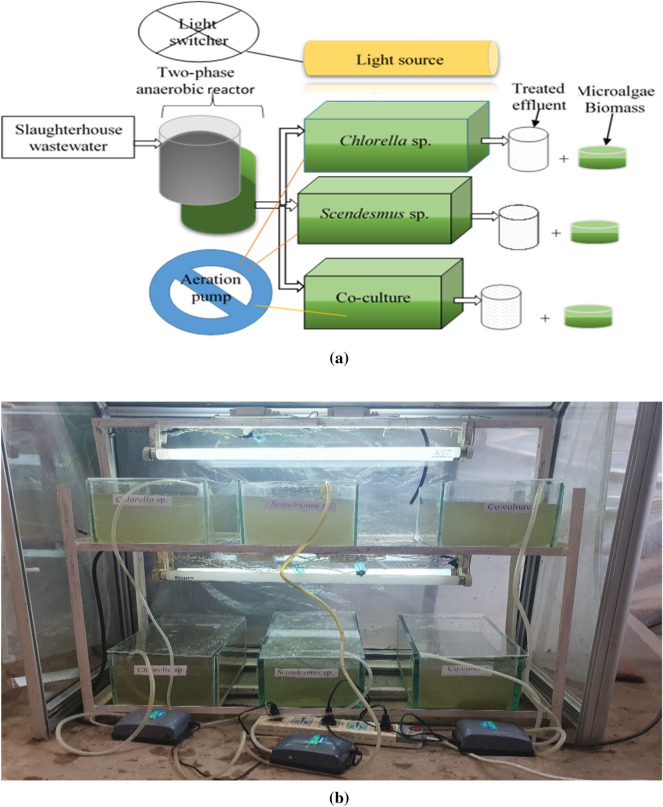
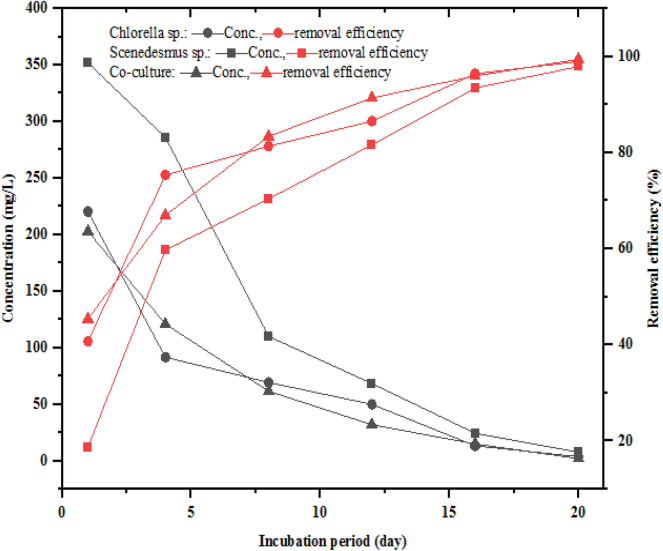
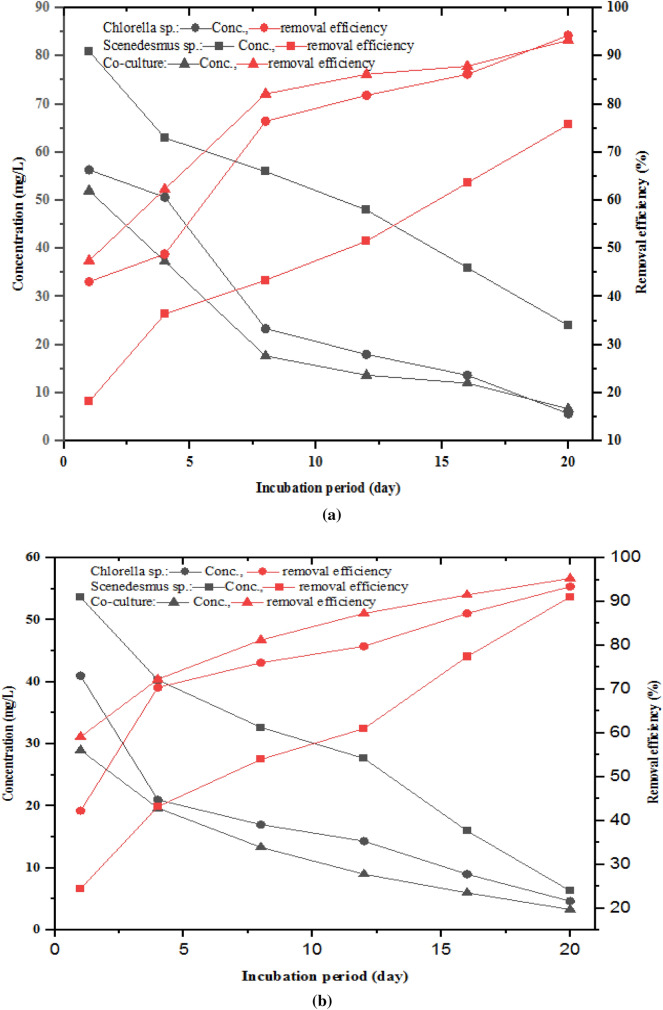
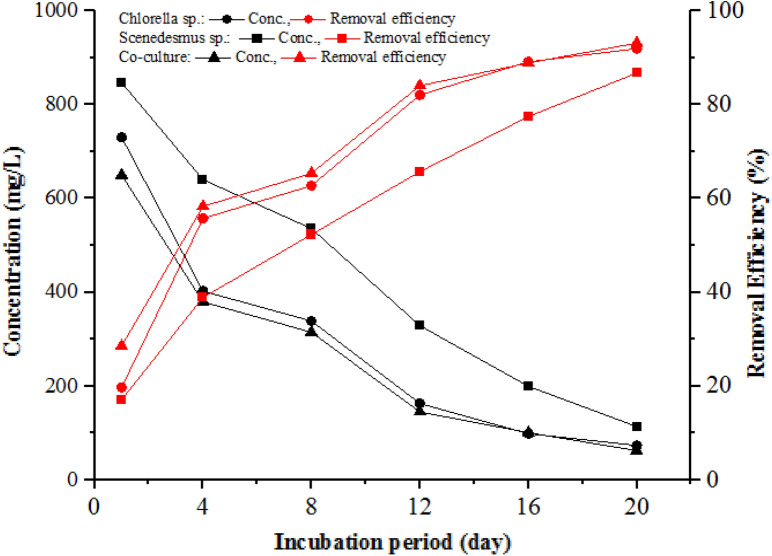
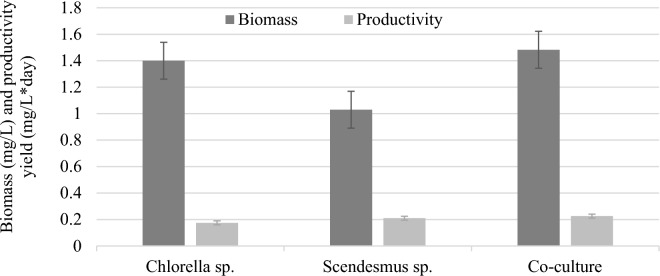
Anaerobically treated slaughterhouse effluent is rich in nutrients, organic matter, and cause eutrophication if discharged to the environment without proper further treatment. Moreover, phosphorus and nitrogen in agro-processing industry wastewaters are mainly removed in the tertiary treatment phase. The objective of this study is to evaluate the pollutant removal efficiency of Chlorella and Scenedesmus species as well as their co-culture treating two-phase anaerobic digester effluent through microalgae biomass production. The dimensions of the rectangular photobioreactor used to conduct the experiment are 15 cm in height, 20 cm in width, and 30 cm in length. Removal efficiencies between 86.74-93.11%, 96.74-97.47%, 91.49-92.91%, 97.94-99.46%, 89.22-94.28%, and 91.08-95.31% were attained for chemical oxygen demand, total nitrogen, nitrate, ammonium, total phosphorous, and orthophosphate by Chlorella species, Scenedesmus species, and their co-culture, respectively. The average biomass productivity and biomass yield of Chlorella species, Scenedesmus species, and their co-culture were 1.4 ± 0.1, 1.17 ± 0.12, 1.5 ± 0.13 g/L, and 0.18, 0.21, and 0.23 g/L*day, respectively. The final effluent quality in terms of chemical oxygen demand, total nitrogen, and total phosphorous attained by Chlorella species and the co-culture were below the permissible discharge limit for slaughterhouse effluent standards in the country (Ethiopia). The results of the study showed that the use of microalgae as well as their co-culture for polishing the nutrients and residual organic matter in the anaerobically treated agro-processing industry effluent offers a promising result for wastewater remediation and biomass production. In general, Chlorella and Scenedesmus species microalgae and their co-culture can be applied as an alternative for nutrient removal from anaerobically treated slaughterhouse wastewater as well as biomass production that can be used for bioenergy.
Keywords: Biomass, microalgae; Nutrient removal-efficiency; Photobioreactor; Resource-recovery; Wastewater.
© 2023. The Author(s).
Conflict of interest statement
The authors declare no competing interests.
Figures



References
-
- Acevedo S, Pino NJ, Peñuela GA. Remoción de nitrógeno, fósforo y producción de biomasa de scenedesmus sp en agua residual domestica. Ingeniería y Competitividad. 2017;19(1):177. doi: 10.2510/iyc.v19i1.2142. - DOI
-
- Adeyinka A, Adekanmi AS, Adekanmi UT, Adekanmi. Biotreatment of slaughterhouse waste water by microalgae. United Int J Res Technol (UIJRT) 2020;01(09):19–30.
-
- Ajala SO, Alexander ML. Assessment of chlorella vulgaris, scenedesmus obliquus, and oocystis minuta for removal of sulfate, nitrate, and phosphate in wastewater. Int J Energy Environ Eng. 2020;11(3):311–326. doi: 10.1007/s40095-019-00333-0. - DOI
-
- Akar T, Tunali S. Biosorption performance of botrytis cinerea fungal by-products for removal of Cd(II) and Cu(II) ions from aqueous solutions. Miner Eng. 2005;18(11):1099–1109. doi: 10.1016/J.MINENG.2005.03.002. - DOI
LinkOut - more resources
Full Text Sources
