


Supervised Versus Unsupervised Exercise for the Improvement of Physical Function and Well-Being Outcomes in Older Adults: A Systematic Review and Meta-analysis of Randomized Controlled Trials
- PMID: 38647999
- PMCID: PMC11258164
- DOI: 10.1007/s40279-024-02024-1
Supervised Versus Unsupervised Exercise for the Improvement of Physical Function and Well-Being Outcomes in Older Adults: A Systematic Review and Meta-analysis of Randomized Controlled Trials
Abstract
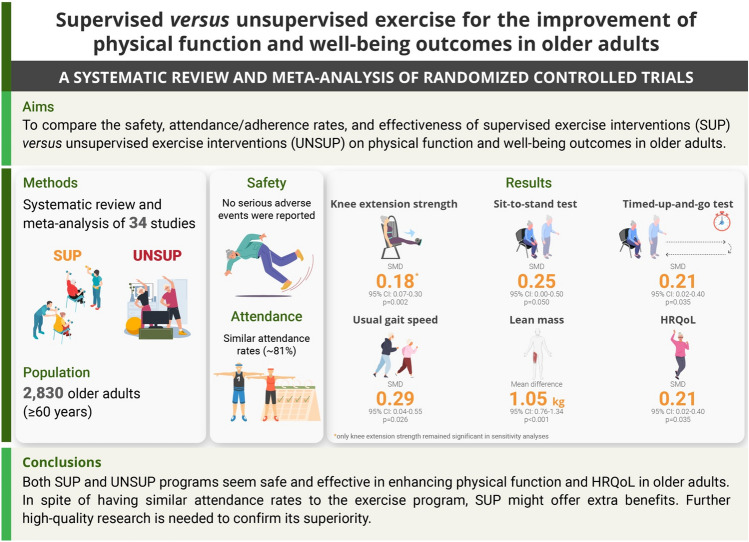
Background: Unsupervised exercise intervention (UNSUP) appears to be a practical and beneficial strategy for older adults, although its feasibility and effectiveness compared to supervised exercise intervention (SUP) remains unknown. We aimed to compare the safety, attendance/adherence rates, and effectiveness of SUP versus UNSUP on physical function and well-being outcomes in older adults.
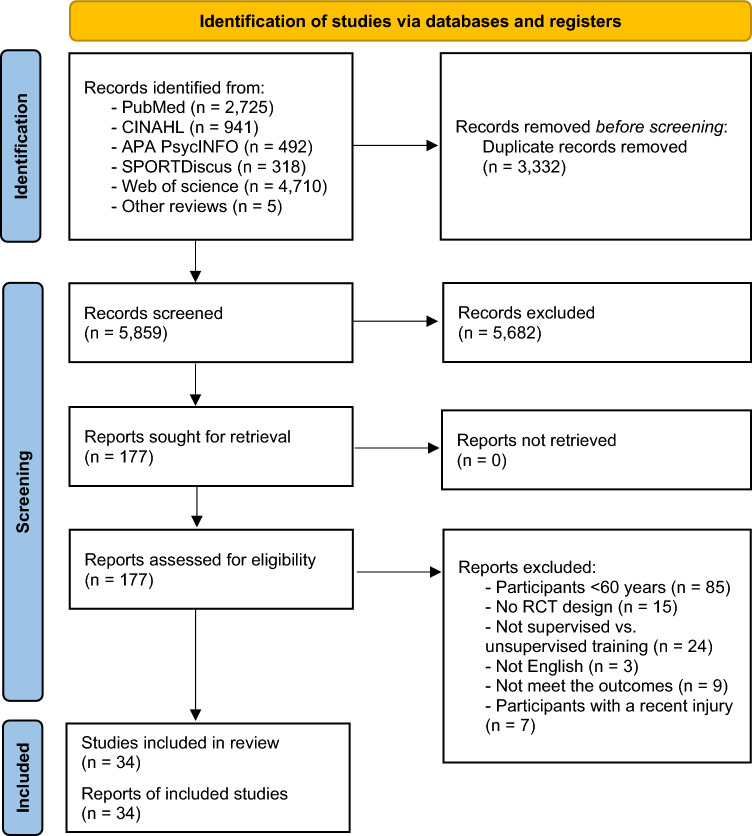
Methods: A systematic search was conducted in PubMed, Web of Science, CINAHL, SPORTDiscus, and APA PsycINFO up to September 2022 for randomized controlled trials comparing SUP versus UNSUP in older adults (≥ 60 years). Safety and attendance/adherence rates were registered as indicators of feasibility, and meta-analyses were performed for physical function and well-being outcomes. Sub-analyses were performed for those studies that applied a similar intervention in both groups and for those studies where participants performed ≥ 66% of the sessions in the assigned condition.
Results: Thirty-four studies were included (n = 2830). No serious adverse events were reported, with similar attendance rates (81%) for both SUP and UNSUP. Compared with UNSUP, SUP induced significant higher benefits on knee extension strength (standardized mean difference (SMD) = 0.18, p = 0.002), sit-to-stand test (STS, SMD = 0.25, p = 0.050), timed-up-and-go test (TUG, SMD = 0.21, p = 0.035), usual gait speed (SMD = 0.29, p = 0.026), lean mass (mean difference = 1.05 kg, p < 0.001) and health-related quality of life (HRQoL, SMD = 0.21, p = 0.035), albeit only knee extension strength remained significant in sensitivity analyses. Sub-analyses revealed superior benefits of SUP on knee extension strength when only considering those studies that applied a similar intervention in both SUP and UNSUP groups. However, no significant benefits were found for the remaining outcomes. Beneficial effects of SUP over UNSUP were also observed for knee extension strength, STS, functional reach test, TUG, usual gait speed, lean mass, and HRQoL when separately analyzing those studies in which participants performed ≥ 66% of the sessions in the assigned condition.
Conclusions: Current evidence suggests that both SUP and UNSUP programs are safe and could exert benefits on physical function and HRQoL. However, despite being associated with similar attendance rates, SUP might offer some additional benefits, although further high-quality research (i.e., accounting for confounding factors such as presence of supervised sessions in UNSUP or vice versa, as well as equating the exercise dose) is necessary to confirm these findings.
Prospero registration number: CRD42022326420.
© 2024. The Author(s).
Conflict of interest statement
The authors declare no conflicts of interest.
Figures
References
-
- Nations U. World Population Prospects New York 2017.
-
- García-Hermoso A, Ramirez-Vélez R, Sáez de Asteasu ML, Martínez-Velilla N, Zambom-Ferraresi F, Valenzuela PL, et al. Safety and effectiveness of long-term exercise interventions in older adults: a systematic review and meta-analysis of randomized controlled trials. Sports Med. 2020;50(6):1095–1106. doi: 10.1007/s40279-020-01259-y. - DOI - PubMed
Publication types
MeSH terms
Grants and funding
LinkOut - more resources
Full Text Sources
