doi: 10.5489/cuaj.8751.
2024 Canadian Urological Association guideline: Female stress urinary incontinence
Affiliations
- PMID: 38648655
- PMCID: PMC11034962
- DOI: 10.5489/cuaj.8751
Item in Clipboard
2024 Canadian Urological Association guideline: Female stress urinary incontinence
Can Urol Assoc J.
2024 Apr.
No abstract available
Conflict of interest statement
COMPETING INTERESTS: Dr. Carlson has been an advisory board member for AbbVie and received honoraria for CME development. Dr. Andrews has been an advisory board member for AbbVie. Dr. Baverstock has been a speaker for Astellas and Boston Scientific; and an advisory board member/speaker for AbbVie. Dr. Nadeau has been an advisory board member for AbbVie and Astellas; a consultant for AbbVie, Boston Scientific, and Searchlight Pharma; and a speaker for AbbVie and Laborie. Dr. Welk has been a consultant for BD Company. The remaining authors do not report any competing personal or financial interests related to this work.
Figures
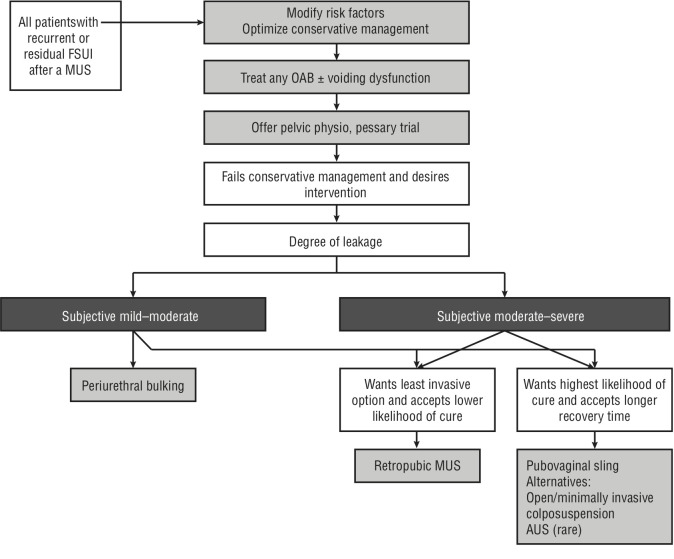
Suggested management approach for isolated residual or recurrent female stress urinary incontinence (FSUI) following a single prior midurethral sling (MUS). AUS: artificial urinary sphincter; OAB: overactive bladder.
References
-
- Milsom I, Altman D, Cartwright R, et al. Epidemiology of urinary incontinence (UI) and other lower urinary tract symptoms (LUTS), pelvic organ prolapse (POP) and anal (AI) incontinence. In: Abrams P, Wagg A, Wein A, editors. International Consultation on Incontinence, C.L. International Continence Society; Bristol: 2017. pp. 1–142.
-
- Nambiar AK, Arlandis S, Bo K, et al. European Association of Urology guidelines on the diagnosis and management of female non-neurogenic lower urinary tract symptoms. Part 1: Diagnostics, overactive bladder, stress urinary incontinence, and mixed urinary incontinence. Eur Urol. 2022;82:49–59. doi: 10.1016/j.eururo.2022.01.045. - DOI - PubMed
LinkOut - more resources
Full Text Sources