. 2024 Apr;628(8009):736-740.
doi: 10.1038/s41586-024-07225-2. Epub 2024 Apr 24.

Optical clocks at sea

Affiliations

Optical clocks at sea

Jonathan D Roslund et al. Nature. 2024 Apr.

Abstract

Deployed optical clocks will improve positioning for navigational autonomy1, provide remote time standards for geophysical monitoring2 and distributed coherent sensing3, allow time synchronization of remote quantum networks4,5 and provide operational redundancy for national time standards. Although laboratory optical clocks now reach fractional inaccuracies below 10-18 (refs. 6,7), transportable versions of these high-performing clocks8,9 have limited utility because of their size, environmental sensitivity and cost10. Here we report the development of optical clocks with the requisite combination of size, performance and environmental insensitivity for operation on mobile platforms. The 35 l clock combines a molecular iodine spectrometer, fibre frequency comb and control electronics. Three of these clocks operated continuously aboard a naval ship in the Pacific Ocean for 20 days while accruing timing errors below 300 ps per day. The clocks have comparable performance to active hydrogen masers in one-tenth the volume. Operating high-performance clocks at sea has been historically challenging and continues to be critical for navigation. This demonstration marks a significant technological advancement that heralds the arrival of future optical timekeeping networks.


Conflict of interest statement

The authors declare no competing interests.

Figures
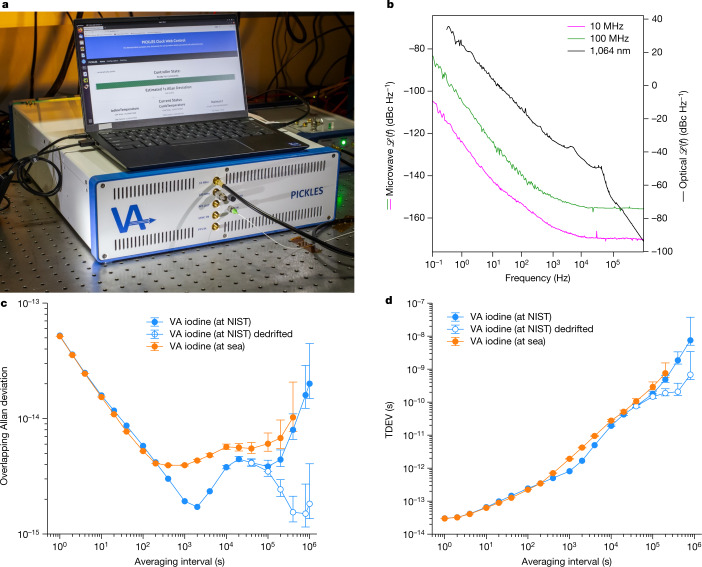
Fig. 1
Fig. 1. Single-clock performance at NIST and at sea.
a, The 3 U, 19-inch rackmount iodine optical clock occupies a volume of 35 l and consumes less than 100 W. b, Measured phase noise for the iodine clock at 10 MHz, 100 MHz and 1,064 nm. c, Overlapping Allan deviation for the iodine clock operating at NIST and at sea. At short timescales, the instability in a dynamic environment is identical to the laboratory. The iodine clock can maintain less than 10−14 frequency instability for several days despite several-degree temperature swings, significant changes in relative humidity and changing magnetic fields. d, The clocks can maintain holdovers of 10 ps for several hours and 1 ns for several days, showing their potential as the basis for a picosecond-level timing network.
Fig. 2
Fig. 2. Long-term clock performance.
Overlapping Allan deviation for the 10 MHz outputs of the two iodine clocks measured against the UTC(NIST) timebase for 34 days (blue and orange traces). The clocks exhibit a raw frequency instability of 4 × 10−15 (PICKLES) and 6 × 10−15 (EPIC) after 105 s of averaging and maintain instability less than 10−14 for nearly 6 days (PICKLES). With linear drift removal, the frequency instability improves to less than 2 × 10−15 (PICKLES) and less than 3 × 10−15 (EPIC) for 106 s (open circles). The performance of a variety of NIST masers against the composite AT1 timescale is shown for comparison (grey traces) as well as a commercial caesium clock (green trace). The long-term frequency record for the two iodine clocks against ST05 is shown as an inset. Each trace is shown as a 1,000 s moving average. The linear drift for each clock is observed to be several 10−15 per day. MJD is the modified Julian day.
Fig. 3
Fig. 3. At-sea demonstration of optical clocks.
a, Clock stackup for RIMPAC 2022. The server rack contained three independent optical clocks, a 1 U power supply and control laptop for each clock, an uninterruptable power supply and the measurement system in a total rack volume of 23 U. b, The cargo container housing the clocks was craned onto the deck of the HMNZS Aotearoa, where it remained for the three-week naval exercise. c, A GPS track of the Aotearoa’s voyage around the Hawaiian Islands. The ship started and ended its voyage at Pearl Harbor, O’ahu. d, Overlapping Allan deviation during the underway. For time periods less than 100 s, individual clock contributions are extracted with a TCH analysis; directly measured pairwise instabilities are shown for periods longer than 100 s. The EPIC–PICKLES pair maintains a fractional frequency instability of 8 × 10−15 after 105 s of averaging, corresponding to a temporal holdover of 400 ps. e, PSD for the PICKLES–EPIC frequency fluctuations at NIST and at sea with the recorded ship pitch and heave (rotation and acceleration on the other ship axes showed similar behaviour). The PICKLES–VIPER PSD (not shown) showed a similar immunity to the ship motion. Photograph of the ship by T. Bacon, DVIDS.
Extended Data Fig. 1
Extended Data Fig. 1. System block diagram and physics packages.
A) Block diagram of the clock illustrating the physics package subsystems and the control system interfaces within the chassis. The clock chassis includes a custom (B) spectrometer, (C) laser system and fiber frequency comb optics packages (bottom and top of image, respectively).
Extended Data Fig. 2
Extended Data Fig. 2. Iodine spectrometer schematic.
The iodine vapor cell and optics are bonded to a common optical bench. Iodine vapor density is controlled via a temperature-stabilized a cold finger. Pump and probe beams are delivered via optical fibers to free-space collimators (Col) for MTS. MTS and RAM signals are monitored on photodiodes (PD). The optical bench is enclosed in a thermal shield that is also temperature stabilized to maintain long-term sub-mk stability. For additional environmental isolation, the spectrometer housing is also temperature stabilized. A Mu-metal shield attenuates ambient magnetic fields by greater than 10×. The VIPER spectrometer operates without the cold finger and magnetic shield.
Extended Data Fig. 3
Extended Data Fig. 3. Clock characterization at NIST.
A) Two independent 3U, 19-inch rackmount optical clocks. Front panel outputs are 10 MHz, 100 MHz, and 1 PPS signals in addition to stabilized 1064 nm clock and 1,550 nm comb light. B) Block diagram for the measurement of two iodine clocks versus the ST05 maser at NIST Boulder. The 10 MHz outputs from each clock were compared to the 5 MHz output from ST05; diagnostics were included to monitor the 1064 nm beatnote in parallel. C) Raw instability results for the three pairwise microwave comparisons over the course of 24 h. These 1-day subsets show both clock instabilities at ∼ 2 × 10−15 after 104 seconds of averaging. Three cornered hat (TCH) extraction of the individual clock instabilities show that the two Iodine clocks operate at 5 × 10−14/τ and 6 × 10−14/τ.
Extended Data Fig. 4
Extended Data Fig. 4. Clock comparison at sea.
A) Block diagram for the measurement of three iodine clocks during RIMPAC 2022. The 100 MHz output from each clock was input to a Microsemi 53100A phase noise analyzer in a three-cornered hat configuration. The three pairwise optical beatnotes at 1064 nm were also collected in parallel. B) Time series for the three pairwise comparisons at 100 MHz over fourteen days at sea. The blue trace in each panel is the fractional frequency noise with a gate time of 1 s. The black trace is a 1,000 s moving average.
Extended Data Fig. 5
Extended Data Fig. 5. Long-term monitoring of PICKLES-EPIC drift (100 s moving average).
Periodic measurements at multiple sites over more than 100 days fall on the same trendline.

References

    1. Koelemeij JC, et al. A hybrid optical–wireless network for decimetre-level terrestrial positioning. Nature. 2022;611:473–478. doi: 10.1038/s41586-022-05315-7. - DOI - PubMed
    1. Marra G, et al. Optical interferometry–based array of seafloor environmental sensors using a transoceanic submarine cable. Science. 2022;376:874–879. doi: 10.1126/science.abo1939. - DOI - PubMed
    1. Clivati C, et al. Common-clock very long baseline interferometry using a coherent optical fiber link. Optica. 2020;7:1031–1037. doi: 10.1364/OPTICA.393356. - DOI
    1. Clivati C, et al. Coherent phase transfer for real-world twin-field quantum key distribution. Nat. Commun. 2022;13:157. doi: 10.1038/s41467-021-27808-1. - DOI - PMC - PubMed
    1. Wang S, et al. Twin-field quantum key distribution over 830-km fibre. Nat. Photonics. 2022;16:154–161. doi: 10.1038/s41566-021-00928-2. - DOI

Publication types
