


A large, multi-center survey assessing health, social support, literacy, and self-management resources in patients with heart failure
- PMID: 38658888
- PMCID: PMC11040866
- DOI: 10.1186/s12889-024-18533-7
A large, multi-center survey assessing health, social support, literacy, and self-management resources in patients with heart failure
Abstract
Background: Most patients with heart failure (HF) have multimorbidity which may cause difficulties with self-management. Understanding the resources patients draw upon to effectively manage their health is fundamental to designing new practice models to improve outcomes in HF. We describe the rationale, conceptual framework, and implementation of a multi-center survey of HF patients, characterize differences between responders and non-responders, and summarize patient characteristics and responses to the survey constructs among responders.
Methods: This was a multi-center cross-sectional survey study with linked electronic health record (EHR) data. Our survey was guided by the Chronic Care Model to understand the distribution of patient-centric factors, including health literacy, social support, self-management, and functional and mental status in patients with HF. Most questions were from existing validated questionnaires. The survey was administered to HF patients aged ≥ 30 years from 4 health systems in PCORnet® (the National Patient-Centered Clinical Research Network): Essentia Health, Intermountain Health, Mayo Clinic, and The Ohio State University. Each health system mapped their EHR data to a standardized PCORnet Common Data Model, which was used to extract demographic and clinical data on survey responders and non-responders.
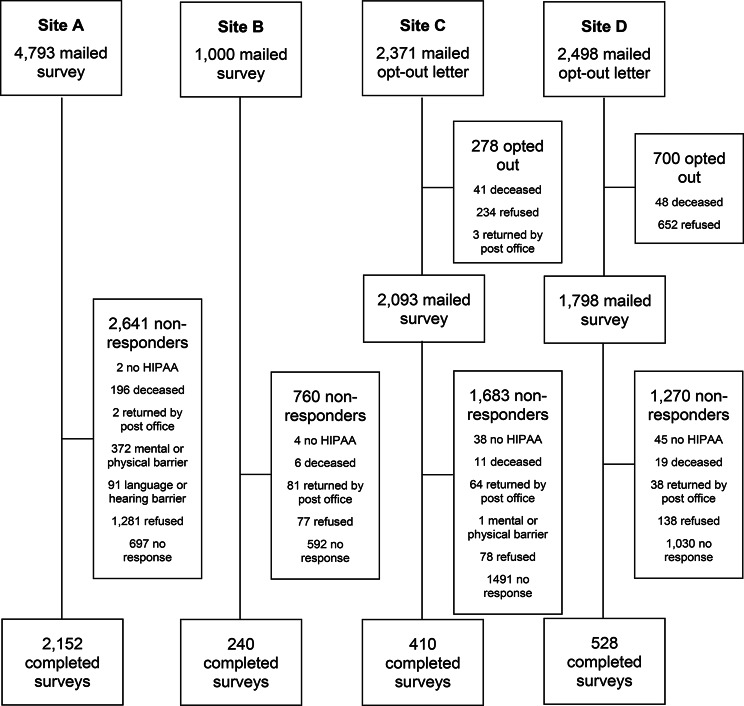
Results: Across the 4 sites, 10,662 patients with HF were invited to participate, and 3330 completed the survey (response rate: 31%). Responders were older (74 vs. 71 years; standardized difference (95% CI): 0.18 (0.13, 0.22)), less racially diverse (3% vs. 12% non-White; standardized difference (95% CI): -0.32 (-0.36, -0.28)), and had higher prevalence of many chronic conditions than non-responders, and thus may not be representative of all HF patients. The internal reliability of the validated questionnaires in our survey was good (range of Cronbach's alpha: 0.50-0.96). Responders reported their health was generally good or fair, they frequently had cardiovascular comorbidities, > 50% had difficulty climbing stairs, and > 10% reported difficulties with bathing, preparing meals, and using transportation. Nearly 80% of patients had family or friends sit with them during a doctor visit, and 54% managed their health by themselves. Patients reported generally low perceived support for self-management related to exercise and diet.
Conclusions: More than half of patients with HF managed their health by themselves. Increased understanding of self-management resources may guide the development of interventions to improve HF outcomes.
Keywords: Heart failure; Participation bias; Patient-reported information; Survey.
© 2024. The Author(s).
Conflict of interest statement
The authors declare no competing interests.
References
-
- McDermott KW, Elixhauser A, Sun R. Trends in hospital inpatient stays in the United States, 2005–2014. HCUP Statistical Brief #225. June 2017. Agency for Healthcare Research and Quality, Rockville, MD; Available from: http://www.hcup-us.ahrq.gov/reports/statbriefs/sb225-Inpatient-US-Stays-...
-
- Yancy CW, Jessup M, Bozkurt B, et al. 2013 ACCF/AHA guideline for the management of heart failure: a report of the American College of Cardiology Foundation/American Heart Association Task Force on Practice guidelines. J Am Coll Cardiol. 2013;62(16):e147–239. doi: 10.1016/j.jacc.2013.05.019. - DOI - PubMed
Publication types
MeSH terms
Grants and funding
LinkOut - more resources
Full Text Sources
Medical
Research Materials
Miscellaneous
