


Hepatolithiasis: Epidemiology, presentation, classification and management of a complex disease
- PMID: 38659478
- PMCID: PMC11036492
- DOI: 10.3748/wjg.v30.i13.1836
Hepatolithiasis: Epidemiology, presentation, classification and management of a complex disease
Abstract
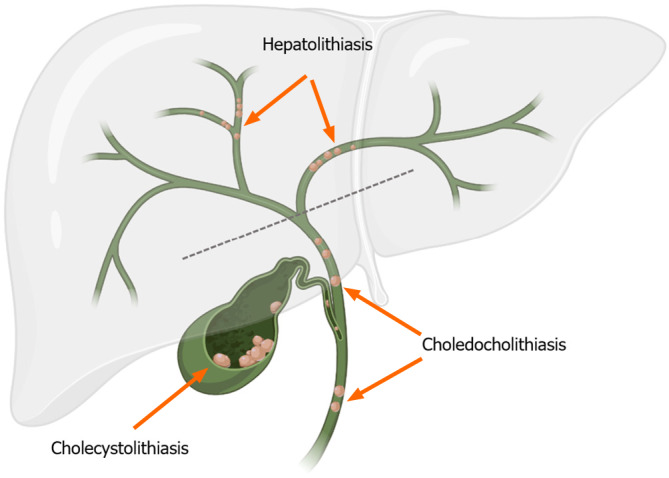
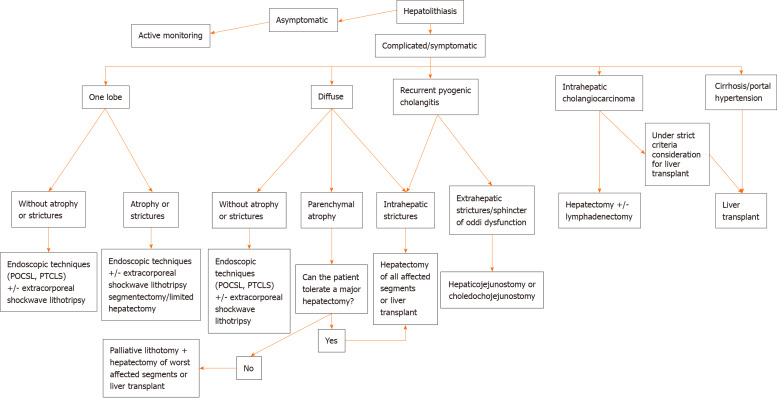
The term hepatolithiasis describes the presence of biliary stones within the intrahepatic bile ducts, above the hilar confluence of the hepatic ducts. The disease is more prevalent in Asia, mainly owing to socioeconomic and dietary factors, as well as the prevalence of biliary parasites. In the last century, owing to migration, its global incidence has increased. The main pathophysiological mechanisms involve cholangitis, bile infection and biliary strictures, creating a self-sustaining cycle that perpetuates the disease, frequently characterised by recurrent episodes of bacterial infection referred to as syndrome of "recurrent pyogenic cholangitis". Furthermore, long-standing hepatolithiasis is a known risk factor for development of intrahepatic cholangiocarcinoma. Various classifications have aimed at providing useful insight of clinically relevant aspects and guidance for treatment. The management of symptomatic patients and those with complications can be complex, and relies upon a multidisciplinary team of hepatologists, endoscopists, interventional radiologists and hepatobiliary surgeons, with the main goal being to offer relief from the clinical presentations and prevent the development of more serious complications. This comprehensive review provides insight on various aspects of hepatolithiasis, with a focus on epidemiology, new evidence on pathophysiology, most important clinical aspects, different classification systems and contemporary management.
Keywords: Biliary parasites; Cholangiocarcinoma; Cholangioscopy; Cholelithiasis; Hepatectomy; Intrahepatic stones; Liver transplant; Oriental cholangiohepatitis; Paediatric; Recurrent pyogenic cholangitis.
©The Author(s) 2024. Published by Baishideng Publishing Group Inc. All rights reserved.
Conflict of interest statement
Conflict-of-interest statement: The authors declare no conflict of interests for this article.
Figures
References
-
- Gallstone Disease: Diagnosis and Management of Cholelithiasis, Cholecystitis and Choledocholithiasis. London: National Institute for Health and Care Excellence (NICE); 2014 Oct- - PubMed
-
- Kim IS, Myung SJ, Lee SS, Lee SK, Kim MH. Classification and nomenclature of gallstones revisited. Yonsei Med J. 2003;44:561–570. - PubMed
-
- Tsui WM, Lam PW, Lee WK, Chan YK. Primary hepatolithiasis, recurrent pyogenic cholangitis, and oriental cholangiohepatitis: a tale of 3 countries. Adv Anat Pathol. 2011;18:318–328. - PubMed
Publication types
MeSH terms
LinkOut - more resources
Full Text Sources
