


Impact of suppression of the SOS response on protein expression in clinical isolates of Escherichia coli under antimicrobial pressure of ciprofloxacin
- PMID: 38659986
- PMCID: PMC11039860
- DOI: 10.3389/fmicb.2024.1379534
Impact of suppression of the SOS response on protein expression in clinical isolates of Escherichia coli under antimicrobial pressure of ciprofloxacin
Abstract
Introduction/objective: Suppression of the SOS response in combination with drugs damaging DNA has been proposed as a potential target to tackle antimicrobial resistance. The SOS response is the pathway used to repair bacterial DNA damage induced by antimicrobials such as quinolones. The extent of lexA-regulated protein expression and other associated systems under pressure of agents that damage bacterial DNA in clinical isolates remains unclear. The aim of this study was to assess the impact of this strategy consisting on suppression of the SOS response in combination with quinolones on the proteome profile of Escherichia coli clinical strains.
Materials and methods: Five clinical isolates of E. coli carrying different chromosomally- and/or plasmid-mediated quinolone resistance mechanisms with different phenotypes were selected, with E. coli ATCC 25922 as control strain. In addition, from each clinical isolate and control, a second strain was created, in which the SOS response was suppressed by deletion of the recA gene. Bacterial inocula from all 12 strains were then exposed to 1xMIC ciprofloxacin treatment (relative to the wild-type phenotype for each isogenic pair) for 1 h. Cell pellets were collected, and proteins were digested into peptides using trypsin. Protein identification and label-free quantification were done by liquid chromatography-mass spectrometry (LC-MS) in order to identify proteins that were differentially expressed upon deletion of recA in each strain. Data analysis and statistical analysis were performed using the MaxQuant and Perseus software.
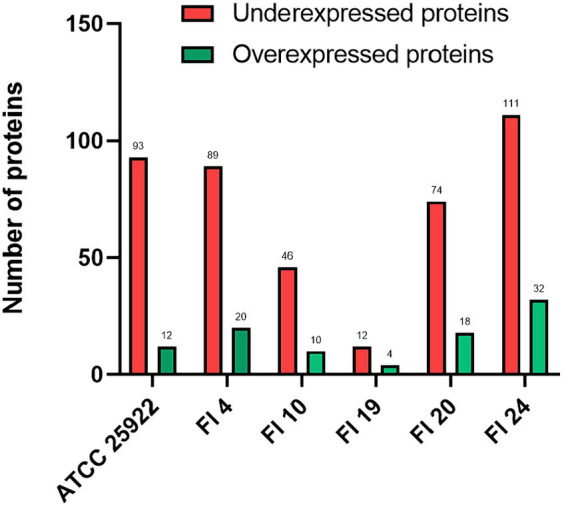
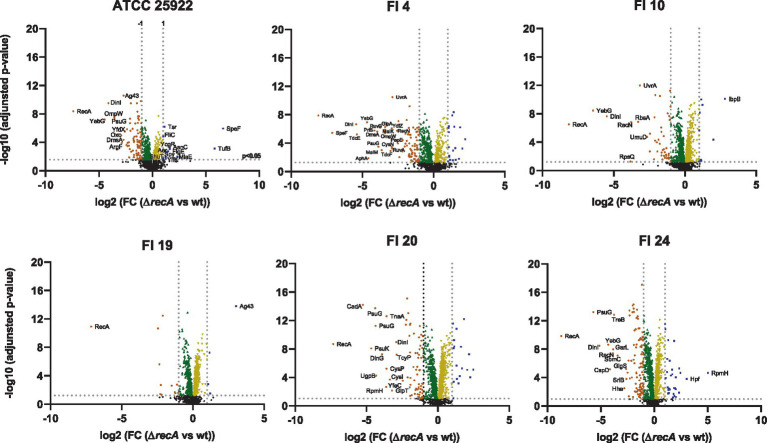
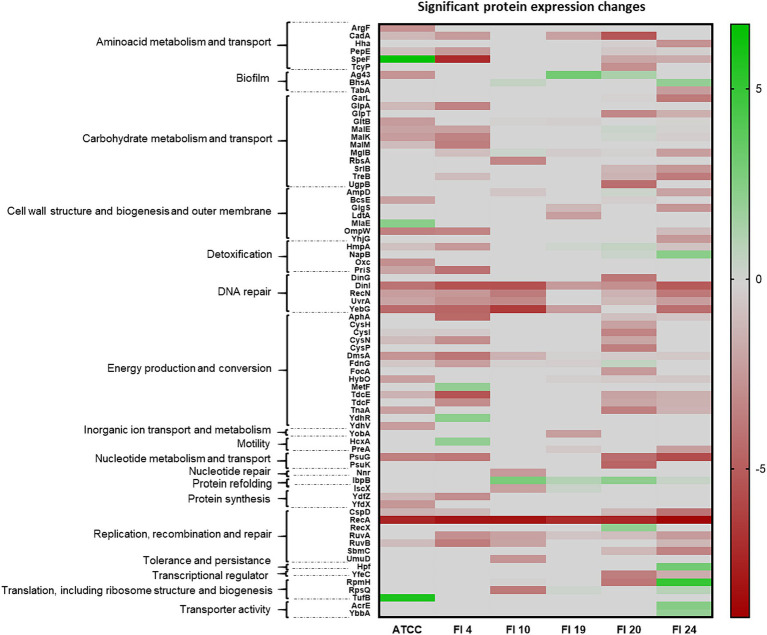
Results: The proteins with the lowest expression levels were: RecA (as control), AphA, CysP, DinG, DinI, GarL, PriS, PsuG, PsuK, RpsQ, UgpB and YebG; those with the highest expression levels were: Hpf, IbpB, TufB and RpmH. Most of these expression alterations were strain-dependent and involved DNA repair processes and nucleotide, protein and carbohydrate metabolism, and transport. In isolates with suppressed SOS response, the number of underexpressed proteins was higher than overexpressed proteins.
Conclusion: High genomic and proteomic variability was observed among clinical isolates and was not associated with a specific resistant phenotype. This study provides an interesting approach to identify new potential targets to combat antimicrobial resistance.
Keywords: Enterobacteriaceae; Escherichia coli; SOS response; antimicrobial resistance; proteome profile.
Copyright © 2024 Recacha, Kuropka, Díaz-Díaz, García-Montaner, González-Tortuero, Docobo-Pérez, Rodríguez-Rojas and Rodríguez-Martínez.
Conflict of interest statement
The authors declare that the research was conducted in the absence of any commercial or financial relationships that could be construed as a potential conflict of interest.
Figures
References
-
- Bartual S. G., Seifert H., Hippler C., Luzon M. A. D., Wisplinghoff H., and Rodríguez-Valera F. (2005). Development of a multilocus sequence typing scheme for characterization of clinical isolates of Acinetobacter baumannii. J. Clin. Microbiol. 43, 4382–90. doi: 10.1128/JCM.43.9.4382-4390.2005 - DOI - PMC - PubMed
-
- Briales A., Rodríguez-Martínez J. M., Velasco C., de Alba P. D., Rodríguez-Baño J., Martínez-Martínez L., et al. (2012). Prevalence of plasmid-mediated quinolone resistance determinants qnr and aac(6′)-Ib-cr in Escherichia coli and Klebsiella pneumoniae producing extended-spectrum β-lactamases in Spain. Int. J. Antimicrob. Agents 39, 431–434. doi: 10.1016/j.ijantimicag.2011.12.009, PMID: - DOI - PubMed
LinkOut - more resources
Full Text Sources
Molecular Biology Databases
