


Uptake of self-management education programmes for people with type 2 diabetes in primary care through the embedding package: a cluster randomised control trial and ethnographic study
- PMID: 38664727
- PMCID: PMC11046789
- DOI: 10.1186/s12875-024-02372-x
Uptake of self-management education programmes for people with type 2 diabetes in primary care through the embedding package: a cluster randomised control trial and ethnographic study
Abstract
Background: Self-management education programmes are cost-effective in helping people with type 2 diabetes manage their diabetes, but referral and attendance rates are low. This study reports on the effectiveness of the Embedding Package, a programme designed to increase type 2 diabetes self-management programme attendance in primary care.
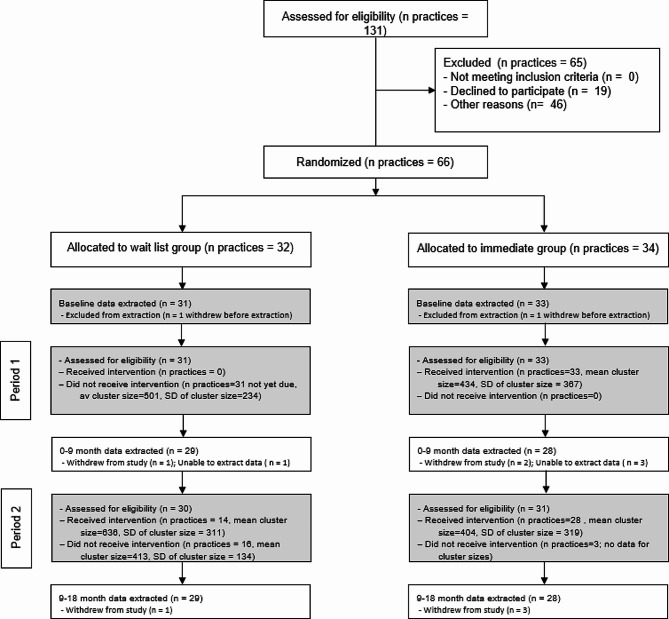
Methods: Using a cluster randomised design, 66 practices were randomised to: (1) a wait-list group that provided usual care for nine months before receiving the Embedding Package for nine months, or (2) an immediate group that received the Embedding Package for 18 months. 'Embedders' supported practices and self-management programme providers to embed programme referral into routine practice, and an online 'toolkit' contained embedding support resources. Patient-level HbA1c (primary outcome), programme referral and attendance data, and clinical data from 92,977 patients with type 2 diabetes were collected at baseline (months - 3-0), step one (months 1-9), step 2 (months 10-18), and 12 months post-intervention. An integrated ethnographic study including observations, interviews, and document analysis was conducted using interpretive thematic analysis and Normalisation Process Theory.
Results: No significant difference was found in HbA1c between intervention and control conditions (adjusted mean difference [95% confidence interval]: -0.10 [-0.38, 0.18] mmol/mol; -0.01 [-0.03, 0.02] %). Statistically but not clinically significantly lower levels of HbA1c were found in people of ethnic minority groups compared with non-ethnic minority groups during the intervention condition (-0.64 [-1.08, -0.20] mmol/mol; -0.06% [-0.10, -0.02], p = 0.004), but not greater self-management programme attendance. Twelve months post-intervention data showed statistically but not clinically significantly lower HbA1c (-0.56 [95% confidence interval: -0.71, -0.42] mmol/mol; -0.05 [-0.06, -0.04] %; p < 0.001), and higher self-management programme attendance (adjusted odds ratio: 1.13; 95% confidence interval: 1.02, 1.25; p = 0.017) during intervention conditions. Themes identified through the ethnographic study included challenges for Embedders in making and sustaining contact with practices and providers, and around practices' interactions with the toolkit.
Conclusions: Barriers to implementing the Embedding Package may have compromised its effectiveness. Statistically but not clinically significantly improved HbA1c among ethnic minority groups and in longer-term follow-up suggest that future research exploring methods of embedding diabetes self-management programmes into routine care is warranted.
Trial registration: ISRCTN23474120, registered 05/04/2018.
Keywords: Implementation; Primary care; Self-management education; Structured education; Type 2 diabetes mellitus.
© 2024. The Author(s).
Conflict of interest statement
University Hospitals of Leicester NHS Trust (MD, AG, MH, KK, AN, RP, SS) receives not-for-profit income through licensing fees to support implementation of a diabetes structured education program (DESMOND) in Clinical Commissioning Groups in the UK, Ireland, and Australia; all payments are made to UHL NHS Trust. JSt manages the licensing, via University of Warwick, for a diabetes structured education programme (Diabetes Manual) that is commercially available; royalties have been paid to University of Warwick but not to JS personally. DB has undertaken paid consultancy work for the University of Leicester for this programme and other projects. AB has received funding for projects from the European Union and National Institute for Health Research. GM has received consulting fees from The Health Foundation, and participated in or chaired advisory groups and steering groups for work funded by The Health Foundation, City University, National Institute for Health Research, and Leicester Centre for Ethnic Health Research. GM has also been a Trustee for the Foundation for the Sociology of Health and Illness and a member of the National Institute for Health Research NETSCC National Stakeholder Advisory Group. SS has received funding for projects from the National Institute of Health Research. The other authors declare that they have no competing interests.
Figures

References
-
- Diabetes UK. Number of people living with diabetes in the UK tops 5 million for the first time. 2023 [cited 2023 Aug 15]. https://www.diabetes.org.uk/about_us/news/number-people-living-diabetes-....
-
- Davies MJ, Aroda VR, Collins BS, Gabbay RA, Green J, Maruthur NM et al. Management of Hyperglycemia in Type 2 Diabetes, 2022. A Consensus Report by the American Diabetes Association (ADA) and the European Association for the Study of Diabetes (EASD). Diabetes Care. 2022 Nov 1 [cited 2023 Aug 15];45(11):2753–86. 10.2337/dci22-0034. - PMC - PubMed
-
- Davies MJ, Heller S, Skinner TC, Campbell MJ, Carey ME, Cradock S et al. Effectiveness of the diabetes education and self management for ongoing and newly diagnosed (DESMOND) programme for people with newly diagnosed type 2 diabetes: cluster randomised controlled trial. BMJ. 2008 [cited 2023 Jun 12];336(7642):491–5. https://pubmed.ncbi.nlm.nih.gov/18276664/. - PMC - PubMed
-
- Deakin TA, Cade JE, Williams R, Greenwood DC. Structured patient education: the Diabetes X-PERT Programme makes a difference. Diabetic Medicine. 2006;23(9):944–54. 10.1111/2Fj.1464-5491.2006.01906.x. - PubMed
Publication types
MeSH terms
Substances
Grants and funding
- RP-PG-1212-20004/National Institute for Health and Care Research
- RP-PG-1212-20004/National Institute for Health and Care Research
- RP-PG-1212-20004/National Institute for Health and Care Research
- RP-PG-1212-20004/National Institute for Health and Care Research
- RP-PG-1212-20004/National Institute for Health and Care Research
- RP-PG-1212-20004/National Institute for Health and Care Research
- RP-PG-1212-20004/National Institute for Health and Care Research
- RP-PG-1212-20004/National Institute for Health and Care Research
- RP-PG-1212-20004/National Institute for Health and Care Research
- RP-PG-1212-20004/National Institute for Health and Care Research
- RP-PG-1212-20004/National Institute for Health and Care Research
- RP-PG-1212-20004/National Institute for Health and Care Research
- RP-PG-1212-20004/National Institute for Health and Care Research
- RP-PG-1212-20004/National Institute for Health and Care Research
- RP-PG-1212-20004/National Institute for Health and Care Research
- RP-PG-1212-20004/National Institute for Health and Care Research
- RP-PG-1212-20004/National Institute for Health and Care Research
- RP-PG-1212-20004/National Institute for Health and Care Research
- RP-PG-1212-20004/National Institute for Health and Care Research
LinkOut - more resources
Full Text Sources
Medical