. 2023;1(1):6.
doi: 10.1038/s44298-023-00008-y. Epub 2023 Nov 27.

Rhinovirus dynamics across different social structures

Affiliations

Rhinovirus dynamics across different social structures

Martha M Luka et al. Npj Viruses. 2023.

Abstract

Rhinoviruses (RV), common human respiratory viruses, exhibit significant antigenic diversity, yet their dynamics across distinct social structures remain poorly understood. Our study delves into RV dynamics within Kenya by analysing VP4/2 sequences across four different social structures: households, a public primary school, outpatient clinics in the Kilifi Health and Demographics Surveillance System (HDSS), and countrywide hospital admissions and outpatients. The study revealed the greatest diversity of RV infections at the countrywide level (114 types), followed by the Kilifi HDSS (78 types), the school (47 types), and households (40 types), cumulatively representing >90% of all known RV types. Notably, RV diversity correlated directly with the size of the population under observation, and several RV type variants occasionally fuelled RV infection waves. Our findings highlight the critical role of social structures in shaping RV dynamics, information that can be leveraged to enhance public health strategies. Future research should incorporate whole-genome analysis to understand fine-scale evolution across various social structures.

Keywords: Epidemiology; Viral epidemiology.


Conflict of interest statement

Competing interestsThe authors declare no competing interests.

Figures
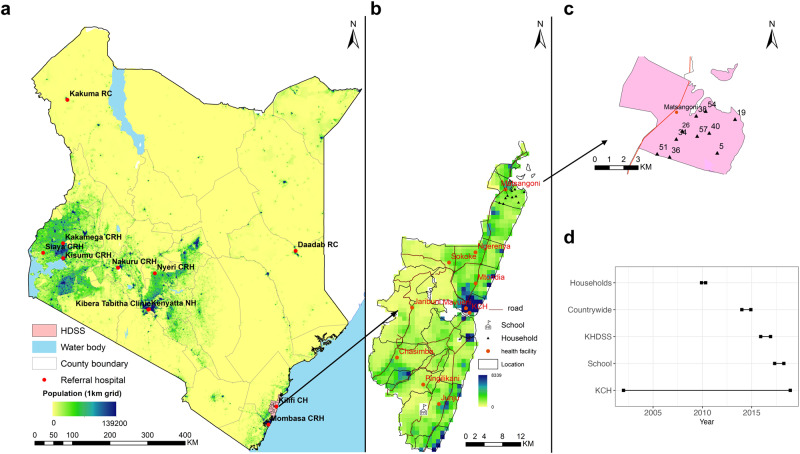
Fig. 1
Fig. 1. Geographical setting and time span of the studies included in the analysis.
a A map of Kenya highlighting the countrywide study sites; b the Kilifi HDSS outpatient study sites, also showing the school location in Junju and the Kilifi County Hospital (KCH). c Households within Matsangoni location of the Kilifi Health and Demographics Surveillance System (HDSS). The map (ac) is author created in ArcMap V.10.5 (ESRI, Redlands, California, USA). d Study periods of the included studies. Only contemporary KCH samples were included in the analysis i.e., KCH samples collected during the household, Kilifi HDSS and school studies. CRH County Referral Hospital, RC Refugee Camp, KCH Kilifi County Hospital.
Fig. 2
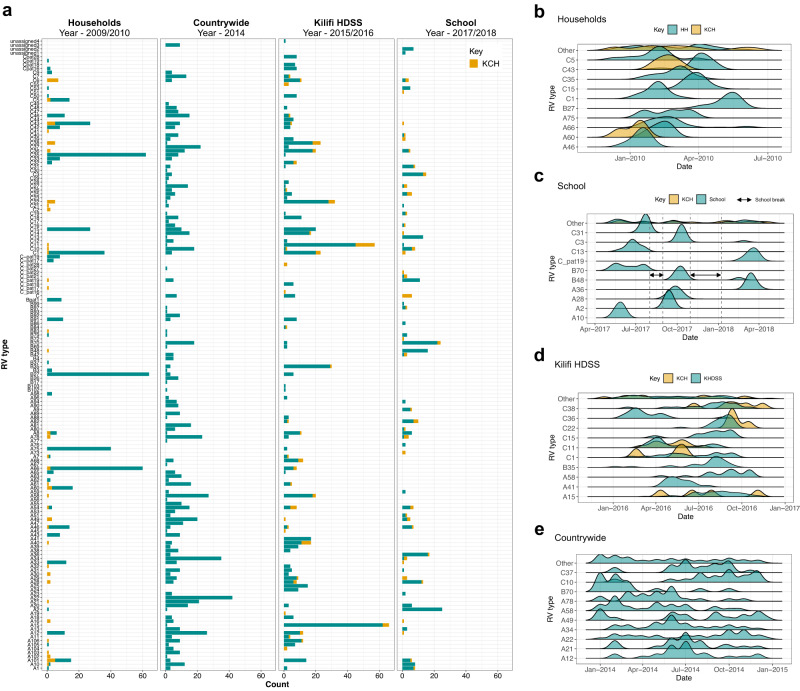
Fig. 2. Summary of rhinovirus (RV) types observed.
a Frequency counts of distinct RV types across the scales of observation. The studies are ordered by study year i.e., household (Dec 2009–May 2010), countrywide (Jan 2014–Dec 2014), Kilifi HDSS (Dec 2015–Nov 2016) and school (May 2017–April 2018). Contemporaneous KCH samples are coloured orange. be Temporal kernel density distributions of frequent RV types within the households, school, Kilifi HDSS, and countrywide study periods, respectively. Contemporaneous KCH samples are coloured orange. KHDSS Kilifi Health and Demographics Surveillance System.
Fig. 3
Fig. 3. Type-specific time-inferred Maximum Clade Credibility (MCC) phylogenetic trees of frequent types observed in each social structure.
a Highlights frequent types in the households study, b The school study, c The Kilifi HDSS, and d Countrywide settings. Across all panels, a total of 918 global sequences were included in the analysis. Tips are coloured by location and branching posterior probabilities greater than 0.95 are displayed. Phylogenetic clusters of interest are labelled K1 - Kn. The x-axis is scaled to the branch length in units of year. A58 was a common type for both the Kilifi HDSS and countrywide studies, and we therefore included one phylogenetic tree highlighting viruses from both studies. hh Households, hdss Health and Demographics Surveillance System.
Fig. 4
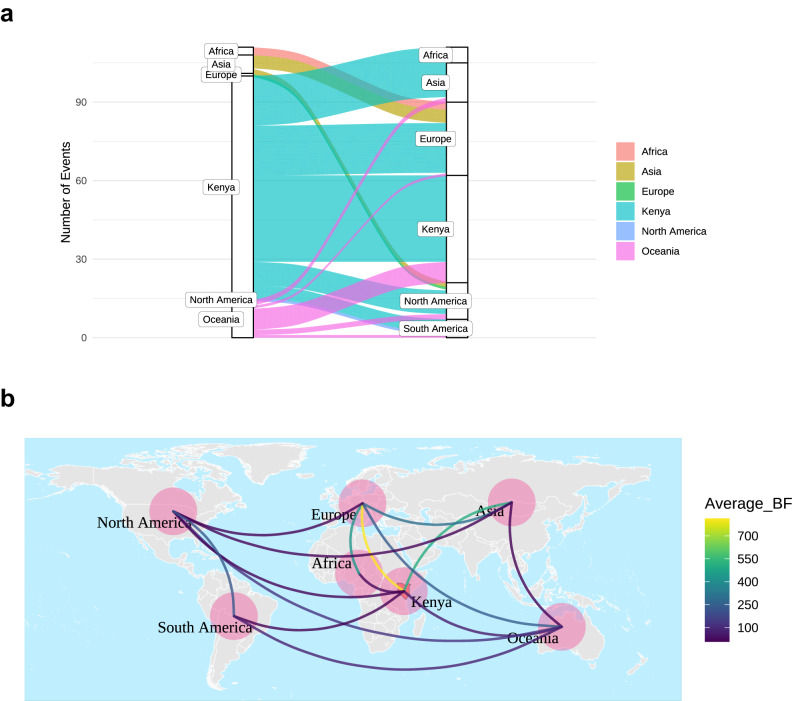
Fig. 4. Rhinovirus transmission links.
a Alluvium plots showing the estimated number and flow of RV transmission across the globe. ‘Africa’ refers to origins or destinations in African countries excluding Kenya. b A global map displaying average Bayes Factor (BF) values of significant transmission links across 19 select RV types. The color of the arc correlates to the average BF value.
Fig. 5
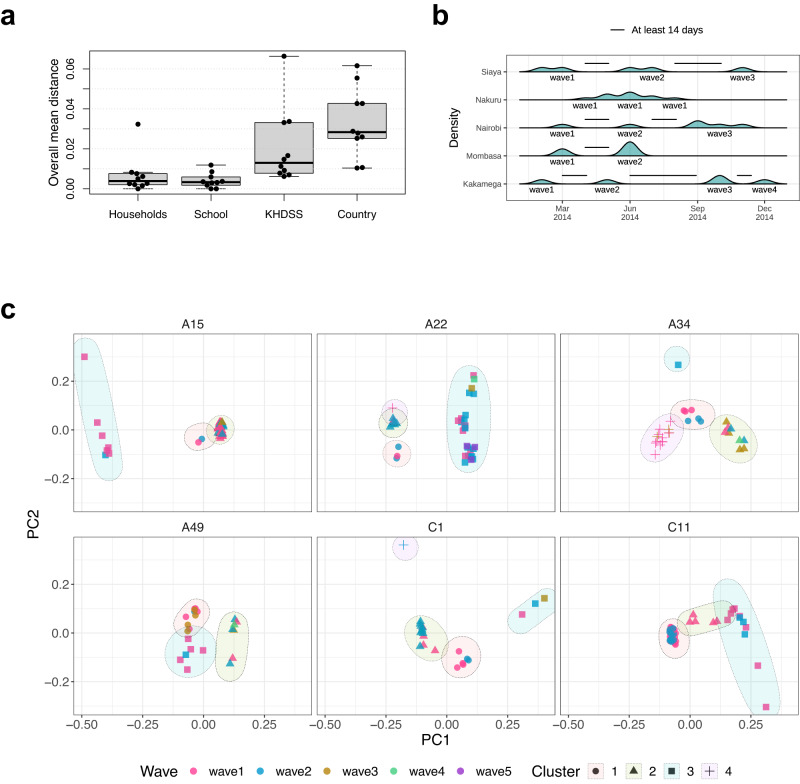
Fig. 5. Genetic diversity of rhinovirus infections.
a Distribution of the overall mean distance of frequent types in different social structures. b An illustration of type-specific mini-epidemic wave definition. Consecutive samples of the same type in the same location/county collected more than 14 days apart were classified into different epidemic waves. c K-means clustering of principal components (PC) performed on six select RV types. Each dot represents a sample. Samples are coloured by their respective epidemic wave. The respective genetic cluster is highlighted by a shaded ellipsis.

References

    1. Jacobs, S. E., Lamson, D. M., Kirsten, S. & Walsh, T. J. Human rhinoviruses. Clin. Microbiol. Rev.26, 135–162 (2013). - PMC - PubMed
    1. Lewis-Rogers, N., Seger, J. & Adler, F. R. Human Rhinovirus Diversity and Evolution: How Strange the Change from Major to Minor. J. Virol.91, 1433–1441 (2017). - PMC - PubMed
    1. Stobart, C. C., Nosek, J. M. & Moore, M. L. Rhinovirus biology, antigenic diversity, and advancements in the design of a human rhinovirus vaccine. Front. Microbiol.8, 307786 (2017). - PMC - PubMed
    1. The Pirbright Institute, U. Picornaviridae. http://www.picornaviridae.com/enterovirus/rv-a/rv-a.htm (2022).
    1. Glanville, N. & Johnston, S. L. Challenges in developing a cross-serotype rhinovirus vaccine. Curr. Opin. Virol.11, 83–88 (2015). - PubMed